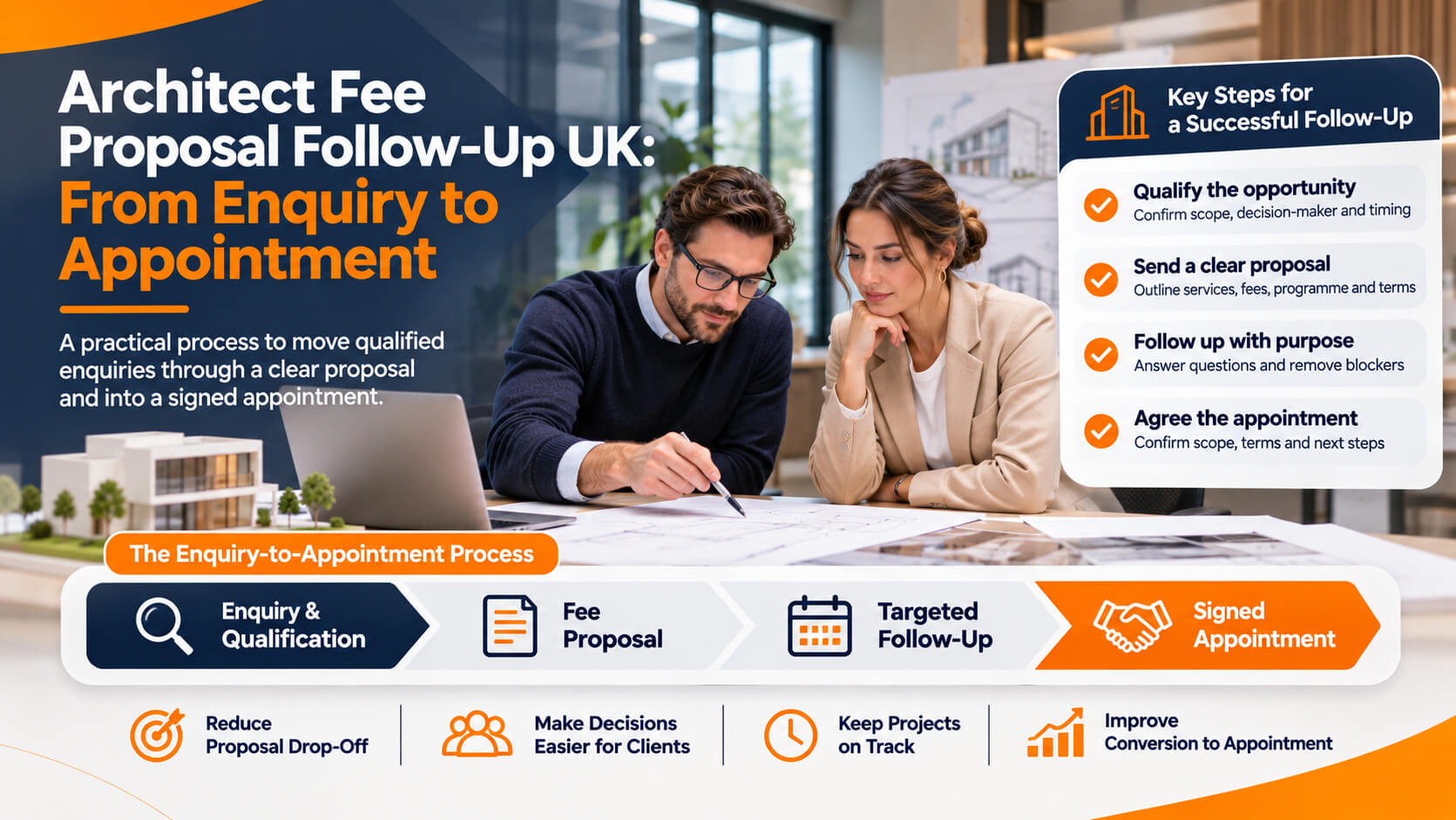
A UK architecture practice can generate plenty of promising enquiries yet lose commissions between the discovery call and the signed appointment. The prospect may not understand the fee scope, a decision-maker may be absent, or the proposal may sit unanswered while the team assumes silence means rejection. A disciplined architect fee proposal follow-up process helps a practice make the next decision easier without applying inappropriate sales pressure.
This guide focuses on the commercial handover from qualified enquiry to appointment: what to include in a proposal, how to handle questions, when to follow up, how to measure progress and when to stop. It complements our architects and engineers lead-generation guide and CRM follow-up workflow. It is operational guidance, not a substitute for professional or legal advice about contract terms.
Why architecture proposals stall after an apparently positive meeting
An architecture appointment is rarely an impulse purchase. A private homeowner may need to align a partner, lender or contractor; a commercial buyer may need procurement approval, a board decision or a comparison of specialist capability. An apparently enthusiastic initial conversation is not evidence that the client has agreed scope, timing or budget.
- Unclear scope: the prospect cannot tell whether surveys, planning, technical design or construction-stage services are included.
- Unclear fees: the total or stage breakdown is difficult to compare, or exclusions are buried.
- Unresolved dependencies: a site purchase, funding decision, planning constraint or consultant appointment is pending.
- Decision complexity: multiple people need to approve the appointment.
- Weak next step: the proposal is sent without an agreed review date or clear way to ask questions.
- Poor fit: the project is outside the practice’s preferred sector, capacity or risk appetite.
The response is not simply “send more reminders”. First diagnose whether the buyer needs clarification, reassurance, an internal decision or a different appointment scope.
Qualify the opportunity before writing the fee proposal
A short qualification record prevents unnecessary proposal work and helps the practice tailor its response. Our architect project enquiry form checklist shows how to capture those essentials before the proposal stage. Capture project type, site and location, intended use, approximate scale, the client’s goals, any known constraints, target programme, who can appoint the architect, what other consultants are involved and what the client needs next.
Use a six-question discovery framework
- What outcome would make this project successful, and what problem are you trying to solve?
- What is already known about the site, ownership, approvals and constraints?
- Which services are you seeking now: feasibility, planning, design development, technical design or construction support?
- Who else will review or approve the proposal?
- What budget and timetable assumptions should we test rather than promise?
- What information would help you make an appointment decision?
For a homeowner, avoid implying that planning permission or a particular build cost is assured. For a developer, identify procurement route and consultant interfaces. For public-sector or framework work, respect the formal procurement timetable and communications rules.
What a clear architect fee proposal should contain
A fee proposal is more than a price. It is a decision document. The RIBA Plan of Work provides a recognised framework for discussing project stages and information exchanges, but a fee schedule should state precisely which services the practice actually offers. The Architects Registration Board’s 2025 Code emphasises professional conduct and clear client communication. The final terms should be reviewed against the practice’s applicable obligations and appointment form.
- Project understanding: concise restatement of the client brief and known assumptions.
- Scope by stage: included tasks, expected outputs and where the appointment starts and ends.
- Exclusions and dependencies: surveys, specialist consultants, planning fees, statutory fees, contractor services and other items not included, where relevant.
- Fee basis: fixed fee, percentage, time charge or another agreed method, with stage breakdown, payment milestones and treatment of variations.
- Programme: indicative sequence, client inputs and external dependencies rather than unqualified guarantees.
- Roles: who leads the work, who approves decisions and which third parties are separate appointments.
- Terms: appropriate written engagement terms, liabilities, insurance and dispute arrangements for professional review.
- Next action: a specific proposal discussion or decision milestone and a named contact.
Use an assumptions box rather than hiding uncertainty
For example: “This proposal assumes the client supplies an existing measured survey. Planning authority timescales and third-party consultant fees are excluded unless separately agreed.” Such wording is illustrative; the practice should use its own accurate terms. A visible assumptions box can reduce back-and-forth without implying that the scope is fixed when it is not.
The proposal-to-appointment workflow
Stage 1: Prepare and send
Assign one proposal owner. Check that the recipient and decision-maker are correctly identified, the attachment opens on mobile, the document version is clear and any confidential material is sent appropriately. In the covering message, summarise the decision required and offer a short review conversation. Avoid “please see attached” as the only explanation.
Stage 2: Confirm receipt and understanding
Where the prospect has not agreed a review date, a brief, respectful check-in can confirm that the document reached them and whether any sections need clarification. Do not interpret email-open tracking as consent or buying intent. Record the response in the CRM.
Stage 3: Resolve the real obstacle
Ask whether the barrier is scope, timing, budget, procurement, stakeholder approval or fit. Offer a revised scope only where the change is professionally appropriate and clearly documented. Discounting a fee without understanding the objection can create later delivery risk.
Stage 4: Agree the appointment route
If the client wishes to proceed, move to the appropriate written terms and acceptance process. Do not treat a verbal expression of interest as an executed appointment. Confirm what information and authorisations are required before work starts.
Stage 5: Close or nurture
If the project is deferred, record the reason and a proportionate next contact date if appropriate. If the prospect declines or asks not to be contacted, respect that decision. Closed-lost records are useful evidence for future proposal improvements.
An illustrative follow-up cadence—not a universal rule
A useful cadence depends on the procurement process, client preferences and urgency. The schedule below is an example for a privately negotiated appointment, not a recommended approach for regulated tenders or an invitation to send unsolicited marketing.
- Day 0: send the proposal with a summary and an offered review slot.
- Day 2–4: where appropriate, confirm receipt and invite clarification.
- Day 7–10: address one specific open question, such as scope options or decision timing.
- Day 14–21: ask whether to keep the opportunity active, defer it or close it.
- Later: contact only where justified by the relationship, agreed expectations and applicable privacy rules.
For formal bids, follow procurement instructions rather than this cadence. For time-sensitive projects, agree the next contact during discovery instead of relying on a template.
Four follow-up messages an architecture practice can adapt
1. Proposal handover
“Thank you for discussing the project. The attached proposal sets out our understanding of the brief, proposed scope, assumptions and fees. Would a short call next week help you review the stages and identify any outstanding questions?”
2. Scope clarification
“I wanted to check whether the distinction between the feasibility and later design stages is clear. If your immediate decision concerns only the initial stage, we can explain what a separately defined first appointment would cover.”
3. Decision timing
“Is the project still moving towards an appointment, or would a later review be more useful? Either is fine; an updated timetable will help us plan capacity accurately.”
4. Respectful close
“We have not heard back, so we will close this proposal in our active pipeline for now. If the project becomes active again, you are welcome to contact us for a fresh review of scope and availability.”
These are illustrative scripts. Adapt them to the actual relationship, procurement restrictions, privacy obligations and the tone of the practice.
How to handle the most common proposal objections
“Your fee is higher than another architect’s”
Compare the actual scope, deliverables, responsibilities and assumptions rather than arguing about price alone. Two quotations may cover materially different stages. Explain the value of the proposed services without disparaging another practice or promising an outcome that cannot be guaranteed.
“We are not ready yet”
Ask what event would make the project ready: purchase completion, finance, planning advice, internal approval or a revised brief. Record a realistic follow-up point. Do not pressure a prospect to sign an appointment before they understand the work.
“Can you start with something smaller?”
A feasibility or briefing phase may be appropriate if its objectives, deliverables and fee are defined. Be explicit about what the smaller appointment does not include and how a later appointment would be agreed.
“Can you guarantee planning permission?”
No practice should present uncertain external approvals as guaranteed. Explain the assessment, consultation and design process, what can be investigated, and which decisions remain with the relevant authority.
Use CRM fields that reveal where proposals actually fail
A lightweight pipeline can work better than a complex system with poor adoption. The architects and engineers CRM guide covers the wider process; the following fields are specific to proposal conversion.
- Enquiry source and project type.
- Qualified opportunity date and proposal sent date.
- Estimated fee value, clearly marked as an estimate.
- Proposal version and stage scope.
- Decision-maker and expected decision date.
- Next action, owner and consent or communication preference where relevant.
- Current status: sent, clarification requested, decision pending, appointed, deferred, declined or withdrawn.
- Lost reason, using consistent categories rather than free text alone.
Metrics worth reviewing each month
Do not treat all leads as equal. A large number of small enquiries may create more administration than a smaller number of well-matched commissions.
- Proposal rate: proposals sent ÷ qualified enquiries.
- Appointment rate: appointments agreed ÷ proposals decided; disclose whether pending proposals are excluded.
- Proposal cycle time: median days from sending to decision.
- Fee value won: agreed professional fee value, not construction budget.
- Loss reasons: percentage of declined proposals attributed to fit, price, timing, procurement or other causes.
- Source quality: appointments and fee value by original enquiry channel.
Illustrative calculation: if 20 proposals receive a decision and 7 become appointments, the decided-proposal appointment rate is 7 ÷ 20 = 35%. This is arithmetic, not an industry benchmark. If 12 further proposals remain pending, disclose that separately rather than silently counting them as losses.
Avoid a misleading win-rate dashboard
A practice that submits five highly selective proposals cannot be compared directly with one that responds to 100 open tenders. Segment by residential versus commercial work, competitive versus negotiated appointment, project type and fee range. Review small samples cautiously.
Privacy, confidentiality and professional safeguards
Project enquiries may contain addresses, financial information, family circumstances or commercially sensitive plans. Collect only information needed for qualification, limit CRM access and agree retention practices. The ICO’s UK GDPR guidance is a starting point for personal-data responsibilities. Distinguish follow-up about an active requested proposal from unrelated promotional email; the legal basis and communications rules may differ.
The ARB’s public guidance on working with an architect also explains why clients should understand the terms of engagement and complaints route. A CRM workflow must not override professional judgement, confidentiality or written appointment requirements.
A 14-day implementation plan
Days 1–3: Audit recent proposals
Sample the last ten to twenty proposals, where available. Record whether each had a clear scope, assumptions, fee basis, decision-maker, next step and final outcome. Do not infer that silence equals a price objection.
Days 4–6: Improve the proposal template
Add a concise project-understanding section, stage scope, exclusions, assumptions and a clearly labelled next action. Have the appropriate professional review contractual language and fee terms.
Days 7–9: Configure pipeline ownership
Create consistent stages, decision dates and lost reasons. Assign a named owner to each active proposal and make sure contacts can request no further follow-up.
Days 10–12: Test the follow-up process
Use real, appropriate client communications, not mass automation. Review whether each message adds useful information and whether the prospect’s preferences are respected.
Days 13–14: Review and adjust
Check missing fields, overdue decisions, unclear scope questions and early outcomes. Document a monthly review process and a quarterly template refresh.
Frequently asked questions
How soon should architects follow up after a fee proposal?
Agree the next contact during the initial discussion where possible. Otherwise, a respectful receipt or clarification check after a few working days may be reasonable for a privately negotiated appointment. Formal procurement rules take precedence.
Should architects offer a discount to win a commission?
Not automatically. First determine whether competing proposals cover the same work and risk. If the scope changes, document what is removed or deferred; do not obscure professional responsibilities.
Can a CRM automatically send every follow-up?
Administrative reminders and acknowledgements can be automated, but meaningful proposal questions and appointment decisions should remain professionally supervised. Respect communication preferences and privacy requirements.
What is a good architect proposal win rate?
There is no single reliable target for every practice. Compare like-for-like project types and procurement routes, and use the practice’s own historical data before setting goals.
Is a fee proposal the same as a signed appointment?
No. A proposal may inform a client’s decision, but the practice should use appropriate written terms and acceptance arrangements before commencing the relevant services.
The practical takeaway
The most effective proposal follow-up process is not the one that sends the most messages. It is the one that gives each qualified prospect a clear scope, an understandable decision, a helpful route to clarification and a respectful next step. Track the outcome, learn from lost opportunities and keep professional standards ahead of sales pressure.
Editorial review: 4 November 2026. This article provides general business-development guidance for UK architecture practices, not legal, contractual or professional indemnity advice.