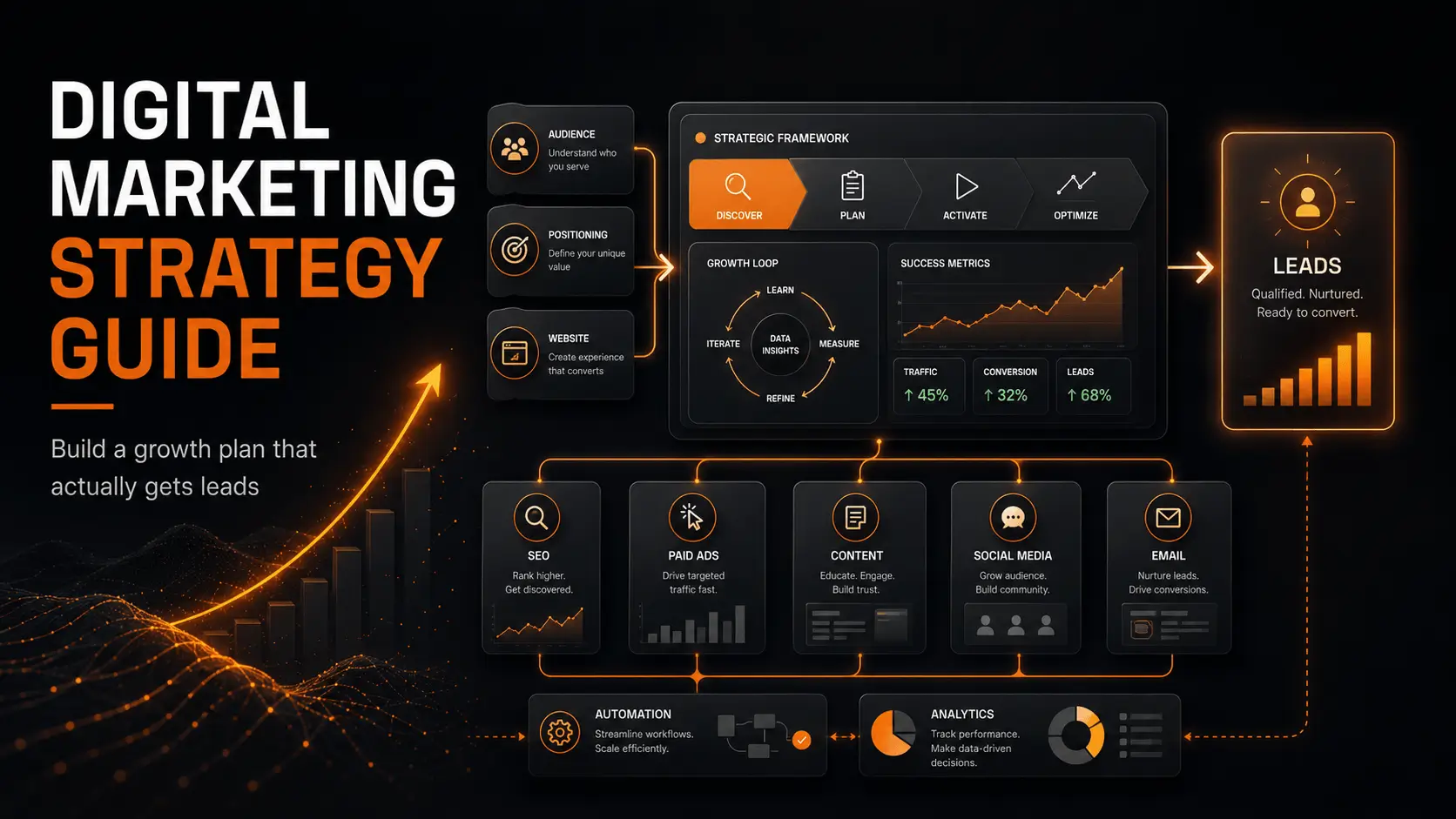
A digital marketing strategy is not a content calendar, a list of channels or a monthly report full of traffic numbers.
A real strategy explains how your business will attract the right people, earn their trust, turn attention into enquiries and measure what is working.
That matters because most businesses are not short of marketing activity. They are short of joined-up thinking. They run Google Ads without fixing the landing page. They publish blogs without a keyword plan. They post on social media without a clear offer. They invest in a new website without tracking the enquiries properly.
The result is usually the same: more effort, more tools, more dashboards — but not enough qualified leads.
This guide explains how to build a practical digital marketing strategy that connects your website, SEO, paid ads, content, social media, email, analytics and automation into one commercial growth system.
For businesses that want this handled properly, Vistoplex builds websites, SEO campaigns, paid media systems and AI automation workflows that work together rather than sitting in separate silos.
What is a digital marketing strategy?
A digital marketing strategy is a structured plan for using online channels to achieve business goals. It defines who you want to reach, what you want them to do, which channels you will use, what content or offers they need, and how you will measure progress.
A strong digital marketing strategy answers seven questions:
- Who are we trying to reach?
- What problem are they trying to solve?
- Why should they choose us instead of a competitor?
- Where do they search, compare and make decisions?
- What content, proof and offers do they need before they enquire?
- How will we turn traffic into leads or sales?
- How will we know what is working?
The mistake many businesses make is starting with the channel: “We need SEO”, “We need TikTok”, “We need Google Ads”, “We need a new website”.
Sometimes they do. But the channel should come after the business goal, the audience, the offer and the conversion path.
Digital marketing strategy vs digital marketing tactics
Strategy and tactics are often confused.
| Term | Meaning | Example |
|---|---|---|
| Strategy | The overall plan for achieving a business objective through digital channels. | Increase qualified enquiries from service businesses by improving search visibility, landing pages and lead follow-up. |
| Campaign | A focused set of activities designed to achieve one outcome within the strategy. | A 90-day Google Ads and landing page campaign for one high-margin service. |
| Tactic | A specific action used inside a campaign. | Writing a comparison page, testing a new ad headline or adding a booking CTA above the fold. |
A tactic can be useful, but it will not fix a weak strategy. Posting more, spending more or redesigning more will not help if the message, audience and conversion path are unclear.
The Vistoplex digital marketing strategy framework
A practical strategy should move in this order:
- Business goal — what growth actually means.
- Audience — who you want more of.
- Positioning — why they should care.
- Offer — what action you want them to take.
- Channels — where you will reach them.
- Website and landing pages — where interest becomes action.
- Content and proof — how you build trust.
- Tracking — how you measure what happened.
- Automation and follow-up — how leads are handled after they enquire.
- Optimisation — how the strategy improves over time.
This order is important. A business with weak positioning should not rush into paid ads. A business with poor tracking should not scale spend. A business with a slow, confusing website should not expect SEO traffic to convert.
Step 1: Start with the business objective
Before choosing channels, define the commercial outcome.
Good objectives sound like this:
- Increase qualified consultation bookings from 20 to 35 per month.
- Reduce reliance on referrals by building organic search visibility.
- Generate more enquiries for one high-margin service.
- Improve lead quality, not just lead volume.
- Lower cost per enquiry from paid campaigns.
- Build a stronger pipeline for a new market or location.
Weak objectives sound like this:
- Get more followers.
- Post more often.
- Do SEO.
- Improve brand awareness.
- Get more traffic.
Those may be useful supporting activities, but they are not strong enough to guide a strategy.
Choose one main growth metric
Pick one primary metric that the strategy will be judged against.
| Business type | Useful primary metric | Supporting metrics |
|---|---|---|
| Service business | Qualified enquiries | Conversion rate, call bookings, cost per lead, source of lead |
| Local business | Calls or bookings | Google Business Profile actions, local rankings, reviews |
| Ecommerce brand | Revenue or profit | Conversion rate, average order value, repeat purchase rate, ROAS |
| B2B company | Sales-qualified leads | Demo requests, pipeline value, lead source, close rate |
| Consultancy | Booked calls with fit | Content-assisted leads, email replies, proposal requests |
The strategy becomes much clearer when everyone agrees what success means. For larger organisations with multiple stakeholders, business units and longer buying journeys, see our enterprise digital marketing approach.
Step 2: Audit your current digital position
A useful strategy starts with an honest audit. You need to know what is already working, what is wasting effort and what is blocking growth.
Website audit
Your website is usually the centre of the strategy. Review:
- Does the homepage explain who you help and what you do within a few seconds?
- Are the main services easy to find?
- Is there a clear call to action above the fold?
- Do service pages answer buyer questions properly?
- Is the website fast and mobile-friendly?
- Are trust signals visible near important conversion points?
- Are forms short enough?
- Are phone numbers, booking links and quote buttons easy to use?
- Is every important page tracked?
If the website is outdated, slow or unclear, start there. Vistoplex provides WordPress website design for businesses that need a faster, clearer and more conversion-focused website.
SEO audit
Review:
- Which pages currently bring organic traffic?
- Which keywords already rank on page one or page two?
- Which commercial keywords are competitors ranking for?
- Are service pages properly structured?
- Are there thin, outdated or duplicate pages?
- Does the site have internal links between related pages?
- Are title tags and meta descriptions written for search intent?
- Are important pages indexed?
- Are there technical issues slowing growth?
For a more structured approach, see Vistoplex’s SEO and search marketing services.
Paid ads audit
Review:
- Which campaigns are generating real leads or sales?
- Which campaigns are only generating clicks?
- Are search terms relevant?
- Are ads connected to dedicated landing pages?
- Is conversion tracking accurate?
- Are calls, forms and bookings tracked separately?
- Is budget being wasted on broad, low-intent traffic?
- Are remarketing audiences being used properly?
Paid traffic is too expensive to send to weak pages. For campaign-specific pages, Vistoplex builds landing pages for Google Ads, paid social and lead generation campaigns.
Content audit
Review:
- Which content brings qualified traffic?
- Which posts attract the wrong audience?
- Which buyer questions are not answered on the site?
- Which content can be updated instead of replaced?
- Which posts could internally link to service pages?
- Which topics support trust, proof and expertise?
The goal is not to publish endlessly. The goal is to create content that helps the right buyer move closer to a decision.
Tracking audit
Review:
- Is GA4 installed correctly?
- Are form submissions tracked?
- Are phone clicks tracked?
- Are booking actions tracked?
- Are thank-you pages set up properly?
- Are leads passed into a CRM?
- Can you see which channel produced each enquiry?
- Can you see which leads became actual customers?
Without tracking, you are guessing. Guessing makes marketing expensive.
Step 3: Define your ideal customer
A digital marketing strategy should not target “everyone who might buy”. It should focus on the customers you want more of.
Start with these questions:
- Who is the most profitable type of customer?
- Who is easiest to serve well?
- Who has the strongest buying intent?
- Who values quality rather than only price?
- Who is likely to come back or refer others?
- Who has a problem you can solve better than competitors?
Build a practical customer profile
A useful customer profile includes:
- Role: business owner, marketing manager, operations director, homeowner, patient, buyer, founder.
- Problem: what they are trying to fix.
- Trigger: what made the need urgent now.
- Objections: why they may delay or choose someone else.
- Decision criteria: price, trust, speed, quality, proof, location, compliance, expertise.
- Search behaviour: what they type into Google or ask AI tools.
- Conversion action: call, quote request, booking, demo, download or purchase.
Example: local service business
A weak audience definition:
“Homeowners in London.”
A stronger audience definition:
“Homeowners in North London who need urgent roof repairs, are comparing local companies, care about proof of insurance and reviews, and are likely to call from mobile search results.”
That second version immediately gives you a better strategy. You need local SEO, Google Business Profile optimisation, strong reviews, mobile-first service pages, clear call buttons and possibly urgent-response Google Ads.
Step 4: Clarify your positioning
Your positioning is the reason someone should choose you instead of another option.
Most businesses do not lose leads because they are bad at marketing. They lose leads because they sound the same as everyone else.
A good positioning statement is simple:
We help [specific audience] achieve [specific outcome] without [main pain or risk].
Examples:
- We help growing law firms generate better enquiries without relying only on referrals.
- We help aesthetic clinics turn website visitors into booked consultations without discount-led marketing.
- We help B2B service companies build SEO and paid campaigns that create measurable pipeline.
- We help local businesses improve search visibility, website conversion and lead follow-up in one joined-up system.
Your positioning should appear across your homepage, service pages, ads, landing pages, email follow-ups and social content.
Step 5: Map the buyer journey
People rarely see one post and become a customer immediately. They move through stages.
| Stage | What the buyer is thinking | Useful content or channel |
|---|---|---|
| Awareness | “I have a problem. What are my options?” | Guides, blog posts, social content, educational videos, SEO content |
| Consideration | “Who can help me? What should I compare?” | Service pages, comparison pages, case studies, reviews, email nurture |
| Decision | “Can I trust this company enough to enquire?” | Landing pages, testimonials, pricing guidance, FAQs, consultation CTA |
| Retention | “Should I come back, upgrade or refer?” | Email, automation, review requests, customer content, remarketing |
A complete digital strategy covers the full journey. Many businesses only focus on awareness, then wonder why traffic does not convert.
Step 6: Choose the right digital marketing channels
Do not choose channels because they are popular. Choose channels because they match the audience, intent and buying journey.
SEO
SEO is best when people already search for your service, problem, location or category. It is ideal for long-term visibility and compounding traffic.
Use SEO when:
- There is proven search demand.
- Your buyers research before enquiring.
- You can create better pages than competitors.
- You want to reduce long-term reliance on paid ads.
- You can commit to technical improvements, content and authority building.
SEO is usually not instant, but it can become one of the most valuable channels once the right pages start ranking.
Paid search
Paid search is useful when buyers are actively looking for a solution now. It works well for high-intent services, urgent needs, local services and commercial categories where fast testing matters.
Use paid search when:
- You need enquiries quickly.
- You have a clear offer.
- You can track conversions properly.
- You have dedicated landing pages.
- You know the value of a lead or sale.
The biggest paid search mistake is sending traffic to a generic homepage. Match the ad, keyword and landing page as closely as possible.
Paid social
Paid social is better for demand creation, retargeting, offers, visual products, events, lead magnets and audience education.
Use paid social when:
- Your buyer needs to be educated before they search.
- You have strong creative assets.
- Your offer can be explained visually.
- You want to retarget website visitors.
- You have enough budget to test messages and audiences.
Paid social often fails when businesses treat cold audiences like people already ready to buy.
Organic social
Organic social helps with trust, visibility and relationship building. It is rarely the full strategy on its own, but it can support every other channel.
Use organic social when:
- Your audience expects to see proof of activity.
- You can show expertise, process, people or results.
- Your service has a visual or educational angle.
- You can post consistently without lowering quality.
For businesses that need content planning, social posting and campaign support, Vistoplex provides social media and content marketing services.
Email marketing
Email is best for nurturing leads, staying visible, increasing repeat purchases and turning interest into action over time.
Use email when:
- Buyers do not always convert immediately.
- You have guides, offers, updates or insights worth sending.
- You want to build an owned audience.
- You need to follow up after downloads, enquiries or abandoned purchases.
Email is not just newsletters. It can include quote follow-ups, onboarding sequences, review requests, reactivation campaigns and segmented lead nurturing.
AI automation
AI automation can support marketing by reducing manual work, improving follow-up speed and connecting tools together.
Useful examples include:
- Automatically routing enquiries to the right team.
- Sending instant lead confirmation emails.
- Creating CRM tasks after form submissions.
- Summarising call notes or enquiry details.
- Generating first-draft content briefs from approved strategy notes.
- Scoring leads based on service, budget, location or urgency.
- Sending review requests after completed work.
Vistoplex builds AI automation systems for lead intake, CRM workflows, customer communication and internal operations.
Step 7: Build your website around conversion
Your website should not just look good. It should help the right person take the next step.
A conversion-focused website needs:
- A clear headline that explains the value quickly.
- Service pages for each important offer.
- Proof close to the point of action.
- Visible calls to action.
- Simple forms.
- Fast loading on mobile.
- Clear navigation.
- Trust signals such as reviews, case studies, accreditations or results.
- Tracking for calls, forms, bookings and key clicks.
Core pages most businesses need
- Homepage: explain who you help, what you do and why it matters.
- Service pages: target commercial search intent and answer buyer questions.
- About page: build trust through people, process and credibility.
- Case studies: show proof, not just claims.
- Contact page: make enquiry simple.
- Blog or insights: answer search queries and support expertise.
- Landing pages: convert campaign traffic with focused messaging.
For examples of proof-led digital work, see the Vistoplex case studies for Blackthorn Avery, Veloura Skin Clinic and Meridian Aero.
Step 8: Create an SEO strategy that supports revenue
SEO should not be treated as “write blog posts and hope”. It needs a proper page and keyword structure.
Build four types of SEO pages
1. Money pages
These are your main service or product pages. They target people who are close to enquiring or buying.
Examples:
- SEO agency for law firms
- WordPress website design
- AI automation services
- Landing page design
- Digital marketing for accountants
2. Problem pages
These target people researching a problem before they know which service they need.
Examples:
- Why is my website not getting enquiries?
- How to reduce cost per lead
- How to improve local SEO
- How to automate lead follow-up
3. Comparison pages
These help buyers compare options.
Examples:
- SEO vs Google Ads
- Agency vs freelancer
- WordPress vs Webflow
- HubSpot vs Pipedrive
4. Proof pages
These build confidence.
Examples:
- Case studies
- Before-and-after website examples
- Client results
- Industry-specific landing pages
- Process pages
Write for people first, then optimise for search
Good SEO content should be specific, useful and grounded in real experience. Generic articles are easier than ever to create, which means they are also easier to ignore.
To improve quality, add:
- Original examples.
- Practical checklists.
- Real decision frameworks.
- Common mistakes from client work.
- Clear recommendations.
- Internal links to relevant services.
- FAQs that answer real buyer questions.
For an example of an industry-specific digital marketing guide, see Vistoplex’s guide to digital marketing for law firms.
Step 9: Use paid media to test and scale demand
Paid media can help you move faster than SEO, but only when the foundation is right.
Before increasing ad spend, check:
- Is the offer clear?
- Is the landing page built for the campaign?
- Is the conversion action obvious?
- Is tracking accurate?
- Are poor-fit leads being filtered?
- Is there a follow-up process after the enquiry?
A simple paid media structure
| Campaign type | Purpose | Best destination |
|---|---|---|
| Brand search | Protect demand from people already looking for you. | Homepage or high-trust brand page |
| High-intent search | Capture people actively looking for your service. | Dedicated service landing page |
| Competitor or comparison search | Reach buyers comparing options. | Comparison or proof-led landing page |
| Retargeting | Bring back previous visitors. | Case study, offer page or booking page |
| Paid social | Create demand and educate colder audiences. | Educational page, lead magnet or campaign page |
Do not scale before you can measure
Scaling a campaign with weak tracking usually scales confusion. You may get more leads, but you will not know which ones are good, where they came from or whether they became revenue.
Paid media works best when campaign structure, landing pages, CRM and reporting are planned together.
Step 10: Build a content system, not random posts
Content should support the buyer journey. That means every article, video, carousel, email or guide should have a job.
Use five content pillars
| Content pillar | Purpose | Example |
|---|---|---|
| Education | Help the audience understand a problem. | How to build a digital marketing strategy |
| Commercial | Explain your service and why it matters. | SEO services for growing businesses |
| Proof | Show evidence that you can deliver. | Case study or client result breakdown |
| Opinion | Show how you think. | Why more traffic is not always better |
| Conversion | Move people to an action. | Book a free audit or request a proposal |
Repurpose content properly
One strong article can become:
- A LinkedIn post.
- An Instagram carousel.
- A short video script.
- An email newsletter.
- A sales follow-up resource.
- A downloadable checklist.
- A paid social creative angle.
This is how content becomes a system. You create one strong asset, then distribute it in formats your audience actually uses.
Step 11: Add social proof and trust signals
Trust is a conversion asset. If two businesses offer the same service, the one with clearer proof usually wins.
Add trust signals such as:
- Case studies.
- Client testimonials.
- Review scores.
- Before-and-after examples.
- Recognisable client logos.
- Accreditations or partnerships.
- Team experience.
- Clear process explanations.
- Transparent pricing guidance where appropriate.
- Strong FAQs that remove doubt.
Place proof near conversion points. A testimonial buried at the bottom of a page is less useful than proof near a form, quote button or service claim.
Step 12: Set up analytics and conversion tracking
Marketing performance should be judged by meaningful actions, not vanity metrics.
Track actions such as:
- Form submissions.
- Phone clicks.
- Email clicks.
- Booking completions.
- Quote requests.
- Downloads.
- Demo requests.
- Purchases.
- Lead source.
- Lead quality.
- Closed revenue where possible.
Useful reporting dashboard structure
| Report section | What to include |
|---|---|
| Traffic | Organic, paid, direct, referral, social and email sessions. |
| Engagement | Top pages, scroll depth, key page paths and content performance. |
| Conversions | Forms, calls, bookings, downloads and purchases. |
| Lead quality | Qualified vs poor-fit leads, service requested, location, budget and urgency. |
| Revenue | Closed deals, average deal value, repeat purchases and pipeline where available. |
The most useful dashboards connect marketing activity to business outcomes. Traffic alone is not enough.
Step 13: Connect marketing to sales follow-up
Many businesses lose leads after the enquiry, not before it.
A strong digital strategy includes the follow-up process:
- What happens after someone submits a form?
- Who receives the lead?
- How quickly is the lead contacted?
- Is there an automatic confirmation email?
- Are leads added to a CRM?
- Are poor-fit leads filtered?
- Are unanswered calls followed up?
- Are quotes chased automatically?
- Are customers asked for reviews?
Fast, organised follow-up can improve results without increasing traffic. This is where automation can have a direct commercial impact.
For smaller companies that need marketing, websites and automation in one system, Vistoplex offers SME digital marketing and AI automation support.
Step 14: Decide your budget and priorities
There is no universal digital marketing budget. The right budget depends on competition, goals, internal resources, speed required and the value of a customer.
A practical way to plan budget is to divide activity into three layers:
Foundation
This includes the website, tracking, core service pages, technical SEO, Google Business Profile, CRM setup and conversion paths.
Do this first if the current setup is weak.
Growth
This includes SEO content, paid ads, landing pages, social content, email marketing and campaigns.
Do this once the foundation can convert traffic properly.
Optimisation
This includes A/B testing, conversion rate optimisation, content updates, automation improvements, lead quality reviews and reporting upgrades.
Do this once there is enough activity and data to improve.
Example budget priorities
| Situation | Best first priority |
|---|---|
| Website looks dated and does not convert | Website redesign, service pages, tracking and clear CTAs |
| Website is good but traffic is low | SEO, content, local search and selected paid campaigns |
| Traffic is good but leads are weak | Landing pages, CRO, offer refinement and lead quality tracking |
| Leads come in but are handled badly | CRM, automation, lead routing and follow-up workflows |
| Paid ads spend is high but returns are unclear | Tracking audit, campaign restructure and landing page improvements |
Step 15: Build a 90-day digital marketing plan
A strategy needs action. Here is a practical 90-day plan.
Days 1–15: Audit and strategy
- Confirm business goals.
- Define target customer segments.
- Review current website performance.
- Audit SEO visibility and keyword opportunities.
- Review paid ads performance.
- Check analytics and conversion tracking.
- Review competitors.
- Identify the biggest conversion blockers.
- Choose the primary growth metric.
Days 16–30: Foundation fixes
- Rewrite key homepage and service page messaging.
- Improve calls to action.
- Fix tracking issues.
- Set up or clean up GA4 and Google Tag Manager.
- Create landing page wireframes for priority campaigns.
- Update title tags and meta descriptions for main pages.
- Improve internal links between related pages.
- Fix obvious technical SEO issues.
Days 31–60: Campaign launch
- Publish or improve priority service pages.
- Create the first cluster of SEO content.
- Launch focused paid search campaigns if appropriate.
- Build or improve landing pages.
- Set up email or CRM follow-up workflows.
- Create social content from the main strategy themes.
- Start collecting or promoting reviews and testimonials.
Days 61–90: Optimise and scale
- Review lead quality by source.
- Improve underperforming landing pages.
- Pause weak ads and expand stronger ones.
- Update content based on early rankings and engagement.
- Add FAQs to pages with repeated sales questions.
- Review form completion and call data.
- Adjust budget based on evidence.
- Create the next 90-day roadmap.
By the end of 90 days, the business should have a clearer message, better tracking, stronger conversion paths and enough data to make better decisions.
Common digital marketing strategy mistakes
1. Starting with channels instead of goals
“We need TikTok” is not a strategy. “We need more consultation bookings from younger first-time buyers, and TikTok is where they research options” is closer to a strategy.
2. Sending paid traffic to weak pages
Ads can bring visitors, but landing pages convert them. If the page is slow, vague or cluttered, the campaign will struggle.
3. Chasing traffic without checking intent
More traffic is not always better. A small number of high-intent visitors can be more valuable than thousands of poor-fit readers.
4. Publishing generic content
Generic content rarely builds trust. Add examples, process, opinion, frameworks and practical detail.
5. Ignoring lead quality
A campaign that produces 100 poor leads is not better than one that produces 20 strong ones. Track quality, not just volume.
6. Treating SEO, ads and website design separately
These channels affect each other. SEO needs good pages. Ads need good landing pages. Websites need traffic. Tracking needs to connect everything.
7. Not following up quickly
Lead response time matters. A good campaign can still fail if enquiries are handled slowly or inconsistently.
One-page digital marketing strategy template
Use this structure to summarise your strategy.
1. Business objective
What outcome are we trying to achieve?
2. Target audience
Who are we trying to reach and what problem are they trying to solve?
3. Positioning
Why should this audience choose us?
4. Offer
What action do we want them to take?
5. Core channels
Which channels will we use and why?
6. Website and landing pages
Which pages need to be created, improved or tested?
7. Content plan
Which topics will support awareness, consideration and conversion?
8. Tracking
Which actions will be measured?
9. Follow-up
What happens after someone enquires?
10. Review rhythm
How often will performance be reviewed and improved?
Digital marketing strategy examples
Example 1: Local professional service firm
Goal: Increase qualified enquiries from local searches.
Strategy: Improve local service pages, build location-specific SEO content, optimise Google Business Profile, collect more reviews, launch high-intent Google Ads and improve phone call tracking.
Core channels: Local SEO, Google Ads, reviews, service pages and call tracking.
Key metric: Qualified calls and form enquiries.
Example 2: B2B consultancy
Goal: Generate more sales-qualified discovery calls.
Strategy: Build authority content around buyer problems, create stronger case studies, improve LinkedIn distribution, add lead magnets, set up CRM nurturing and track consultation bookings.
Core channels: SEO, LinkedIn, email, case studies and CRM automation.
Key metric: Qualified booked calls.
Example 3: Ecommerce brand
Goal: Increase profitable revenue without depending only on discounts.
Strategy: Improve product page conversion, build category SEO, create product comparison content, run paid shopping and paid social campaigns, set up abandoned basket emails and measure repeat purchase rate.
Core channels: SEO, paid shopping, paid social, email and CRO.
Key metric: Profit-driven revenue.
How often should you review your digital marketing strategy?
Review performance monthly, but do not rebuild the whole strategy every month.
A useful rhythm is:
- Weekly: check leads, urgent campaign issues and tracking problems.
- Monthly: review performance by channel, landing page and lead quality.
- Quarterly: adjust priorities, budget, content roadmap and campaign focus.
- Annually: review positioning, market changes, service focus and growth goals.
Digital strategy should be stable enough to create momentum but flexible enough to respond to data.
Digital marketing strategy FAQs
What should a digital marketing strategy include?
A digital marketing strategy should include business goals, target audience, positioning, channel plan, website and landing page plan, content strategy, paid media plan, analytics setup, lead follow-up process, budget and review schedule.
What is the best digital marketing strategy for small businesses?
For many small businesses, the best strategy is to start with a clear website, local SEO, strong service pages, review generation, focused content, basic paid search and proper lead tracking. The right mix depends on the market, competition, budget and customer journey.
How long does a digital marketing strategy take to work?
Some improvements, such as better landing pages or paid search campaigns, can produce early results within weeks. SEO, content and authority building usually take longer. Most businesses should think in 90-day cycles, with a longer six to twelve-month view for compounding growth.
Is SEO or paid ads better?
SEO is better for long-term visibility and compounding traffic. Paid ads are better for speed, testing and high-intent campaigns. Many businesses benefit from using both together, with paid ads generating faster data while SEO builds long-term demand.
Do I need social media for my digital marketing strategy?
Not always. Social media is useful when your audience uses it to research, compare or build trust. For some businesses, search and website conversion matter more. For others, especially visual, founder-led or community-driven brands, social media can be an important part of the strategy.
How much should a business spend on digital marketing?
The right spend depends on growth goals, competition, industry, average customer value and internal resources. A business with a weak website may need to invest in foundations first. A business with strong conversion paths may be ready to spend more on SEO, paid ads and content.
How do you measure digital marketing success?
Measure success through meaningful actions such as qualified leads, bookings, calls, purchases, cost per lead, conversion rate, sales pipeline and revenue. Traffic, impressions and followers can support reporting, but they should not be the only measures of success.
Can AI help with digital marketing strategy?
AI can help with research, content planning, reporting, lead scoring, workflow automation and follow-up. It should support the strategy, not replace human judgement. The best results come when AI is used with clear positioning, approved messaging, accurate data and a proper review process.
Final thoughts
A good digital marketing strategy gives your business focus. It stops you from chasing every new tactic and helps you build a system that can be measured and improved.
Start with the business goal. Define the audience. Clarify the offer. Choose the right channels. Build pages that convert. Track the actions that matter. Follow up properly. Then improve every month based on real data.
That is how digital marketing becomes more than activity. It becomes a growth system.
If you want support with the full system — website, SEO, paid campaigns, landing pages, analytics and automation — speak to Vistoplex about building a digital marketing strategy that is practical, measurable and built around real business outcomes.