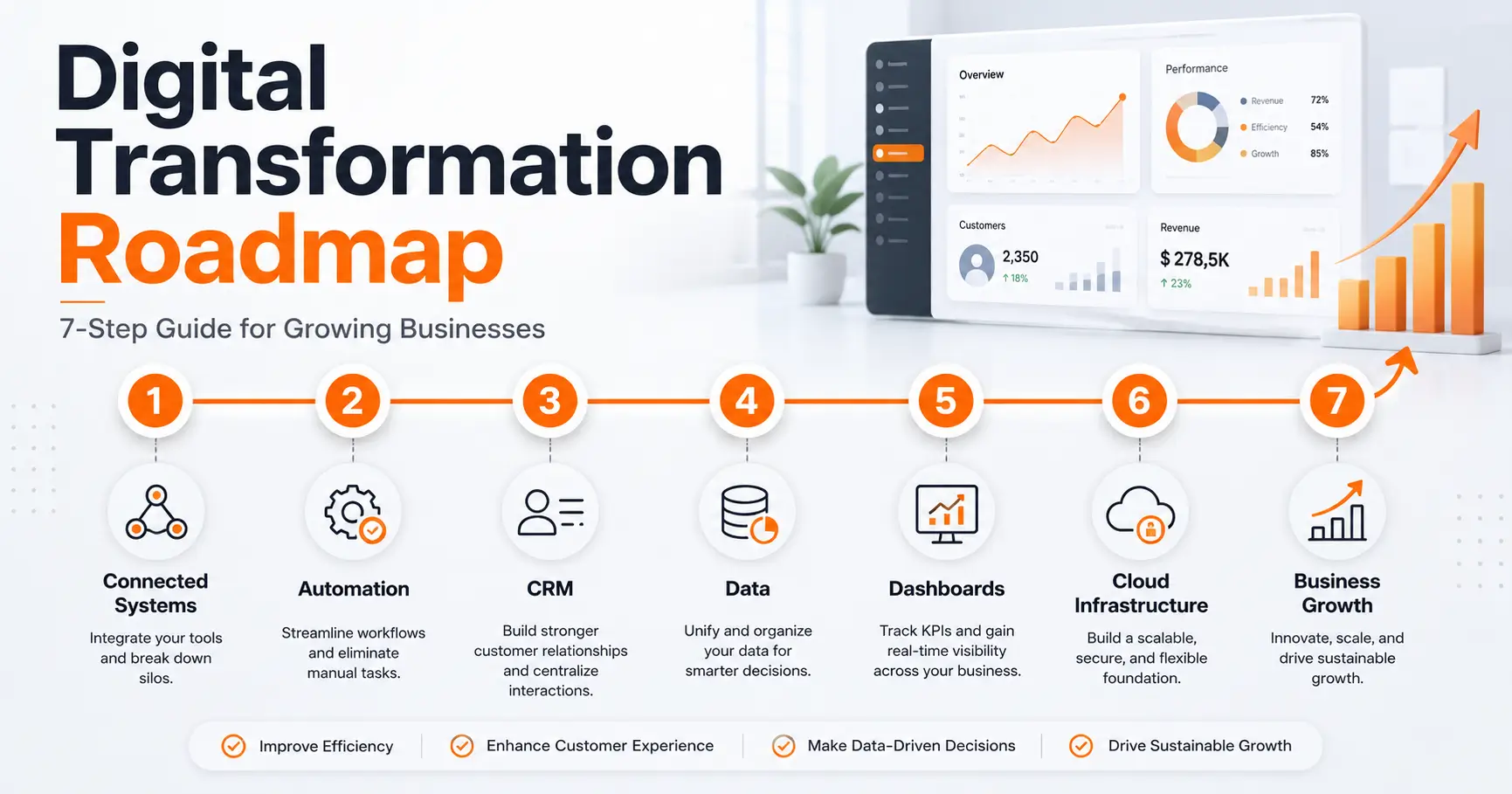
Digital transformation can sound like a big, complicated project.
For some organisations, it is. But for most growing businesses, digital transformation simply means using better technology, cleaner data and smarter workflows to make the business faster, more efficient and easier to scale.
That might mean replacing disconnected spreadsheets with a proper CRM. It might mean automating customer follow-ups. It might mean connecting your website, sales process, reporting dashboard and internal operations so your team is no longer chasing information across five different systems.
The problem is not that businesses lack digital tools.
The problem is that most businesses add tools without a roadmap.
They buy software because a competitor uses it. They launch AI because it is trending. They migrate to the cloud without fixing their processes first. They build dashboards without agreeing what decisions the dashboard should support.
That is how digital transformation becomes expensive noise.
A good digital transformation roadmap prevents that. It gives you a clear sequence: where you are now, where you want to get to, what should change first, what can wait, what needs budget, who owns delivery, and how success will be measured.
In this guide, we will break down how to create a practical digital transformation roadmap, whether you are an SME, professional services firm, e-commerce business, manufacturer or larger organisation planning a more structured IT transformation programme.
If your systems are already holding you back, Vistoplex can help with enterprise IT transformation and digital strategy, AI automation, custom software, cloud infrastructure and Data & BI.
What Is a Digital Transformation Roadmap?
A digital transformation roadmap is a structured plan that shows how a business will improve its technology, processes, data, customer experience and internal operations over time.
It is not just an IT plan.
It is a business plan with technology inside it.
A useful roadmap normally answers seven questions:
- What business problems are we trying to solve?
- Which systems, processes and workflows are currently slowing us down?
- Which digital improvements will create the most commercial value?
- What should we do first, second and third?
- What budget, people and external support will be needed?
- How will we manage risk, adoption and change?
- How will we measure whether the transformation worked?
The best roadmaps are not vague documents full of buzzwords. They are practical, phased and measurable.
A weak digital transformation goal would be:
“We want to become more digital.”
A stronger roadmap objective would be:
“Over the next 12 months, we will replace manual lead tracking with a connected CRM, automate enquiry follow-ups, build a real-time sales dashboard, reduce admin time by 30%, and improve response time to new enquiries from 24 hours to under 30 minutes.”
That is the difference between a slogan and a roadmap.
Why Digital Transformation Matters
Digital transformation matters because customers, employees and leadership teams now expect faster, clearer and more connected digital experiences.
Customers expect quick replies, online booking, clear pricing, helpful content, instant confirmation emails and smooth follow-up.
Employees expect systems that do not force them to copy and paste the same information all day.
Leadership teams expect better reporting, better forecasting and better visibility over performance.
At the same time, AI has changed the conversation. Businesses are no longer only asking, “Which software should we use?” They are asking:
- Which workflows can be automated?
- Where can AI reduce repetitive work?
- How do we connect our tools properly?
- How do we protect data while moving faster?
- How do we stop technology spend from becoming waste?
The commercial message is clear: businesses are investing in digital capability, but not every investment creates value.
Technology alone does not transform a business.
Better operating models do.
The 7-Step Digital Transformation Roadmap
Here is a practical roadmap businesses can use to plan digital transformation in a structured, realistic and commercially useful way.
Step 1: Diagnose the Current State
Before choosing new software or automation tools, you need to understand how the business currently works.
This is where many transformation projects go wrong. They start with solutions before properly defining the problem.
Your first step should be a current-state assessment.
This means reviewing your systems, workflows, data, customer journey, team pain points and operational bottlenecks.
Look at areas such as:
- Website and enquiry forms
- CRM or lead tracking
- Sales pipeline management
- Customer communication
- Project management
- Finance and invoicing
- Stock, fulfilment or service delivery
- Reporting and dashboards
- Data quality
- Manual admin tasks
- Cloud infrastructure
- Cybersecurity and access control
The goal is not to criticise the existing setup. The goal is to create a clear map of what is actually happening.
Useful questions to ask:
- Where does work get delayed?
- Which tasks are repeated manually every week?
- Where do customers drop off?
- Which systems do not talk to each other?
- Where is data duplicated?
- Which reports take too long to produce?
- Which processes depend too heavily on one person?
- Which systems are becoming unreliable, expensive or difficult to maintain?
A strong diagnosis creates the foundation for the rest of the roadmap.
Without it, digital transformation becomes guesswork.
For larger organisations, this is where a structured enterprise IT transformation discovery phase can be valuable. It turns scattered internal feedback into a prioritised transformation plan.
Step 2: Define the Business Outcomes
Digital transformation should always be linked to business outcomes.
Do not start with “we need AI” or “we need a new CRM”.
Start with what the business needs to improve.
Common transformation outcomes include:
- Increasing qualified enquiries
- Reducing manual admin
- Improving customer response time
- Improving quote or proposal turnaround
- Increasing online bookings
- Reducing operational errors
- Improving reporting accuracy
- Reducing software duplication
- Improving team productivity
- Reducing cloud or infrastructure costs
- Improving customer retention
- Creating better management visibility
Each outcome should have a measurable baseline.
For example:
- Lead response time: from 12 hours to under 30 minutes
- Monthly reporting: from 2 manual days to a live dashboard
- Customer follow-up: from inconsistent reminders to automated sequences
- Sales pipeline: from email and spreadsheets to a central CRM
- Internal approvals: from email chains to structured workflows
This is where digital transformation becomes commercially grounded.
A roadmap should not simply list projects. It should show why each project matters.
Step 3: Prioritise the Highest-Value Use Cases
Most businesses have more digital problems than they can fix at once.
That is normal.
The mistake is trying to transform everything at the same time.
That creates slow delivery, unclear ownership and internal fatigue.
Instead, prioritise use cases based on three factors:
- Business value: How much commercial or operational impact will this create?
- Delivery effort: How difficult, expensive or disruptive will it be?
- Risk: What could go wrong if this is done badly?
A simple way to prioritise is to group projects into four categories.
Quick Wins
Quick wins are low-effort, high-value improvements. These should be tackled early because they build momentum.
Examples include:
- Automated enquiry confirmations
- CRM pipeline clean-up
- Website form improvements
- Simple reporting dashboard
- Automated review requests
- Appointment booking automation
- Follow-up reminders
- Better website tracking
- Clearer contact forms
- Faster quote workflows
Strategic Projects
Strategic projects have higher delivery effort but higher long-term value. These need planning, budget and proper governance.
Examples include:
- CRM implementation
- ERP integration
- Customer portal development
- Cloud migration
- Custom internal platform
- Data warehouse or BI programme
- Legacy system modernisation
- Multi-system integration
- AI-powered workflow automation
- Advanced reporting architecture
Maintenance Fixes
Maintenance fixes may not look exciting, but they improve stability and reduce operational friction.
Examples include:
- Removing duplicate tools
- Improving permissions
- Cleaning outdated plugins
- Reducing spreadsheet dependency
- Documenting workflows
- Standardising file storage
- Fixing broken automations
- Removing unused software subscriptions
- Improving backup processes
- Cleaning customer data
Distractions
Distractions are low-value or poorly timed ideas. These should be parked until there is a stronger business case.
Examples include:
- Launching AI before data is structured
- Building an app when the website journey is broken
- Buying enterprise software without adoption capacity
- Creating dashboards for metrics nobody acts on
- Automating a process that should be redesigned first
- Migrating platforms without understanding the actual problem
The best digital transformation roadmap is not the one with the most projects.
It is the one with the right sequence.
Step 4: Design the Technology and Data Architecture
Once priorities are clear, you need to decide how your systems should work together.
This is where many businesses need external support, because the issue is rarely one tool.
The issue is how the whole stack connects.
Your technology architecture should answer questions such as:
- Which system is the source of truth for customer data?
- Where should enquiries be captured?
- How should the website connect to the CRM?
- How should sales, operations and finance share information?
- Which workflows should be automated?
- Which reports should leadership see every week?
- Where should data be stored?
- Which systems need to be integrated?
- What security, permissions and compliance controls are needed?
For SMEs, this might involve connecting a website, CRM, email marketing platform, booking system, accounting software and reporting dashboard.
For enterprise organisations, it might involve cloud infrastructure, legacy system modernisation, custom software, business intelligence, RFP governance, UAT planning and multi-site deployment.
At this stage, it is useful to think in layers.
Customer Layer
This is how customers find and interact with the business.
Examples include:
- Website
- Landing pages
- Booking forms
- Client portals
- Contact forms
- Live chat
- Review platforms
- Email journeys
Workflow Layer
This is how work moves through the business.
Examples include:
- CRM
- Project management system
- Approval workflows
- Task automation
- Sales pipeline
- Customer onboarding
- Internal ticketing
- Document workflows
Data Layer
This is how information is stored, structured and reported.
Examples include:
- Databases
- Dashboards
- BI tools
- Data warehouse
- Reporting systems
- Customer records
- Sales reports
- Operational analytics
Infrastructure Layer
This is how systems are hosted, secured and maintained.
Examples include:
- Cloud hosting
- Backups
- Access controls
- Integrations
- Security monitoring
- Infrastructure management
- User permissions
- Disaster recovery
Intelligence Layer
This is how automation and AI support better decisions.
Examples include:
- AI assistants
- Lead scoring
- Forecasting
- Automated insights
- Internal knowledge search
- Document processing
- Customer service automation
- Reporting summaries
This layered thinking helps prevent random tool adoption.
If your business needs bespoke internal systems, explore custom software and application development.
If your infrastructure is ageing or expensive, start with cloud migration and IT infrastructure.
If reporting is unclear, review your data and business intelligence setup.
Step 5: Build a 90-Day Pilot Before Scaling
A digital transformation roadmap should include long-term direction, but delivery should begin with a focused pilot.
A 90-day pilot reduces risk. It allows you to test assumptions, prove value and learn what adoption challenges appear before you roll changes across the entire organisation.
A good pilot has:
- A clear business problem
- A small number of users or teams
- A defined process or workflow
- A measurable baseline
- A target outcome
- A named owner
- A fixed review date
For example, instead of transforming the entire sales operation at once, you might run a 90-day pilot focused on new enquiry handling.
The pilot could include:
- Improving website enquiry forms
- Connecting forms to a CRM
- Adding automated confirmation emails
- Creating lead qualification fields
- Building a simple sales dashboard
- Automating follow-up reminders
- Measuring enquiry response time and conversion rate
This is a strong pilot because it is narrow, measurable and commercially meaningful.
Once the pilot proves value, the roadmap can move into wider rollout.
For smaller businesses, Vistoplex’s AI automation services can help automate enquiry handling, customer follow-ups, booking flows and internal admin.
For businesses still fixing the front-end journey, a better starting point may be website design and SEO before deeper operational automation.
Step 6: Set Governance, Ownership and Delivery Rhythm
Digital transformation needs ownership.
Without it, projects drift.
Everyone agrees the work is important, but nobody has enough authority, time or accountability to move it forward.
Your roadmap should define:
- Executive sponsor
- Project owner
- Technical owner
- Department leads
- External partners or vendors
- Decision-making process
- Budget approval process
- Risk register
- Delivery milestones
- Reporting cadence
For SMEs, governance does not need to be heavy. A weekly project check-in and a simple roadmap tracker may be enough.
For larger organisations, governance needs to be more formal. That may include:
- Sprint planning
- Stakeholder reviews
- UAT governance
- Vendor management
- Change control
- Post-go-live support
- Budget reporting
- Risk management
- Adoption tracking
The important point is this: digital transformation should not be treated as an occasional side project.
It needs a delivery rhythm.
A practical rhythm could look like this:
- Weekly: project progress, blockers and next actions
- Monthly: KPI review, budget review and roadmap updates
- Quarterly: strategic review, priority changes and new transformation opportunities
If your business needs senior technology leadership but not a full-time CTO, CTO-as-a-Service can help with technology roadmap development, vendor evaluation, IT governance, board reporting and transformation oversight.
Step 7: Drive Adoption, Training and Continuous Improvement
Go-live is not the finish line.
In many digital transformation projects, the system is technically delivered but commercially underused.
The business has paid for the tool, but the team does not fully adopt it.
That usually happens for one of three reasons:
- The new process was not designed around how people actually work.
- The team was not trained properly.
- Leadership stopped paying attention after launch.
A strong roadmap includes adoption from the beginning.
That means:
- Involving users before decisions are finalised
- Testing workflows with real scenarios
- Providing practical training
- Creating simple process documentation
- Tracking usage after launch
- Fixing friction quickly
- Reviewing whether the expected benefits are being achieved
Adoption should be measured, not assumed.
Useful adoption metrics include:
- Percentage of users actively using the new system
- Number of manual workarounds still happening
- Time saved per process
- Error reduction
- Customer response time
- Task completion time
- Team satisfaction
- Number of support issues after launch
The businesses that get the most value from digital transformation are not always the ones with the biggest budgets.
They are the ones that manage change properly.
A Practical 90-Day Digital Transformation Plan
A roadmap can cover 12 to 24 months, but the first 90 days matter most.
This is where you create proof, momentum and internal confidence.
Here is a practical 90-day structure.
Days 1–15: Current-State Review
Focus on understanding how the business works today.
Review:
- Current systems
- Manual workflows
- Customer journey
- Data quality
- Team pain points
- Reporting process
- Website enquiry flow
- Sales and operations handover
- Existing software subscriptions
Output:
- Current-state map
- Problem list
- System inventory
- Workflow gaps
- Initial quick-win opportunities
Days 16–30: Business Outcomes
Focus on defining what success should look like.
Agree:
- Commercial goals
- Operational goals
- Customer experience goals
- Reporting goals
- Productivity goals
- Cost reduction goals
- Risk reduction goals
Output:
- Transformation objectives
- KPI framework
- Baseline metrics
- Success criteria
Days 31–45: Prioritisation
Focus on deciding what should happen first.
Score possible projects by:
- Business value
- Delivery effort
- Cost
- Risk
- Urgency
- Internal capacity
- Customer impact
Output:
- Prioritised roadmap
- Quick-win list
- Pilot project selection
- Deferred project list
Days 46–60: Solution Design
Focus on designing the right system, workflow or automation.
Define:
- Tools required
- Integrations needed
- Data structure
- Workflow steps
- User roles
- Permissions
- Reporting requirements
- Training requirements
Output:
- Technical plan
- Delivery scope
- Workflow design
- Ownership structure
Days 61–75: Pilot Build
Focus on implementing one narrow but valuable use case.
Examples include:
- CRM lead capture setup
- Automated enquiry response
- Sales dashboard
- Client onboarding workflow
- AI-assisted support process
- Internal approval workflow
- Website-to-CRM integration
Output:
- Working pilot
- Test users
- Initial feedback
- Adoption issues
- Performance data
Days 76–90: Measure and Improve
Focus on reviewing whether the pilot worked.
Measure:
- Time saved
- Response time
- Conversion rate
- User adoption
- Error reduction
- Customer experience
- Reporting improvement
Output:
- Scale, adjust or stop decision
- Lessons learned
- Updated roadmap
- Next phase plan
This 90-day plan is not meant to transform the whole business.
It is meant to create proof, confidence and momentum.
That is usually the smartest way to begin.
Digital Transformation Roadmap Template
Use the structure below as a simple template for your own roadmap.
1. Business Vision
What should the business be able to do better in 12 to 24 months?
Example:
“We want a connected operating model where leads, customers, projects, reporting and follow-ups are managed through integrated systems rather than disconnected spreadsheets and inboxes.”
2. Current-State Problems
List the main problems holding the business back.
Examples:
- Leads are not tracked consistently.
- Reporting is manual and delayed.
- Customer follow-ups depend on memory.
- Data is duplicated across systems.
- Operational tasks take too long.
- Management lacks real-time visibility.
- Customer communication is inconsistent.
- The team uses too many disconnected tools.
3. Target Outcomes
Define what success should look like.
Examples:
- Reduce enquiry response time to under 30 minutes.
- Increase lead-to-consultation conversion rate by 20%.
- Reduce weekly admin by 10 hours.
- Create one live dashboard for management reporting.
- Automate customer follow-up sequences.
- Improve customer onboarding speed.
- Reduce software duplication.
- Improve reporting accuracy.
4. Priority Projects
Group the transformation work into phases.
Example structure:
- Phase 1: CRM clean-up and lead capture improvement
- Phase 2: Automation of enquiry replies and follow-ups
- Phase 3: Reporting dashboard and data clean-up
- Phase 4: Custom workflow tools or deeper system integrations
- Phase 5: AI-assisted workflows and advanced analytics
5. Technology Requirements
List what is needed to deliver the roadmap.
Examples:
- CRM
- Website form integration
- Email automation
- Analytics and tracking
- Dashboard or BI tool
- Cloud storage or infrastructure changes
- Custom software or API integration
- AI assistant or automation tool
- Secure user permissions
- Backup and recovery process
6. Ownership
Assign clear roles.
Examples:
- Executive sponsor
- Project lead
- System owner
- Data owner
- Department representative
- External delivery partner
- Technical lead
- Training owner
7. KPIs
Agree what will be measured.
Examples:
- Time saved
- Revenue influenced
- Conversion rate improvement
- Customer response time
- Reporting time reduction
- Cost reduction
- System adoption rate
- Error reduction
- Customer satisfaction
- Manual work removed
8. Risks and Dependencies
Identify what could slow delivery.
Examples:
- Poor data quality
- Team resistance
- Unclear ownership
- Vendor delays
- Integration complexity
- Budget limits
- Security or compliance requirements
- Low adoption
- Lack of training
- Overcomplicated scope
9. Timeline
Break the roadmap into realistic phases.
Example timeline:
- 0–3 months: audit, quick wins and pilot
- 3–6 months: core system improvements and automation
- 6–12 months: integrations, dashboards and process redesign
- 12–24 months: advanced analytics, AI workflows and larger platform changes
Examples of Digital Transformation by Business Type
Digital transformation looks different depending on the business.
A law firm does not need the same roadmap as an e-commerce brand. A manufacturer does not need the same systems as a consulting firm.
The right roadmap depends on the business model, customer journey, team structure and operational bottlenecks.
Professional Services Firms
For law firms, accountants, consultants and advisory businesses, digital transformation often starts with lead handling, document workflows, client onboarding and reporting.
Typical roadmap priorities include:
- New enquiry capture from the website
- CRM pipeline setup
- Automated consultation reminders
- Document request workflows
- Client onboarding sequences
- Review generation
- Local SEO and service-page optimisation
- Management dashboards
- Proposal automation
- Follow-up sequences
The commercial aim is usually better enquiry quality, faster follow-up and less admin pressure on senior staff.
A professional services firm may not need a complex platform at the beginning.
It may simply need a better website, clearer conversion journey, structured CRM, automated follow-ups and visibility over which enquiries turn into paying clients.
E-commerce and Retail Businesses
For e-commerce businesses, transformation is often focused on customer journey, stock visibility, fulfilment, retention and marketing automation.
Typical roadmap priorities include:
- Website speed and conversion improvements
- Abandoned cart automation
- Customer segmentation
- Email and SMS flows
- Inventory system integration
- Customer service automation
- Returns workflow improvement
- Revenue dashboard
- Product performance reporting
- Personalised product recommendations
The aim is to increase revenue while reducing manual operational friction.
For example, an e-commerce business may have good traffic but poor conversion.
In that case, the roadmap should not begin with a new back-office system. It should begin with conversion tracking, checkout improvement, abandoned cart recovery, customer segmentation and product performance reporting.
Manufacturing and Industrial Businesses
For manufacturers, digital transformation is often more operational.
The roadmap may include production visibility, maintenance workflows, quality control, data capture and system integration.
Typical priorities include:
- Replacing paper-based processes
- Connecting operational data sources
- Building production dashboards
- Improving maintenance tracking
- Reducing manual reporting
- Modernising legacy software
- Cloud migration
- Data governance
- Quality control workflows
- Stock and supply chain visibility
For manufacturing businesses, digital transformation should be closely linked to operational efficiency.
Useful goals might include reducing downtime, improving production visibility, reducing reporting delays or improving stock accuracy.
If you are planning smart factory or Industry 4.0 initiatives, read Vistoplex’s guide to Industry 4.0 for UK manufacturers.
Growing SMEs
For many SMEs, the roadmap does not need to begin with a huge IT programme.
It often begins with fixing the basics.
Typical priorities include:
- A website that converts
- Search visibility for commercial keywords
- A CRM that the team actually uses
- Automated enquiry responses
- Clear reporting
- Simple AI workflows
- Better customer follow-up
- Better appointment booking
- Simple dashboards
- Reduced spreadsheet dependency
If your business is still relying on inboxes, spreadsheets and manual reminders, digital transformation can create meaningful value quickly.
Read Vistoplex’s guide to AI automation for small businesses in the UK for practical workflow ideas.
Mid-Market and Enterprise Organisations
For larger organisations, digital transformation usually needs stronger governance because there are more systems, stakeholders, risks and dependencies.
Typical roadmap priorities include:
- Technology audit
- Legacy system assessment
- Vendor review and rationalisation
- Cloud migration planning
- Custom software development
- Data architecture improvement
- Business intelligence dashboards
- RFP and procurement support
- User acceptance testing
- Post-go-live adoption and support
- Security and access control
- Multi-team implementation planning
This is where Vistoplex’s enterprise IT transformation and digital strategy service is most relevant.
For enterprise teams, the roadmap must do more than identify technology. It must create alignment between leadership, operations, IT, finance, users and external vendors.
How Much Does Digital Transformation Cost?
Digital transformation costs vary widely because the scope can range from a small CRM and automation project to a multi-system enterprise transformation programme.
For a growing SME, an initial transformation project might involve:
- Website improvements
- CRM setup
- Workflow automation
- Reporting dashboard
- Basic integrations
- AI-assisted admin workflows
For a larger organisation, the work may include:
- Discovery
- System architecture
- Cloud migration
- Custom software
- Vendor selection
- UAT
- Change management
- Security review
- Data architecture
- Post-go-live support
Instead of asking “how much does digital transformation cost?”, a better question is:
“What is the smallest transformation project that can create measurable value and prove the case for further investment?”
A practical budget structure usually includes four stages.
Discovery
This stage helps you understand current systems, problems and opportunities.
Typical output:
- Findings report
- Current-state review
- Roadmap
- Priority list
- Risk areas
- Budget estimate
Pilot
This stage helps you test one high-value use case before scaling.
Typical output:
- Working process
- Automation
- Dashboard
- CRM workflow
- User feedback
- Performance data
Core Implementation
This stage rolls out the agreed system or workflow.
Typical output:
- Live system
- User training
- Documentation
- Integrations
- Reporting setup
- Adoption plan
Optimisation
This stage improves usage, performance and commercial value after launch.
Typical output:
- Better adoption
- Reduced friction
- Improved reporting
- Workflow refinements
- New automation opportunities
- Next phase roadmap
For cloud-focused projects, cost control should be part of the roadmap from the beginning.
Read Vistoplex’s guide to cloud cost optimisation for enterprise if your infrastructure spend is increasing without clear visibility.
Common Digital Transformation Mistakes
Many digital transformation projects fail because the technology is bad.
But many more fail because the plan is unclear.
Here are the mistakes to avoid.
1. Starting With Tools Instead of Problems
Buying software before defining the business problem is one of the fastest ways to waste money.
The roadmap should define the problem, outcome and process before selecting tools.
For example, “we need a CRM” is not enough.
A better statement would be:
“We need one place to track enquiries, assign owners, automate follow-ups and report on which channels generate paying customers.”
That gives the technology a clear purpose.
2. Trying to Change Everything at Once
Large transformation programmes fail when they become too broad too early.
Start with focused use cases.
Prove value.
Then scale.
A smaller project with clear results is better than a huge programme that loses momentum.
3. Ignoring Data Quality
Automation and AI depend on reliable data.
If your customer records are duplicated, incomplete or inconsistent, advanced tools will simply make poor data move faster.
Before building dashboards or AI workflows, clean the core data.
That might mean standardising customer records, removing duplicates, defining fields properly and agreeing who owns each data source.
4. Underestimating Change Management
People do not adopt new systems just because leadership announces them.
You need:
- Training
- Communication
- Documentation
- Support
- Clear ownership
- Simple workflows
- Feedback loops
- Leadership reinforcement
The easier the new process is to understand, the more likely the team is to use it.
5. Building Dashboards Without Decisions
A dashboard is only useful if it supports decisions.
Before building reports, define what the leadership team needs to decide weekly or monthly.
Examples include:
- Which marketing channels are generating qualified leads?
- Which sales opportunities are stuck?
- Which projects are delayed?
- Which customers need follow-up?
- Which services are most profitable?
- Which operational issues are repeating?
If the dashboard does not support a decision, it is probably just decoration.
6. Treating AI as a Separate Strategy
AI should be part of the wider digital transformation roadmap, not a disconnected experiment.
The best AI use cases are tied to real workflows.
Examples include:
- Enquiry handling
- Reporting
- Customer support
- Document processing
- Content operations
- Forecasting
- Internal knowledge retrieval
- Lead qualification
- Admin automation
AI becomes more valuable when your systems, data and processes are already structured.
7. Forgetting Post-Go-Live Support
The first few months after launch are critical.
This is when adoption either sticks or quietly fails.
Post-go-live support should include:
- User support
- Issue tracking
- Workflow refinement
- Training refreshers
- Usage monitoring
- KPI review
- System improvements
A digital transformation project should not end the day the system goes live.
That is when the real business value begins.
Digital Transformation KPIs to Track
Your roadmap should include clear KPIs from the start.
Useful digital transformation KPIs include:
- Manual hours saved per week
- Lead response time
- Conversion rate
- Customer satisfaction
- System adoption rate
- Number of manual workarounds removed
- Reporting time saved
- Error reduction
- Operational cost reduction
- Cloud cost visibility
- Revenue influenced by digital channels
- Customer retention rate
- Average time to complete key workflows
- Quote turnaround time
- Onboarding completion time
- Number of duplicated systems removed
- Number of automated workflows launched
Do not track too many metrics at once.
Choose the metrics that prove whether the roadmap is creating business value.
For example, if your transformation is focused on sales efficiency, track:
- Lead response time
- Follow-up completion rate
- Conversion rate
- Sales pipeline visibility
- Revenue generated from digital channels
If your transformation is focused on operations, track:
- Time saved
- Error reduction
- Process completion time
- Manual tasks removed
- Team adoption
If your transformation is focused on reporting, track:
- Reporting time saved
- Data accuracy
- Dashboard usage
- Decision speed
- Number of manual reports removed
The KPI should match the business problem.
When Should You Bring in a Digital Transformation Partner?
You may be able to manage small improvements internally.
But a transformation partner becomes useful when:
- Your systems are disconnected
- You are unsure which tools to choose
- Your team lacks technical delivery capacity
- You need custom software or integrations
- You are planning cloud migration
- You need better reporting and BI
- You are considering AI automation
- You need board-level technology strategy
- You have multiple stakeholders and vendors
- You need accountability for delivery, not just advice
A good partner should not push technology for its own sake.
They should help you clarify the commercial case, sequence the roadmap and deliver practical improvements.
At Vistoplex, our work covers the full digital transformation journey: strategy, websites, SEO, automation, custom systems, cloud infrastructure, Data & BI and enterprise programme delivery.
You can explore our case studies to see how we approach practical digital growth and transformation work.
How Vistoplex Helps Build and Deliver Digital Transformation Roadmaps
Vistoplex helps businesses move from scattered digital activity to a clear, commercially grounded transformation roadmap.
Depending on your situation, we can support with:
- Enterprise IT transformation and digital strategy
- CTO-as-a-Service and technology roadmap development
- AI automation and workflow automation
- Custom software and internal platforms
- Cloud migration and IT infrastructure
- Data and business intelligence dashboards
- Conversion-focused website design
- SEO and search growth
For SMEs, we can start with quick wins: better enquiry handling, CRM workflows, automation, website improvements and reporting.
For larger organisations, we can support structured discovery, roadmap development, programme governance, vendor management, UAT, deployment and post-go-live optimisation.
The goal is not to make your business “more digital” for the sake of it.
The goal is to build a better operating system for growth.
Final Thoughts: Your Roadmap Should Create Clarity, Not Complexity
Digital transformation does not need to begin with a huge programme.
It needs to begin with clarity.
What is slowing the business down?
Where are customers experiencing friction?
Which tasks are wasting team time?
Which systems are no longer fit for purpose?
Which data would help leadership make better decisions?
Which workflows could be automated safely?
Once those questions are clear, the roadmap becomes much easier to build.
Start with the current state.
Define the business outcomes.
Prioritise the highest-value use cases.
Design the right technology architecture.
Run a focused pilot.
Put ownership in place.
Measure adoption and improve continuously.
That is how digital transformation becomes practical.
And practical transformation is the kind that actually delivers value.
Need Help Building Your Digital Transformation Roadmap?
Vistoplex helps businesses plan and deliver practical digital transformation across strategy, AI automation, custom software, cloud infrastructure, Data & BI, websites and SEO.
Book a consultation with Vistoplex or start with a free website audit if your transformation journey begins with your website, SEO and customer enquiry flow.
Frequently Asked Questions
What is a digital transformation roadmap?
A digital transformation roadmap is a structured plan that shows how a business will improve its systems, processes, data, customer experience and operations using digital technology. It sets priorities, timelines, ownership, budgets and measurable outcomes.
Why do businesses need a digital transformation roadmap?
Businesses need a roadmap because digital projects can become expensive and disconnected without clear priorities. A roadmap helps the business focus on the improvements that create the most value, reduce risk and support long-term growth.
What should be included in a digital transformation roadmap?
A strong roadmap should include a current-state assessment, business objectives, priority use cases, technology requirements, data strategy, delivery phases, ownership, budget, risks, KPIs and adoption plan.
How long does digital transformation take?
A focused SME transformation project can show results within 90 days. Larger transformation programmes may take 6, 12 or 24 months depending on the number of systems, stakeholders, integrations and operational changes involved.
What is the first step in digital transformation?
The first step is understanding the current state. Before choosing tools, the business should audit its systems, workflows, data, customer journey and operational bottlenecks.
How do you prioritise digital transformation projects?
Prioritise projects by business value, delivery effort and risk. Start with quick wins that prove value, then move into strategic projects such as CRM implementation, automation, cloud migration, custom software or data dashboards.
What are examples of digital transformation?
Examples include CRM implementation, AI-powered enquiry handling, automated customer follow-ups, cloud migration, custom internal dashboards, e-commerce automation, digital client onboarding, legacy system modernisation and business intelligence reporting.
How can AI fit into a digital transformation roadmap?
AI should be used where it improves real workflows. Good use cases include customer support, lead qualification, internal knowledge search, content workflows, reporting, forecasting, document processing and repetitive admin automation.
How much does digital transformation cost?
The cost depends on scope. A small business may begin with a focused CRM, automation or website workflow project. Larger organisations may need discovery, system architecture, cloud migration, custom software, vendor selection and programme governance.
Can Vistoplex help create a digital transformation roadmap?
Yes. Vistoplex helps businesses create and deliver practical digital transformation roadmaps across strategy, AI automation, custom software, cloud infrastructure, Data & BI, website systems and enterprise IT transformation.