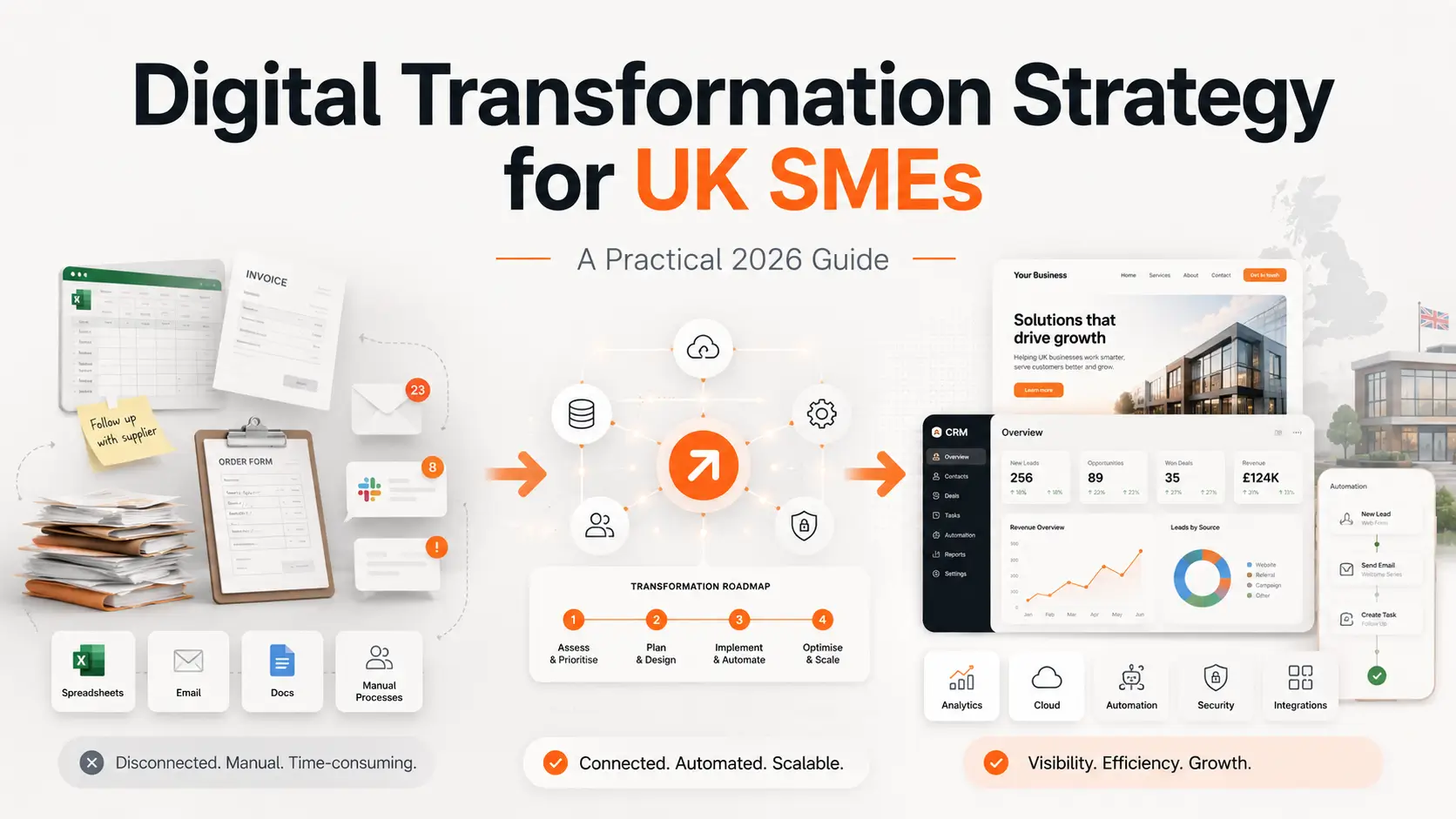
Digital transformation is often explained as if every SME needs a full enterprise technology programme, a new software stack and a board-level innovation department.
That is not how it works in real businesses.
For most UK SMEs, digital transformation means something much more practical: making the business easier to run, easier to measure and easier to scale.
It means fewer manual admin tasks. Fewer missed enquiries. Better customer follow-up. Cleaner data. More reliable systems. Less dependence on spreadsheets that only one person understands. Faster reporting. Better visibility over what is happening in the business.
At Vistoplex, we see the same pattern again and again with growing SMEs. The business does not usually have a “technology problem” at first. It has a process problem that has become more painful as the company has grown.
The enquiry process worked when there were five leads per week, but not when there are fifty. The spreadsheet worked when one person managed operations, but not when three departments now need the same information. The website worked when most business came from referrals, but not when the company now needs predictable inbound leads. The manual reporting worked when the owner was close to everything, but not when the team has grown and decisions need better data.
That is where a digital transformation strategy becomes useful.
Not as a buzzword. Not as a vanity project. Not as a reason to buy software.
A good digital transformation strategy gives your SME a clear plan for where technology should improve the business, what should be fixed first, how much change the team can realistically absorb, and how each digital investment will produce a measurable commercial result.
What is digital transformation for UK SMEs?
Digital transformation for UK SMEs is the structured use of digital tools, automation, data and improved systems to make the business more efficient, more measurable and more scalable.
In plain English, it is the process of moving from disconnected manual work to joined-up digital operations.
That could include:
- Replacing paper forms with digital forms
- Moving from spreadsheets to a CRM or operations platform
- Automating enquiry follow-up
- Connecting your website forms to your sales pipeline
- Using AI to handle repetitive admin or customer service tasks
- Moving old systems to cloud infrastructure
- Creating dashboards for sales, operations or finance
- Improving cybersecurity and access control
- Integrating finance, marketing, CRM and project tools
- Building custom software where off-the-shelf tools no longer fit
The important point is this: digital transformation is not just “going paperless” or “using AI”.
It is a business improvement programme supported by technology.
The UK government has placed serious attention on SME digital adoption. GOV.UK reported that SMEs account for 99.85% of the UK business population, with 5.7 million private sector businesses at the start of 2025. That makes SME digital capability a major part of UK productivity and competitiveness.
The Department for Business and Trade also created the SME Digital Adoption Taskforce to explore how SMEs can better adopt digital technology to improve productivity, with an ambition to make UK SMEs the most digitally capable and AI-confident in the G7 by 2035.
For SME leaders, the message is clear: digital transformation is no longer something only large companies need to think about. It is now part of how smaller businesses compete, protect margin and grow without adding unnecessary overhead.
Why digital transformation strategies fail in SMEs
Most SME digital transformation projects do not fail because the tools are bad.
They fail because the strategy is unclear.
The most common mistakes we see are:
- Buying software before mapping the process
- Automating a broken workflow
- Choosing tools because competitors use them
- Giving the team too much change at once
- Ignoring data quality
- Treating the website, CRM, marketing, finance and operations as separate systems
- Measuring activity instead of commercial impact
- Underestimating training and adoption
- Allowing every department to choose its own tools without governance
- Starting with AI before the business has clean processes and reliable data
A weak strategy sounds like this:
“We need a CRM.”
A stronger strategy sounds like this:
“We are losing leads because enquiries come from the website, email, phone and social media, but they are not captured in one place. We need a CRM and automated follow-up system so every enquiry is logged, assigned, followed up within five minutes and reported weekly.”
That difference matters.
The first version starts with a tool. The second starts with a business problem.
Digital transformation should always begin with the business outcome.
The Vistoplex view: transformation should start with friction
In our experience, the best place to start is not with the newest technology.
It is with friction.
Friction is the repeated manual work, delay, confusion or rework that slows the business down.
Examples include:
- Staff copying information between systems
- Leads sitting in inboxes with no follow-up
- Quotes being created manually every time
- Customer details being retyped into multiple platforms
- Reports taking hours to prepare
- Files being stored in inconsistent locations
- No one knowing which version of a document is final
- Sales and delivery teams using different information
- Managers relying on gut feel because data is late or incomplete
- Customers chasing for updates because internal workflows are unclear
These are the areas where digital transformation creates immediate value.
A transformation strategy does not need to start with a £100,000 system change. Often, the first win is a better form, a cleaner CRM setup, an automated notification, a simple dashboard, or a workflow that removes two hours of admin every day.
That is why Vistoplex takes an audit-led approach across SME digital marketing, AI automation, websites, cloud infrastructure and custom software. The aim is not to add more technology. The aim is to find the points where better technology improves how the business performs.
You can see this approach across our SME digital marketing and AI automation services, where the focus is on websites that convert, marketing that compounds and automation that removes time-wasting tasks.
What should a digital transformation strategy include?
A strong digital transformation strategy for a UK SME should include nine core parts:
- Business goals
- Current-state audit
- Process map
- Customer journey review
- Technology stack review
- Data and reporting plan
- Automation opportunities
- Risk, security and compliance review
- 30, 60 and 90-day implementation roadmap
Each part helps answer one important question:
Where will digital change create the most value with the least unnecessary disruption?
1. Start with business goals, not software
Before choosing tools, define what the business needs to improve.
Common SME goals include:
- Increase qualified leads
- Improve enquiry response speed
- Reduce admin time
- Improve customer experience
- Reduce operating costs
- Improve visibility over sales and delivery
- Standardise internal workflows
- Improve cash collection
- Reduce errors
- Support remote or hybrid working
- Prepare for growth, investment or acquisition
- Improve cybersecurity and business continuity
Your goal should be specific enough to guide decisions.
Weak goal:
“Improve efficiency.”
Better goal:
“Reduce manual admin in the enquiry-to-quote process by 40% within 90 days.”
Weak goal:
“Use AI.”
Better goal:
“Use AI automation to draft first responses to routine enquiries, qualify leads and route complex requests to the right team member.”
Weak goal:
“Improve the website.”
Better goal:
“Rebuild the website so it clearly explains our services, ranks for high-intent search terms, captures enquiries properly and feeds leads into the CRM.”
Digital transformation becomes much easier when every decision is connected to a measurable business outcome.
2. Audit where the business is now
A digital transformation strategy should begin with an honest audit.
This does not need to be complicated. Start by reviewing five areas:
- How work comes into the business
- How work moves through the business
- How customers are updated
- How information is stored
- How performance is measured
Ask practical questions:
- Where do enquiries come from?
- Who receives them?
- How quickly are they answered?
- Where are customer details stored?
- How are quotes created?
- How are tasks assigned?
- Where do delays happen?
- Which tasks are repeated every day?
- Which reports are prepared manually?
- Which systems do not speak to each other?
- Which processes rely on one person’s memory?
- What breaks when the business gets busier?
This stage often reveals that the biggest problems are not invisible.
People already know where the friction is. They just have not had the time or structure to fix it.
3. Map the process before changing the tool
One of the most expensive mistakes SMEs make is replacing software without understanding the process.
A CRM will not fix a weak sales process.
A project management tool will not fix unclear responsibilities.
An AI chatbot will not fix poor service information.
A cloud migration will not fix messy file structures by itself.
Before you change the tool, map the workflow.
For example, an enquiry-to-sale process might look like this:
- Visitor lands on website
- Visitor submits enquiry form
- Notification goes to shared inbox
- Team member replies manually
- Lead details are added to spreadsheet
- Quote is prepared in Word
- Quote is emailed
- Follow-up depends on staff memory
- Sale is confirmed by email
- Invoice is created manually
- Delivery team is updated separately
This process creates obvious risks:
- Enquiries can be missed
- No clear ownership
- Follow-up is inconsistent
- Reporting is slow
- Quote quality varies
- Delivery handoff is manual
- Customer experience depends heavily on individual staff habits
A better digital workflow could be:
- Website enquiry enters CRM automatically
- Lead is tagged by service type
- Auto-response confirms receipt
- Sales task is created
- AI-assisted draft response is prepared
- Quote template is generated
- Follow-up reminders are triggered
- Customer status updates automatically
- Deal outcome is recorded
- Dashboard tracks source, conversion rate and revenue
This is digital transformation in practice.
Not theory. Not jargon. Just a better operating system for the business.
4. Review the customer journey
Digital transformation should improve the customer experience, not just internal efficiency.
Look at the business from the customer’s point of view:
- Can they understand what you do quickly?
- Can they find the right service?
- Can they contact you easily?
- Do they receive a fast response?
- Are next steps clear?
- Are forms simple?
- Is pricing or quote information explained well?
- Do they receive reminders or updates?
- Can they book, pay, upload files or approve work online?
- Do they trust the business from the first click?
For many SMEs, the website is the first major digital transformation opportunity.
An outdated website can create friction before a customer even speaks to the team. Slow pages, unclear service copy, weak calls to action and poor mobile design all reduce conversion.
That is why a website should not be treated as a brochure. It should be treated as part of the business system.
A strong SME website should:
- Explain the offer clearly
- Build trust quickly
- Capture enquiries cleanly
- Connect to analytics and CRM
- Support SEO
- Work well on mobile
- Answer common objections
- Make the next step obvious
For businesses relying on search, paid ads or inbound leads, this is often the first commercial layer of transformation.
5. Build a connected technology stack
Many SMEs do not have a technology stack. They have a collection of tools.
The difference matters.
A collection of tools looks like this:
- Website on one platform
- Forms going to email
- Leads tracked in spreadsheets
- Customer details stored in inboxes
- Finance in accounting software
- Projects in another tool
- Marketing emails in a separate platform
- Reports prepared manually
- Files stored across personal drives
A technology stack works as a connected system.
For example:
- Website captures lead
- CRM stores lead
- Automation assigns task
- Email sequence follows up
- Calendar books appointment
- Proposal tool sends quote
- Finance tool raises invoice
- Project system starts delivery
- Dashboard reports performance
You do not need the most expensive tools. You need the right tools connected in the right way.
Common SME tools may include:
- CRM: HubSpot, Pipedrive, Zoho or Salesforce
- Accounting: Xero, QuickBooks or Sage
- Project management: ClickUp, Monday, Asana or Trello
- Email marketing: Mailchimp, Klaviyo, HubSpot or Brevo
- Automation: Zapier, Make, n8n or custom workflows
- Analytics: GA4, Search Console, Looker Studio
- Cloud storage: Google Workspace, Microsoft 365, Dropbox or SharePoint
- Customer support: Help Scout, Zendesk, Intercom or Freshdesk
- AI tools: ChatGPT, Microsoft Copilot, Gemini or custom AI agents
The right stack depends on your business model, team size, budget, compliance needs and growth plans.
At Vistoplex, we usually advise SMEs to avoid overcomplicating the stack too early. The goal is not to impress the team with software. The goal is to make the business easier to run.
6. Use automation where it removes real work
Automation is one of the highest-return areas of digital transformation for SMEs.
But only when it is applied to the right tasks.
Good automation candidates are:
- Repetitive
- Rules-based
- High-volume
- Time-consuming
- Low-risk
- Easy to review
- Connected to clear triggers
Examples include:
- New enquiry auto-replies
- Lead qualification
- Appointment reminders
- Quote follow-ups
- Client onboarding emails
- Document collection reminders
- Invoice reminders
- Review requests
- Weekly reporting
- CRM updates
- Task creation
- Social media scheduling
- Internal notifications
- Basic customer service FAQs
Automation should not remove human judgment where judgment matters. It should remove the repetitive work around it.
For example, an AI enquiry assistant should not make sensitive commercial decisions without oversight. But it can collect information, answer common questions, create draft responses, route requests and reduce response time.
Vistoplex’s AI automation services are built around this principle: automate the repetitive parts of the workflow while keeping human control where accuracy, sensitivity or commercial judgment matters.
The best SME automations usually do one of three things:
- Save staff time
- Improve response speed
- Increase conversion rate
If an automation does not support one of those outcomes, question whether it is worth building.
7. Improve data before expecting better decisions
Most SMEs want better reporting.
The problem is that reporting depends on data quality.
If the CRM is incomplete, the dashboard will be misleading.
If lead sources are not tracked, marketing ROI will be guesswork.
If sales stages are inconsistent, conversion rates will be unreliable.
If project data is missing, capacity planning will be weak.
A digital transformation strategy should define what data the business needs to capture and why.
Useful SME data points may include:
- Lead source
- Service requested
- Enquiry date
- Response time
- Sales owner
- Quote value
- Quote status
- Conversion outcome
- Reason for loss
- Delivery stage
- Gross margin
- Customer type
- Repeat purchase behaviour
- Marketing channel
- Customer lifetime value
The aim is not to track everything.
The aim is to track the data that improves decisions.
A simple dashboard that shows enquiries, lead source, conversion rate, quote value and revenue can be more valuable than a complex reporting suite no one uses.
8. Do not ignore cybersecurity
Digital transformation increases dependence on digital systems. That makes cybersecurity more important, not less.
The UK government’s Cyber Security Breaches Survey 2025 found that phishing was the most common type of breach or attack, affecting 85% of businesses that identified a breach or attack. This equated to 37% of all businesses experiencing phishing breaches or attacks.
For SMEs, the practical message is simple: every digital transformation strategy should include basic security controls.
These may include:
- Multi-factor authentication
- Strong password management
- User access reviews
- Device security
- Email security
- Regular backups
- Tested recovery process
- Staff phishing awareness
- Secure cloud configuration
- CRM and file access permissions
- Data retention rules
- Supplier access controls
- Cyber Essentials readiness
Security should not be treated as a separate technical issue. It is part of operational resilience.
If your business depends on the CRM, website, email, cloud files, booking system or payment process, those systems need to be protected.
For businesses with ageing infrastructure, cloud hosting issues or poor backup arrangements, Vistoplex’s cloud migration and IT infrastructure services can support infrastructure assessment, cybersecurity, disaster recovery and cloud planning.
9. Decide what to buy, what to configure and what to build
Not every SME needs custom software.
In fact, many should avoid it at the beginning.
Off-the-shelf software is often the right choice when:
- The process is standard
- The budget is limited
- The team needs speed
- The tool already fits 80% of the requirement
- Integration needs are simple
- Internal capacity is limited
Configuration is better when:
- A good platform exists but needs tailoring
- Workflows need automation
- Forms, fields and dashboards need customisation
- The business wants faster implementation
- The team needs flexibility without full custom development
Custom software becomes useful when:
- The process is genuinely unique
- Off-the-shelf tools force too many compromises
- Multiple systems need one unified interface
- The business model depends on proprietary workflows
- The company needs a customer portal, internal tool or platform
- Manual work remains high despite existing software
- The software itself creates competitive advantage
This decision is important.
Many SMEs overspend by building too early. Others lose years forcing the business into tools that were never designed for them.
A good digital transformation strategy should be honest about the difference.
For more complex requirements, Vistoplex’s custom software and application development services support internal tools, dashboards, portals, mobile applications, AI-powered platforms and workflow systems.
A practical digital transformation framework for UK SMEs
Here is a simple framework SMEs can use.
Stage 1: Stabilise
Fix the basics first.
This includes:
- Website reliability
- Email deliverability
- File organisation
- User access
- Password security
- Backups
- Analytics setup
- CRM cleanliness
- Form reliability
- Basic reporting
Do not automate chaos. Stabilise the foundations.
Stage 2: Standardise
Create consistent ways of working.
This includes:
- Standard enquiry process
- Standard quote templates
- Standard sales stages
- Standard onboarding steps
- Standard file naming
- Standard reporting rhythm
- Standard approval process
- Standard customer update points
Standardisation makes automation easier later.
Stage 3: Connect
Link the tools that should already be working together.
This includes:
- Website to CRM
- CRM to email
- CRM to calendar
- CRM to quoting
- Project tool to delivery workflow
- Finance tool to invoice reminders
- Analytics to dashboards
- Forms to internal notifications
This stage reduces rekeying, missed handoffs and duplicated admin.
Stage 4: Automate
Remove repetitive manual work.
This includes:
- Follow-up sequences
- Reminder workflows
- Lead routing
- Client onboarding
- Document collection
- Review requests
- Report generation
- Internal task creation
- AI-assisted responses
Automation works best once processes are stable and connected.
Stage 5: Optimise
Use data to improve performance.
This includes:
- Conversion rate tracking
- Channel ROI
- Capacity planning
- Customer retention analysis
- Sales pipeline quality
- Delivery bottlenecks
- Cost-to-serve
- Workflow improvement
- AI-assisted insights
Optimisation is where digital transformation becomes a long-term advantage rather than a one-off project.
The 90-day digital transformation plan for SMEs
A 90-day plan is usually more useful than a 12-month transformation document that no one follows.
Here is a practical structure.
Days 1–30: Audit, map and prioritise
Focus on understanding the business properly.
Actions:
- Review website, CRM, marketing, sales, operations and reporting
- Map the enquiry-to-sale journey
- Identify manual admin tasks
- List all software tools and monthly costs
- Review data quality
- Check security basics
- Interview team members about repeated friction
- Identify the top five operational bottlenecks
- Prioritise by commercial impact and ease of implementation
Outputs:
- Current-state audit
- Process map
- Technology stack list
- Automation opportunity list
- Priority matrix
- First 90-day roadmap
The key question for this stage:
Where are we losing the most time, money or opportunity?
Days 31–60: Fix foundations and create quick wins
Focus on visible improvements.
Actions:
- Clean CRM fields and sales stages
- Improve website forms and tracking
- Set up lead source tracking
- Create enquiry auto-response
- Build quote follow-up reminders
- Standardise templates
- Improve file structure
- Add basic dashboards
- Implement multi-factor authentication
- Remove unused tools or duplicate subscriptions
Outputs:
- Cleaner CRM
- Faster enquiry handling
- Better tracking
- Reduced admin
- Improved team visibility
- Stronger security basics
The key question for this stage:
What can we improve quickly without disrupting the business?
Days 61–90: Automate and measure
Focus on automation and reporting.
Actions:
- Automate lead assignment
- Automate follow-up sequences
- Connect website forms to CRM
- Create weekly performance dashboard
- Build customer onboarding workflow
- Automate review requests
- Create management reporting view
- Test AI-assisted admin or response workflows
- Train staff on new processes
- Review impact against baseline
Outputs:
- Working automation flows
- Improved response speed
- Reduced manual work
- Better reporting
- Clear next-phase roadmap
The key question for this stage:
What has improved, what should be refined and what should we scale next?
What should UK SMEs digitise first?
The best first area depends on the business, but these are often the highest-impact starting points.
Enquiries and lead management
If leads are missed, slow to receive a response or tracked inconsistently, fix this first.
Improvements may include:
- Better website forms
- CRM integration
- Auto-response emails
- Lead source tracking
- Sales task creation
- Follow-up reminders
- Quote tracking
- Lost lead reporting
This directly affects revenue.
Customer onboarding
If every new customer requires manual chasing, repeated emails or unclear handoffs, onboarding is a strong automation opportunity.
Improvements may include:
- Welcome emails
- Digital forms
- Document upload links
- Payment links
- Internal task lists
- Status updates
- Reminder sequences
This improves customer experience and reduces admin.
Reporting
If managers cannot see what is happening without asking multiple people, reporting needs attention.
Improvements may include:
- Sales dashboard
- Marketing dashboard
- Delivery dashboard
- Finance dashboard
- Weekly KPI email
- Lead source report
- Capacity view
This improves decision-making.
Admin workflows
If staff spend hours copying, chasing, retyping or updating, automation can create fast returns.
Improvements may include:
- Task automation
- Invoice reminders
- Quote templates
- Internal notifications
- AI draft responses
- CRM updates
- Document generation
This improves capacity without immediately hiring.
Website and digital presence
If the business relies on inbound leads, the website should be part of the transformation plan.
Improvements may include:
- Clearer service pages
- Stronger calls to action
- Faster mobile experience
- Better SEO structure
- Conversion-focused forms
- Analytics setup
- Landing pages for paid campaigns
- Trust signals and case studies
If you are building a wider digital growth plan, read our guide to digital marketing strategy.
Common digital transformation tools for SMEs
Here are the main categories to consider.
CRM
A CRM helps manage leads, customers, sales pipeline and follow-up.
Useful when:
- Leads are being missed
- Sales follow-up is inconsistent
- Customer information is spread across inboxes
- Management cannot see pipeline value
- Marketing ROI is unclear
Marketing automation
Marketing automation helps nurture leads and customers.
Useful when:
- Leads need repeated follow-up
- Email campaigns are manual
- Review requests are inconsistent
- Customer education is important
- The business wants better retention
AI automation
AI automation helps with repetitive knowledge work.
Useful when:
- Staff answer the same questions repeatedly
- Enquiries need faster triage
- Drafting takes too long
- Admin tasks follow a pattern
- The team needs support without adding headcount
Cloud systems
Cloud systems improve access, resilience and scalability.
Useful when:
- Files are hard to manage
- Remote working is clumsy
- Legacy servers are expensive
- Backups are unreliable
- Systems need better availability
Dashboards and BI
Dashboards help turn data into decisions.
Useful when:
- Reports take too long
- Data lives in different systems
- Managers lack visibility
- Revenue, conversion or capacity is hard to track
Custom software
Custom software helps when standard tools no longer fit.
Useful when:
- The business has a unique workflow
- Teams need one internal portal
- Off-the-shelf tools create workarounds
- Customer experience depends on a custom journey
- The business wants a proprietary operational advantage
How much does digital transformation cost for a UK SME?
There is no single cost because the scope can vary from a small automation project to a full operational rebuild.
As a practical guide, SME digital transformation can be grouped into four levels.
Level 1: Foundation fixes
Typical scope:
- Website form fixes
- Tracking setup
- CRM cleanup
- Email templates
- Basic automation
- Dashboard setup
Typical investment:
£500 to £5,000 depending on scope.
Best for:
Small businesses that need quick improvements without major system change.
Level 2: Workflow automation
Typical scope:
- CRM setup or rebuild
- Lead routing
- Follow-up automation
- Client onboarding
- Review requests
- Reporting dashboards
- Tool integrations
Typical investment:
£2,000 to £15,000 depending on complexity.
Best for:
SMEs with repeated admin tasks, missed leads or inconsistent follow-up.
Level 3: System modernisation
Typical scope:
- CRM, project and finance integration
- Cloud migration
- Data restructuring
- Security improvements
- Department workflows
- Management reporting
Typical investment:
£10,000 to £50,000+ depending on the number of systems and users.
Best for:
Growing SMEs with operational complexity and disconnected tools.
Level 4: Custom platform or transformation programme
Typical scope:
- Bespoke internal software
- Customer portal
- Multi-system integration
- Advanced automation
- Data dashboards
- Cloud infrastructure
- Change management
- Ongoing optimisation
Typical investment:
£30,000 to £250,000+ depending on requirements.
Best for:
Businesses where technology is becoming central to operational scale or competitive advantage.
The key is not to start with the maximum budget. Start with the most valuable bottleneck.
How to prioritise digital transformation projects
Use a simple scoring system.
Score each idea from 1 to 5 against:
- Revenue impact
- Time saved
- Customer experience improvement
- Risk reduction
- Ease of implementation
- Team readiness
- Cost
- Strategic importance
Then group projects into four categories.
Quick wins
High value, low complexity.
Examples:
- Enquiry auto-response
- CRM cleanup
- Quote follow-up reminders
- Review request automation
- Basic dashboard
Do these early.
Strategic projects
High value, high complexity.
Examples:
- CRM migration
- Cloud migration
- Custom software
- Full website rebuild
- Multi-system integration
Plan these carefully.
Nice-to-have projects
Low urgency, moderate value.
Examples:
- Advanced reporting before data is clean
- Extra tools without adoption plan
- Complex AI use cases without process clarity
Delay these.
Avoid projects
Low value, high complexity.
Examples:
- Building custom software for a standard process
- Automating a workflow no one has agreed
- Replacing tools without fixing adoption
- Adding AI where accuracy risk is too high
Challenge these strongly.
Digital transformation and AI: where should SMEs start?
AI can be useful, but it should not be the whole strategy.
The best AI use cases for SMEs are practical and controlled.
Start with:
- Drafting first responses to enquiries
- Summarising customer messages
- Creating internal knowledge base answers
- Classifying leads
- Preparing quote notes
- Drafting social posts from approved content
- Turning meeting notes into tasks
- Creating report summaries
- Helping staff find information faster
Avoid starting with:
- Fully autonomous customer decisions
- Sensitive legal, financial or medical advice
- Unsupervised complaint handling
- AI tools trained on messy or outdated business information
- Automations with no human escalation path
AI works best when the business already understands the workflow.
If your process is unclear, AI will usually make the confusion faster.
The role of leadership in SME digital transformation
Digital transformation cannot be delegated entirely to software providers.
SME leaders need to set the direction.
That does not mean the owner or managing director needs to understand every technical detail. But they do need to make decisions on:
- Business priorities
- Budget
- Risk appetite
- Customer experience standards
- Team responsibilities
- Data ownership
- Security expectations
- What success looks like
A common problem in SMEs is that technology decisions are made reactively.
Someone buys a tool because a problem appears. Another department buys a different tool. A freelancer adds a plugin. A staff member creates a spreadsheet. Over time, the business becomes dependent on a patchwork of disconnected systems.
Leadership brings structure.
That may mean appointing an internal digital owner, working with a digital partner, or using fractional technology leadership.
For SMEs that need senior technology direction without hiring a full-time CTO, Vistoplex provides CTO-as-a-Service to support technology roadmaps, vendor decisions, IT governance and board-level reporting.
How to get team buy-in
Digital transformation fails when it is done to the team rather than with the team.
People are more likely to adopt new systems when they understand:
- Why the change is happening
- What problem it solves
- How it makes their work easier
- What will happen to the old process
- Who owns the new workflow
- How they will be trained
- Where to get support
- How success will be measured
Do not present transformation as “we are installing new software”.
Present it as:
“We are reducing manual chasing.”
“We are making sure no lead is missed.”
“We are giving the team one place to find customer information.”
“We are reducing repeated admin.”
“We are making reporting faster and more accurate.”
The language matters.
People do not want more systems. They want fewer headaches.
Digital transformation checklist for UK SMEs
Use this checklist before starting.
Business clarity
- Do we know the main business goal?
- Do we know which process needs improvement first?
- Do we know what success should look like?
- Do we have a clear owner for the project?
- Do we have budget and timeline expectations?
Process readiness
- Have we mapped the current workflow?
- Do we know where delays happen?
- Do we know which tasks are repeated manually?
- Do we know which handoffs fail?
- Have we agreed the future workflow?
Technology readiness
- Do we know which tools we currently use?
- Do we know what each tool costs?
- Do we know which tools duplicate each other?
- Do we know which tools need to connect?
- Do we know whether existing systems can support the plan?
Data readiness
- Is our customer data clean?
- Are lead sources tracked?
- Are sales stages consistent?
- Are reports trusted?
- Do we know which KPIs matter?
Security readiness
- Is multi-factor authentication enabled?
- Are staff using secure password practices?
- Are backups working and tested?
- Are access permissions reviewed?
- Are key suppliers checked?
- Do we understand GDPR implications?
Team readiness
- Has the team been consulted?
- Do staff understand the reason for change?
- Is training planned?
- Is there a support process?
- Are old processes being retired properly?
30 questions to ask before choosing digital transformation software
Before buying a new platform, ask:
- What exact business problem are we solving?
- Is this a process problem or a software problem?
- Have we mapped the current workflow?
- What will this replace?
- What will this need to integrate with?
- Who will use it daily?
- Who will own it internally?
- What data needs to move into it?
- How clean is that data?
- What reports do we need from it?
- Does it support our future process?
- Does it force unnecessary workarounds?
- Can the team adopt it easily?
- What training is required?
- What is the total monthly cost?
- What is the setup cost?
- What happens if we outgrow it?
- Can we export our data?
- Does it support user permissions?
- Does it meet our security needs?
- Does it support GDPR requirements?
- Can it automate key tasks?
- Does it work well on mobile?
- Does it support our customer experience?
- How quickly can it go live?
- What could go wrong during implementation?
- What support is available?
- What does success look like after 90 days?
- What will we stop doing once this is live?
- Is there a simpler way to solve the same problem?
These questions can prevent expensive mistakes.
Example: a realistic SME digital transformation roadmap
Here is a realistic example for a UK service business with 15 staff.
Current problems
- Website enquiries go to a shared inbox
- No CRM
- Quotes are prepared manually
- Follow-up depends on memory
- Customers chase for updates
- Management has no weekly sales dashboard
- Files are stored inconsistently
- Team uses multiple spreadsheets
- Response speed varies by staff availability
Phase 1: Foundation
- Set up CRM
- Connect website forms
- Create enquiry auto-response
- Standardise lead stages
- Build quote templates
- Add lead source tracking
- Create weekly sales dashboard
Phase 2: Automation
- Add quote follow-up reminders
- Automate new client onboarding
- Create internal task notifications
- Automate review requests
- Add AI-assisted enquiry drafting
- Connect CRM to email marketing
Phase 3: Optimisation
- Review conversion rate by source
- Improve website service pages
- Build landing pages for paid campaigns
- Add customer status updates
- Introduce management dashboard
- Review staff workload and bottlenecks
Expected results
- Faster enquiry response
- Fewer missed leads
- More consistent follow-up
- Better visibility
- Less admin
- Improved customer experience
- More reliable sales reporting
This is the type of transformation most SMEs actually need: practical, staged and connected to revenue.
Digital transformation strategy template for SMEs
Use this structure for your own internal plan.
1. Business objective
What are we trying to improve?
Example:
Reduce manual admin and improve lead conversion by creating a connected enquiry, CRM and follow-up process.
2. Current problem
What is happening now?
Example:
Leads arrive through multiple channels and are handled manually. Follow-up is inconsistent and management cannot clearly see conversion rates by source.
3. Commercial impact
Why does this matter?
Example:
Missed follow-up reduces conversion, staff spend too much time on admin and marketing ROI is unclear.
4. Future workflow
What should happen instead?
Example:
Every enquiry should enter the CRM automatically, be assigned to the right person, receive a fast response and be tracked through to quote, sale or lost reason.
5. Tools required
Which tools are needed?
Example:
CRM, website form integration, email automation, dashboard and quote template system.
6. Data required
What information must be captured?
Example:
Lead source, service type, contact details, enquiry date, quote value, status, owner and outcome.
7. Automation opportunities
Which tasks can be automated?
Example:
Acknowledgement emails, internal task creation, follow-up reminders, review requests and weekly reporting.
8. Risks
What could go wrong?
Example:
Poor CRM adoption, messy imported data, unclear ownership and lack of training.
9. Success measures
How will we know it worked?
Example:
Response time under one hour, 100% of leads logged, 20% increase in quote follow-up completion and weekly visibility of sales pipeline.
10. Roadmap
What happens first?
Example:
30-day audit and CRM setup, 60-day automation launch, 90-day reporting and optimisation review.
Digital transformation KPIs for SMEs
Track a small number of useful KPIs.
Sales and marketing KPIs
- Website enquiries
- Conversion rate
- Cost per lead
- Lead source
- Quote value
- Quote-to-sale rate
- Average response time
- Follow-up completion rate
Operations KPIs
- Admin hours saved
- Task completion time
- Delivery turnaround time
- Error rate
- Customer update time
- Rework volume
Customer experience KPIs
- Response time
- Review score
- Repeat purchase rate
- Complaint volume
- Customer satisfaction
- Churn rate
Finance KPIs
- Revenue by source
- Gross margin
- Invoice delay
- Payment collection time
- Software cost per user
- Cost saved through automation
Technology KPIs
- System uptime
- Number of manual workarounds
- User adoption rate
- Support issues
- Security incidents
- Backup success
Do not over-measure. Choose the numbers that help management make better decisions.
Where Vistoplex fits into SME digital transformation
Vistoplex supports UK and UAE businesses across digital strategy, websites, SEO, AI automation, custom software, cloud infrastructure and fractional technology leadership.
For SMEs, this matters because digital transformation rarely sits inside one neat category.
A lead generation issue may involve the website, SEO, CRM, landing pages and automation.
An operations issue may involve software, workflows, reporting and cloud infrastructure.
A growth issue may involve marketing, data, sales process and customer experience.
A leadership issue may require a technology roadmap and vendor governance.
That is why transformation should not be treated as a single software purchase.
It needs joined-up thinking.
Depending on where the bottleneck sits, useful starting points include:
- SME digital marketing and AI automation
- AI automation services
- Custom software development
- Cloud migration and IT infrastructure
- CTO-as-a-Service
- Digital marketing services
- Contact Vistoplex
Final thoughts
Digital transformation for UK SMEs does not need to be overwhelming.
It should not start with a huge platform decision, a long consultancy document or a vague ambition to “become more digital”.
It should start with the business.
Where are you losing time?
Where are you losing leads?
Where are customers waiting?
Where is the team repeating work?
Where is data unreliable?
Where are systems creating risk?
Where would better visibility help management make better decisions?
The best digital transformation strategy is practical, staged and measurable.
Stabilise the basics.
Standardise the workflow.
Connect the tools.
Automate repetitive work.
Use data to improve.
That is how SMEs turn digital transformation from a buzzword into a commercial advantage.
Frequently asked questions
What is digital transformation for SMEs?
Digital transformation for SMEs is the use of digital tools, automation, data and improved systems to make the business more efficient, measurable and scalable. It can include CRM, automation, cloud systems, dashboards, websites, AI tools, cybersecurity improvements and custom software.
Why do UK SMEs need a digital transformation strategy?
UK SMEs need a digital transformation strategy because random software purchases often create more complexity. A strategy helps the business focus on the areas where technology will improve revenue, efficiency, customer experience, reporting or resilience.
What should an SME digitise first?
Most SMEs should start with the process that creates the most friction or commercial loss. This is often enquiry handling, lead follow-up, customer onboarding, reporting, admin workflows or website conversion.
Is digital transformation expensive for SMEs?
It does not have to be. Small improvements such as CRM cleanup, enquiry automation, better forms, dashboards or follow-up workflows can be delivered before larger system changes. The right starting point depends on business impact, complexity and budget.
How long does digital transformation take?
A focused SME digital transformation project can create useful improvements within 30 to 90 days. Larger projects involving CRM migration, cloud infrastructure, custom software or multi-system integration may take several months and should be phased carefully.
Is AI part of digital transformation?
Yes, but AI should be used where it supports a clear workflow. Useful SME AI use cases include enquiry drafting, lead classification, customer support assistance, meeting summaries, report summaries and internal knowledge search. AI should not be added before the process is understood.
What is the biggest mistake SMEs make with digital transformation?
The biggest mistake is buying software before defining the business problem and mapping the workflow. Technology should support the operating model, not force the business into a process that does not fit.
Do SMEs need custom software?
Not always. Many SMEs should start with off-the-shelf tools, configuration and automation. Custom software is best when the business has a unique workflow, needs a customer portal, requires complex integrations or has outgrown standard platforms.
How can digital transformation improve customer experience?
Digital transformation can improve customer experience by speeding up response times, making communication clearer, reducing errors, improving booking or payment processes, providing better updates and making the business easier to deal with online.
How should an SME start digital transformation?
Start with an audit. Map current workflows, identify repeated manual tasks, review the technology stack, check data quality, assess cybersecurity basics and prioritise the changes that will create the greatest business impact in the next 90 days.