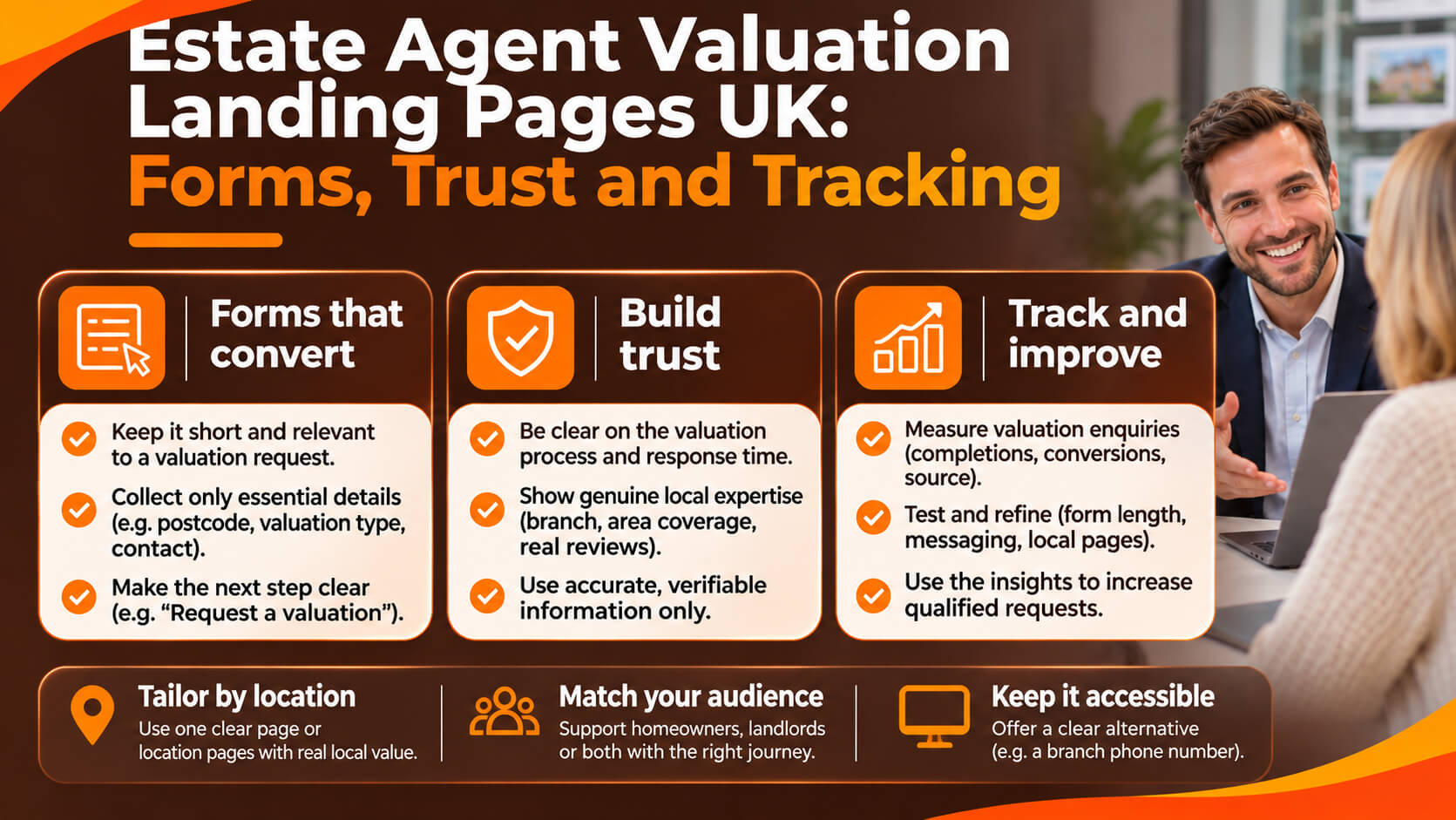
A property valuation enquiry is not the same as a viewing request or a general contact message. Agencies handling buyers separately can use our viewing request form and booking workflow guide. A homeowner considering a sale wants to know whether the agent understands the area, what kind of valuation they will receive, how much effort the next step requires and whether their details will trigger unwanted calls. An estate agent valuation landing page should answer those questions before asking for contact information.
This guide is for UK independent estate agencies and multi-branch marketing teams building a dedicated property valuation landing page. It concentrates on the page and form itself: message match, local proof, friction, accessibility, analytics and testing. It does not repeat the broader search strategy in our estate agent SEO guide or the campaign setup in our estate agent Google Ads guide.
Start with one clear valuation proposition
The first screen should say who the service is for, where it operates and what happens after the request. “Find out what your home could sell for in [area]” is clearer than “Unlock your property’s potential”. If the offer is an in-person appraisal, call it that. If it is an automated estimate, explain the estimate’s limitations and whether a local agent will subsequently contact the visitor.
A useful page title is “Request a property valuation in [town]”. Beneath it, specify whether the service is available to homeowners considering a sale, landlords seeking a rental appraisal or both. These audiences have different questions and should not be pushed into an identical follow-up journey. Do not promise a sale price, guaranteed valuation accuracy or an appointment slot you cannot substantiate.
Decide whether to use one page or separate local landing pages
A single page may work for an agency serving one compact area. A multi-branch business may benefit from location-specific pages when each offers genuine branch information, local market context and a distinct contact route. Avoid creating dozens of near-identical postcode pages simply to target keyword variations: the pages should provide additional value, not duplicate one another.
- Single branch: show the town, nearby service areas, branch address and a clear valuation request.
- Multi-branch: show the responsible office, named team where verified, relevant local experience and the correct booking workflow.
- Sales and lettings: distinguish sales appraisals from rental valuations at the first decision point.
- Paid campaigns: match the landing-page offer to the exact ad promise and geography.
- Organic search: link the page naturally from relevant local service content; avoid doorway-page patterns.
Build the page around the homeowner’s decision
1. Explain the valuation process
Say whether an agent visits the property, whether a remote appraisal is possible, what information the homeowner should prepare, and when they can expect to hear from the agency. Give a realistic response window only if operations can meet it. A transparent process reduces the uncertainty that often leads to incomplete forms.
2. Demonstrate local knowledge without invented proof
Use verifiable evidence: the branch’s coverage area, real team profiles, relevant property types and genuinely attributable reviews or case studies. If you quote sold-price data, explain its source and date. Never invent “average days to sell”, conversion rates, sale-price premiums, review scores or a local transaction count. A smaller amount of accurate proof is more persuasive than unsupported superlatives.
3. Make the next action unmistakable
Use a primary call to action such as “Request a valuation” or “Book a valuation appointment” only when that describes the next step. If submitting the form merely triggers a callback, label it “Request a valuation callback”. Keep the button visible after the value proposition and again after substantive questions, without interrupting the reading experience with repeated pop-ups.
4. Offer a reasonable alternative
Some homeowners will not complete a form, particularly on a mobile device. Offer a working branch telephone number or another accessible contact route. Explain business hours and avoid implying a call will be answered immediately outside those hours.
The minimum viable valuation form
A short form should collect enough information to route a useful request without turning the first interaction into a full property questionnaire. Decide which details are genuinely necessary for a first callback; collect further information when the appointment is arranged.
- Property postcode or location: helps route the enquiry to the right branch; do not automatically assume the person owns the property.
- Valuation type: sale or rental, if both services are offered.
- Contact name: enables a personalised reply.
- One reliable contact method: phone or email, with the other optional where operationally feasible.
- Preferred contact time: useful when the branch can honour it.
- Timing: “exploring options”, “within three months” or “ready to proceed” can help prioritise, but avoid making this mandatory without a reason.
Fields such as estimated asking price, full property description, reason for moving and personal circumstances may be useful later, but are rarely essential to establish first contact. Collecting less data can also reduce privacy risk. Explain why information is needed and how it will be used.
Single-step versus multi-step forms: choose by evidence
A single-step form exposes the full request immediately and may be easier to understand. A multi-step form can divide a complex task into manageable stages but adds navigation, validation and progress-state requirements. Neither approach universally wins. Test the design against actual completed, qualified valuation requests—not just clicks on the first step.
If using multiple steps, provide clear progress information, retain answers when users go back, make error messages specific, and avoid asking for contact details before the visitor understands what is being requested. Ensure each step works with a keyboard and screen reader. A step that appears to advance but silently loses an answer is a conversion and accessibility failure.
A model page structure for an estate agency
- Hero: “Request a property valuation in [town]”, one sentence explaining the service and a clear CTA.
- Process: three simple stages—request, contact, appraisal—with accurate expectations.
- Local expertise: branch coverage, verified team information and relevant property knowledge.
- Valuation request: accessible, concise form with a clear privacy notice link.
- Practical questions: costs, timescales, whether the owner must be ready to sell and what happens next.
- Alternative contact: branch telephone and opening hours.
- Confirmation: explicit success message and realistic next steps.
Mobile experience: test the entire journey
A page can look attractive in a desktop mock-up and still fail on the device where a homeowner first discovers the agency. Test on a narrow viewport with the keyboard open, with zoom enabled and on a slow connection. Check that the sticky header does not hide the form, that buttons are not covered by a cookie banner, and that selecting a postcode does not unexpectedly reset other fields.
Make field labels persistent rather than relying only on placeholder text. Use appropriate input types for email and telephone fields, but do not impose unnecessarily strict validation that rejects legitimate UK phone formats or unusual addresses. Tell users exactly which field needs correction and preserve their other answers.
Trust and privacy at the point of submission
A valuation request is a service enquiry, not automatic permission to send indefinite marketing emails or texts. Distinguish messages needed to respond to the requested valuation from subsequent promotional campaigns. The ICO’s electronic marketing guidance explains consent and limited soft opt-in conditions under PECR. Do not assume that every submitted valuation form qualifies for a soft opt-in.
Where marketing consent is needed, use a genuinely optional, clearly worded choice that is not bundled into accepting the valuation service. Keep a record of the wording shown and the choice made. Provide a privacy notice that explains relevant purposes, recipients and retention arrangements. Configure access to lead details so staff only see what they need.
Track successful valuation enquiries, not button clicks
The most common measurement error is treating a click on “Submit” as a lead. A form can fail validation or a server request can time out after that click. Configure analytics to register a lead only when the request is actually accepted and the user sees a successful confirmation. Google’s GA4 recommended events documentation describes the generate_lead event and subsequent lead qualification events.
A useful measurement plan
- Landing-page sessions: visits by campaign, device and location, subject to consent and measurement limitations.
- Form starts: users who begin the form; distinguish this from field focus caused by automation or autofill.
- Valid submissions: accepted requests, deduplicated where possible.
- Qualified valuation requests: enquiries within service area and relevant to the agency’s offering.
- Appointments booked: confirmed valuation appointments, not tentative call attempts.
- Appointments completed: visits that actually took place.
- Instructions won: signed agency instructions attributed to the enquiry where evidence permits.
A helpful funnel is: landing-page sessions → valid requests → qualified requests → booked appraisals → completed appraisals → signed instructions. Each stage has a different owner and potential failure point. An improved form completion rate can be misleading if it attracts a higher share of irrelevant enquiries.
Illustrative funnel calculation
Suppose a page receives 1,000 visits, 45 valid requests, 30 qualified requests, 20 booked appraisals and 8 signed instructions. The form submission rate is 45 ÷ 1,000 = 4.5%; the qualified-request share is 30 ÷ 45 = 66.7%; the instruction rate per valid request is 8 ÷ 45 = 17.8%. These are illustrative figures only, not Vistoplex performance claims or industry benchmarks.
If an experiment increases submissions from 45 to 60 but instructions remain at 8, investigate lead quality and staff capacity before celebrating the higher form conversion rate. Conversely, a shorter form may reduce irrelevant submissions while increasing the proportion that becomes booked appointments.
Connect the page to branch operations
The best landing page cannot compensate for requests that never reach the responsible team. Set up branch routing, duplicate handling, acknowledgement messages, appointment scheduling and a documented fallback for staff absence. Avoid sending a homeowner’s details to an unrelated branch merely because that branch has spare capacity.
The operational steps after form submission belong in the CRM, where ownership and outcomes can be recorded. Our estate agent CRM follow-up guide covers that wider workflow. On the landing page, the key obligation is to create an accurate, traceable handoff and set expectations the team can actually fulfil.
Five high-value experiments to run
Experiment 1: clarify the offer
Compare a vague headline against one that states the valuation type and locality. Hold the form and traffic sources constant. Look for changes in qualified requests, not just scroll depth.
Experiment 2: remove unnecessary fields
Identify fields that staff rarely use before the first contact. Test removing them while monitoring the number of completed appraisals and whether staff need to chase missing details later.
Experiment 3: explain the next step beside the form
Add a concise statement describing who will contact the homeowner, how and within what realistic window. This may reduce uncertainty and unwanted surprise, but do not invent a response-time promise.
Experiment 4: test local proof
Compare a page with generic claims against one with authentic branch-specific information and properly attributed evidence. Check that proof is current and applicable to the service area.
Experiment 5: simplify mobile errors
Audit postcode entry, autofill, phone number formatting and validation messages. Fix errors before running more traffic to a broken journey. A usability defect is not an A/B testing opportunity when it blocks users.
A 14-day implementation checklist
- Days 1–2: define the valuation offer, service area, target homeowner and actual branch response process.
- Days 3–4: draft the headline, process explanation, evidence and FAQs; verify every claim.
- Days 5–6: build the minimal form, confirmation state and alternative contact route.
- Days 7–8: complete privacy, consent, accessibility and mobile checks.
- Days 9–10: test CRM routing, duplicate handling, failed submissions and analytics events.
- Days 11–12: launch to a controlled audience and review quality of requests with branch staff.
- Days 13–14: fix friction, document the baseline and select one meaningful experiment.
A small branch may need longer to collect enough enquiries for a statistically useful comparison. Do not declare a winner from a handful of form submissions; combine quantitative data with usability observations and staff feedback.
Frequently asked questions
Should an estate agent offer a free online valuation or an in-person appraisal?
Offer only what the agency can actually deliver. Automated estimates may help visitors explore options, but they are not necessarily equivalent to a property-specific professional appraisal. Clearly distinguish the two and explain the next step.
How many fields should a valuation form contain?
There is no universally correct number. Start with the minimum needed to route and respond to the request, then test whether any additional field improves qualification enough to justify its friction.
Can the same landing page serve landlords and sellers?
It can, if the visitor can clearly select the appropriate service and see relevant expectations. Separate pages may be more useful when the offers, local proof and follow-up processes differ materially.
What is the most useful conversion metric?
Qualified valuation requests and downstream signed instructions provide more business context than raw form submissions. Track each stage separately to see whether the page or the branch process needs attention.
Should an agency automatically email every valuation enquirer marketing offers?
No. Responding to the requested service and sending unrelated promotional marketing are different activities. Review PECR and UK GDPR requirements and use appropriate consent or another valid route where applicable.
Final takeaway
A strong estate agent valuation landing page makes a specific, truthful promise and removes obstacles between a homeowner’s question and a useful conversation. Begin with accurate local relevance, an understandable process, a concise accessible form and reliable branch handoff. Measure whether those enquiries turn into appraisals and instructions before scaling advertising spend.
Editorial review: 4 November 2026. This guide provides general marketing and operational information, not legal advice. Any examples are illustrative and should be adapted to the agency’s actual processes.