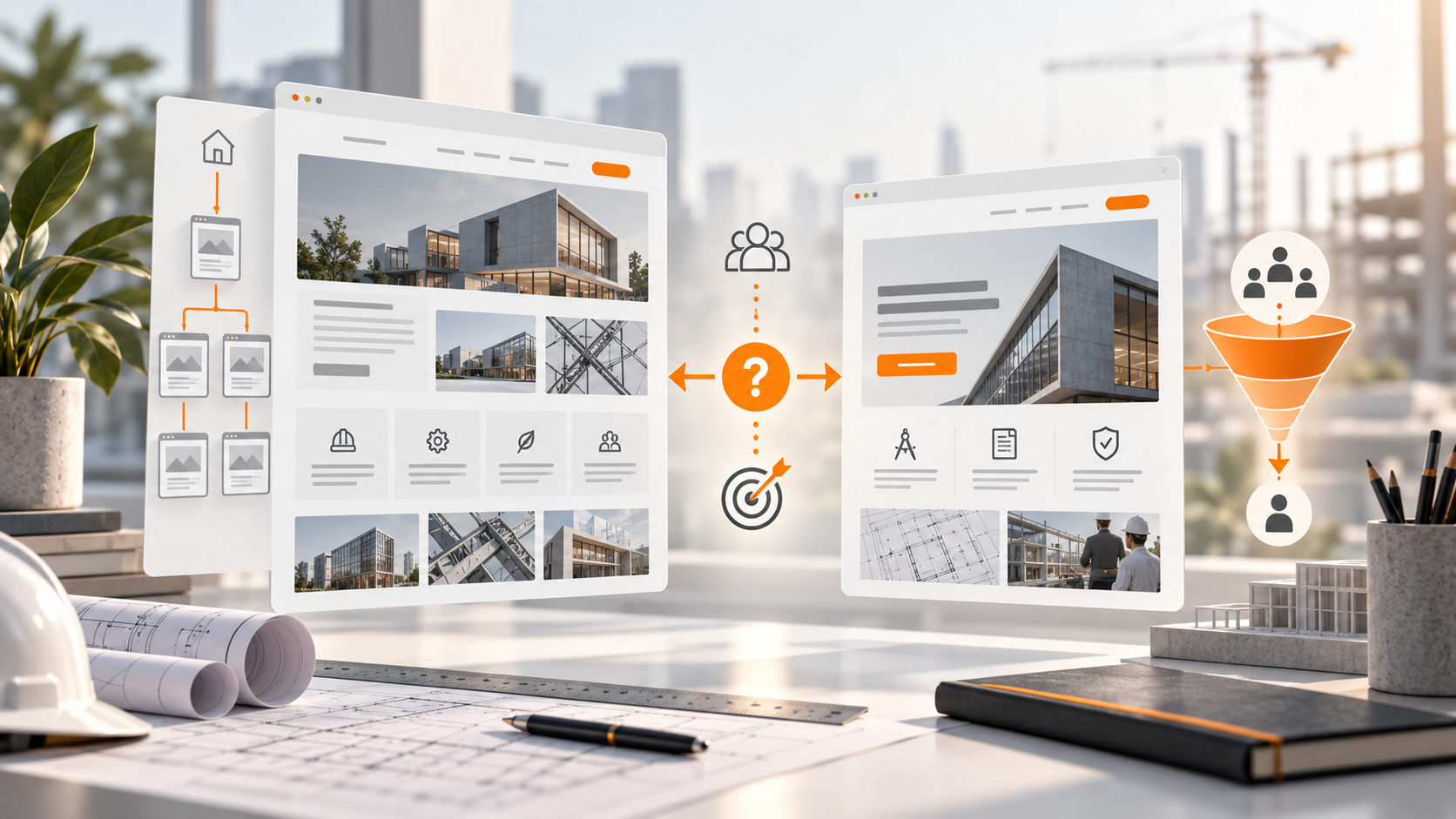
Marketing an architecture practice is not mainly a question of posting more often or buying more traffic. The harder job is making the practice easy to discover, easy to evaluate and easy to contact for the kinds of projects it actually wants to win.
This guide is for UK architecture practice owners, directors and marketing leads who want a more deliberate route from visibility to qualified project enquiries. If you are looking for agency support rather than a DIY framework, see our digital marketing services for architects.
What makes marketing for architects different?
Architecture is a considered purchase. A homeowner may research for months before choosing a practice. A developer, contractor or institutional buyer may assess sector experience, delivery capability and team credibility before a formal brief is issued. That means one advert or one social post rarely does the whole job.
Most practices need their marketing to support four stages:
- Discovery: being found for relevant services, locations, project types and specialist expertise.
- Evaluation: showing projects, process, people and evidence that match the buyer’s problem.
- Shortlisting: making the practice’s positioning and suitability clear enough to compare confidently.
- Enquiry: giving the prospect a sensible next step, whether that is a consultation, project brief, capability request or fee proposal.
The most useful marketing plan therefore starts with the projects the practice wants more of, not with a channel checklist.
1. Define the project mix before choosing channels
A residential studio seeking extensions and whole-house renovations needs a different acquisition system from a commercial practice pursuing workplace, healthcare or education commissions. The first step is to define the work that is commercially and strategically valuable.
For each priority project type, document:
- the buyer or appointing organisation
- typical geography
- project value or fee potential
- common triggers that start the search
- questions and risks considered before appointment
- proof the practice can genuinely provide
- the most useful next action
This prevents a common problem: a website that says the practice can do almost anything, while giving a prospective client no clear reason to believe it is especially suitable for their project.
2. Make the website useful before sending more traffic
An architecture website can be visually excellent and still underperform commercially. Image-led design is not the problem. The problem is when the visitor has to infer the services, sectors, locations and relevance of the work from a gallery alone.
A strong architecture website normally needs clear routes to:
- services and appointment scope
- project types or sectors
- genuine locations or service areas where relevant
- project case studies
- team and credentials
- process and common questions
- contact or project-brief submission
Turn portfolio pages into decision-support pages
Project pages should remain visually led, but they should also explain enough for a prospective client to judge relevance. Useful context includes the project type, location, client objective, constraints, the practice’s role, design response and outcome.
Instead of a page that says only “Townhouse renovation, London”, explain what made the project difficult and what the practice was appointed to solve. That additional context helps both prospective clients and search engines understand why the work matters.
For a deeper search-specific framework, read our SEO for Architects UK guide. If the question is whether to rebuild the whole website or use a focused campaign page, see our website redesign vs landing pages guide for architects and engineers.
3. Use SEO to capture existing demand
SEO is most useful when potential clients already search for the service, project type, location or problem. Architecture practices often have more search opportunities than they realise because their expertise is hidden inside project names rather than expressed through pages that match buyer language.
A practical keyword and page map may include:
| Intent | Example | Best destination |
|---|---|---|
| Service + location | residential architect Bristol | Relevant service/location page |
| Specialist capability | listed building architect | Specialist service page |
| Project type | house extension architect | Project-type page |
| Sector | healthcare architects | Sector page |
| Research question | how to choose an architect | Guide or explainer |
The goal is not to create a page for every keyword variation. Group searches around genuine services and buying needs, then make the most relevant page strong enough to answer them.
Local SEO only where the practice genuinely operates
Location targeting can be valuable for residential and regionally focused practices, but it should reflect real service areas. A useful local page needs distinct information: relevant project types, local work, planning or building context where appropriate and a truthful explanation of how the practice serves the area. Thin town pages copied across dozens of locations are a poor substitute for local relevance.
4. Use Google Ads when speed and testing matter
Google Ads can complement SEO by capturing active demand while organic visibility develops, or by testing whether a particular project type or location produces worthwhile enquiries before larger investment.
For architects, paid search normally works better when campaigns are segmented tightly. Residential extensions, planning support, conservation work and commercial services should not be mixed into one generic campaign if the economics and buyer journeys differ.
Useful controls include:
- high-intent keywords rather than broad architecture terms
- strong negative-keyword lists to exclude students, jobs and irrelevant research
- location settings matched to where work can genuinely be delivered
- landing pages matched to the project type
- call and form tracking
- lead-quality feedback, not just conversion counts
See our Google Ads services if paid search is the immediate priority.
5. Give LinkedIn and Instagram different jobs
Architecture practices often treat social media as one activity. LinkedIn and Instagram usually perform different roles.
Instagram is naturally suited to visual storytelling: completed projects, materials, sketches, site progress, details and studio culture. It helps people become familiar with the practice and its design character.
LinkedIn is typically more useful for professional visibility: sector commentary, commercial projects, team expertise, developer and contractor relationships, recruitment and wider built-environment conversations.
Neither platform should be judged only by likes. Useful questions are whether the right people are seeing the work, whether the content strengthens later brand searches and whether it assists conversations that matter commercially.
6. Publish content that helps a client make a decision
Generic “architecture trends” articles are easy to produce and easy to ignore. Stronger content sits close to the questions a prospective client asks before appointment.
Examples include:
- what happens during feasibility and concept design
- how to prepare for an initial architect consultation
- what affects architect fees
- planning considerations for a particular project type
- how listed-building or conservation constraints change a project
- retrofit and energy-performance trade-offs
- what a commercial client should include in a brief
- how the practice approaches a specialist sector
The strongest material usually comes from questions already answered in meetings, proposals, project reviews and technical conversations. Marketing should extract that expertise rather than manufacture generic commentary around it.
7. Treat case studies as proof, not decoration
A case study should help a future client understand whether the practice has solved a comparable problem. That means it needs more than final photographs.
A useful structure is:
- Brief: what the client needed.
- Constraints: planning, heritage, site, programme, budget or stakeholder issues.
- Role: what the practice was appointed to do.
- Response: the important decisions and why they were made.
- Outcome: what changed or was delivered, using only evidence the practice can substantiate.
- Next step: the relevant service or enquiry route for a similar prospect.
Avoid invented performance numbers or exaggerated sustainability claims. The value of a case study is the specificity of the real work.
8. Improve enquiry handling before scaling lead volume
Marketing performance can be lost after the form is submitted. If enquiries sit in a shared inbox, receive inconsistent responses or are not classified by project type, the practice may not know which channels actually produce useful opportunities.
A simple enquiry system should record:
- source
- project type
- location
- estimated timing
- fit with the practice
- consultation or proposal status
- reason for rejection where appropriate
Automation can help with routing, acknowledgements and reminders, but the commercial judgement about whether a project is suitable should remain with the practice. See our AI automation services for workflow support.
9. A practical 90-day marketing plan for an architecture practice
| Period | Priority | Useful output |
|---|---|---|
| Days 1–30 | Define demand and fix foundations | Priority project map, measurement baseline, technical issues and core page plan |
| Days 31–60 | Improve commercial pages and proof | Stronger service pages, upgraded project pages, internal links and enquiry routes |
| Days 61–90 | Build demand and test channels | Search content, controlled paid tests, social distribution and lead-quality review |
The objective is not to “finish marketing” in 90 days. It is to establish a system that reveals what deserves more investment.
10. Measure project quality, not marketing activity
Traffic, impressions, rankings and engagement are diagnostic metrics. The commercial questions come later in the journey.
Where systems permit it, track:
- qualified project enquiries
- enquiries by project type and location
- consultation bookings
- fee proposals or tender invitations
- cost per qualified enquiry for paid activity
- which project and service pages assist enquiries
- reasons unsuitable leads are rejected
This makes it possible to improve the marketing towards the work the practice actually values, rather than optimising for whichever channel generates the easiest form fills.
Frequently asked questions
What is the best marketing strategy for architects?
There is no single best channel. Most practices need a combination of clear positioning, a strong portfolio website, search visibility, credible project evidence and reliable enquiry follow-up. The right mix depends on the buyers and project types the practice wants to win.
Do architects need SEO?
SEO is valuable when prospective clients search for the practice’s services, locations, sectors or project types. It also supports referred prospects who search the practice before deciding whether to make contact. Read our dedicated architect SEO guide for the implementation detail.
Do Google Ads work for architecture firms?
They can work when there is active search demand and campaigns are tightly controlled. Project types, geography, negative keywords, landing pages and lead-quality feedback matter more than simply increasing clicks.
Should architects use Instagram or LinkedIn?
Both can be useful for different reasons. Instagram is strong for visual familiarity and project storytelling. LinkedIn is usually more useful for professional relationships, commercial audiences and sector expertise.
How should an architecture practice measure marketing?
Track visibility and engagement, but continue through to qualified enquiries, consultations, proposals and project mix where the practice’s systems allow it. Marketing should be judged by the quality of opportunities it helps create.
Where to start
Choose the two or three project types the practice most wants to win. Then review whether a prospective client can find those services, see relevant proof and understand the next step within a few minutes of arriving on the website. That exercise usually reveals the highest-value marketing work faster than another generic content calendar.
If you want Vistoplex to review the complete acquisition journey, visit our architecture marketing agency page or contact us.