SEO for aesthetic clinics in the UK is not simply a matter of ranking treatment names. A clinic must help people find a genuine local provider, understand who is responsible for their care, assess whether a consultation is appropriate and make an enquiry without encountering misleading medical claims. For some treatments, advertising restrictions also change which pages and keywords can be used at all.
This practical guide is for owners and marketing managers of UK skin, laser, medical-aesthetics and cosmetic clinics. It focuses on clinic-specific local search, compliant content decisions and consultation measurement. For a wider checklist covering salons, beauty ecommerce and other businesses, see Vistoplex’s health and beauty SEO guide. For a separate paid-search workflow, see our Google Ads for UK aesthetic clinics guide, covering CAP rules, campaign eligibility, budgets and consultation tracking.
Important scope note: This is a marketing and website planning guide, not clinical, legal or regulatory approval. A qualified clinical lead and appropriately informed compliance adviser should approve treatment-specific material before publication. Rules can vary by treatment, setting and UK nation.
Start with a compliance gate, not a keyword list
A common SEO mistake is to turn every popular search into a promotional treatment page. In aesthetic medicine, that can be unsafe or non-compliant. Before assigning any query to a page, decide what the clinic is legally and professionally permitted to say, whether the content is promotional, and who will sign it off.
The Advertising Standards Authority’s CAP guidance on prescription-only medicines explains that CAP Code rule 12.12 prohibits advertising prescription-only medicines (POMs) to the public, including promotional website content. Botulinum toxin products are a particularly important example. The CAP Botox guidance explains the narrow circumstances for purely informational website references; it is not permission to build promotional, keyword-targeted POM landing pages. Indirect euphemisms can also be problematic.
| Proposed content | Editorial decision | What to do next |
|---|---|---|
| Clinic location, opening hours, directions and contact information | Generally useful business information | Verify facts, profile eligibility and the real premises. |
| Practitioner biography and qualifications | Potential trust information | Verify registration, credentials and any protected professional titles. |
| Information about a non-POM service | Requires claims and audience review | Check evidence, clinical approval and applicable CAP rules before publication. |
| Promotional page targeting a prescription-only injectable | High-risk; do not publish as an SEO tactic | Seek specialist compliance advice; do not work around the restriction with euphemisms. |
| Consultation process and suitability assessment | Potentially useful decision support | Describe the genuine process without promising a treatment or outcome. |
| Before-and-after images or testimonials | Visual and testimonial claims require scrutiny | Verify consent, authenticity, context, substantiation and advertising compliance. |
CAP’s cosmetic interventions advertising guidance also covers unrealistic claims, responsibility and restrictions on targeting under-18s. These considerations apply to the substance of the message, not only paid advertising.
Map patient search intent to the correct type of page
The right page depends on what a person is trying to learn or do. Someone checking a clinic’s address needs a location page; someone comparing practitioner experience needs a biography; someone researching a procedure may need balanced, professionally reviewed educational material. Do not create a separate page for every spelling variation.
| Search intent | Appropriate page owner | What the page should answer |
|---|---|---|
| Clinic name or ‘clinic near me’ | Homepage and genuine location page | Where is it, how do I contact it, and who works there? |
| Non-POM service available at the clinic | Relevant service page, subject to advertising review | What is the service, who assesses suitability and what happens at consultation? |
| Concern or condition research | Clinically reviewed educational guide | What should someone consider, including uncertainty and when to seek qualified advice? |
| Practitioner name or qualifications | Individual practitioner profile | Who is the professional and what credentials can be verified? |
| Prices and consultation process | Accurate pricing/consultation information | What is included, what affects the quote and how is suitability assessed? |
| Travel, accessibility or opening hours | Actual clinic location page | How can someone reach and use this specific location? |
One intent should have one clear primary page. If a clinic already has a strong service page, improve it rather than creating a blog article that repeats the same commercial pitch. For generic search and page-structure fundamentals, the UK local SEO guide provides broader background.
Build a location presence that reflects the real clinic
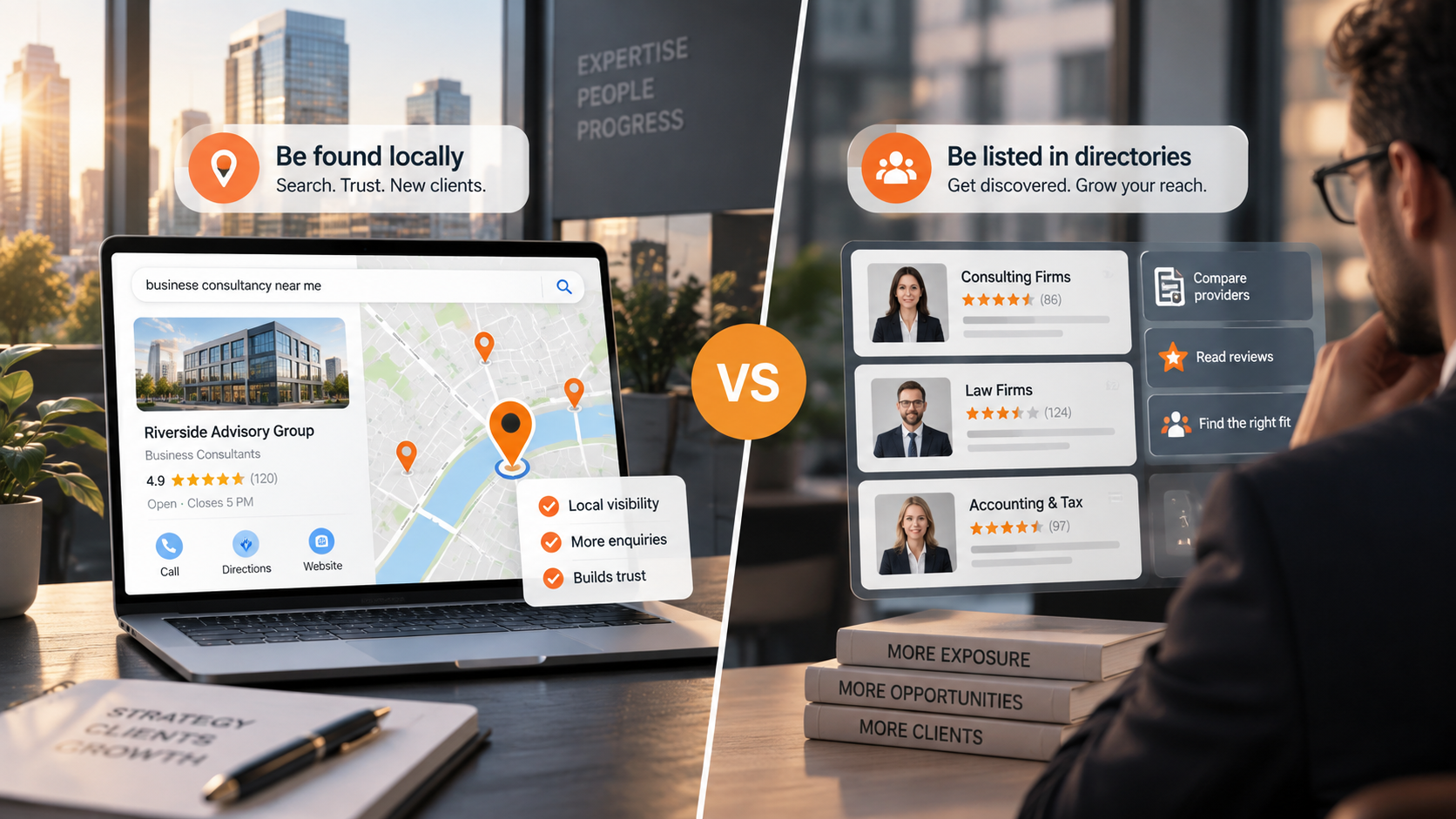
For physical clinics, local discovery can be central to consultation enquiries. Google says local ranking is primarily influenced by relevance, distance and prominence, not by buying a ranking position. See Google’s official local-ranking explanation. A marketing agency cannot change the distance between a clinic and the person searching.
Google Business Profile checklist
- Verify and maintain the correct business name, address, phone number, opening hours and website link.
- Choose categories that accurately describe the business; do not add categories merely because they contain popular keywords.
- Use real photographs of the premises, access route and team where permission is held.
- Keep appointment links and service information accurate, subject to applicable advertising restrictions.
- Respond professionally to genuine reviews without disclosing patient relationships or treatment information.
- Review duplicates, former locations and practitioner listings before creating another profile.
- Keep the location page consistent with the real-world premises and business details.
Avoid mass-produced pages implying that a clinic operates in neighbouring towns where it has no premises. A genuine second clinic deserves its own location information; a catchment area does not automatically justify dozens of near-identical location pages.
What to put on an individual clinic location page
Include the real address, accessible directions, opening hours, contact route, services available there, practitioner details when appropriate, parking or public-transport information, and a clear way to request a consultation. If services differ between branches, say so. An original photograph of the entrance can be more helpful than a generic treatment image.
Make practitioner credibility verifiable
Search visibility and patient trust both suffer when the site is vague about who delivers a service. Practitioner profiles should use accurate names, roles, relevant qualifications and any registrations that the clinic can verify. Avoid implying that all aesthetic practitioners have the same regulated status or that every cosmetic procedure is CQC-regulated.
The Care Quality Commission explains which cosmetic services it regulates in England. It explicitly does not regulate every non-surgical cosmetic treatment, including certain injections, chemical peels and laser or IPL treatments. Do not describe a non-regulated service as CQC-approved. Registration and regulatory scope should be checked against the actual provider and activities.
- Provide a named clinical reviewer for medically substantive pages, where appropriate, and show a truthful review date.
- Link to the practitioner’s genuine profile and relevant public registration information when applicable.
- Describe the consultation, suitability assessment, possible alternatives and aftercare process accurately.
- Avoid unverified superlatives such as ‘the UK’s safest clinic’ or ‘guaranteed results’.
- Explain how clinical questions are handled by appropriately qualified people rather than a generic marketing chatbot.
Create educational content around decisions, not promotional workarounds
Useful educational topics include how consultations work, what information to prepare, the difference between a consultation and a procedure, questions to ask a practitioner, how aftercare is arranged and how a clinic assesses whether a service is appropriate. Treatment-specific clinical advice needs expert authorship or review and should avoid presenting general information as an individual diagnosis.
A sound article structure answers the reader’s question early, distinguishes established facts from uncertainties, explains when a clinician must make the decision, and provides links to authoritative information. It does not use a question-led article as a disguised advertisement for a prescription-only product.
Example: a consultation information page
- Explain what the consultation is for and who carries it out.
- State what information a patient may be asked to provide and why.
- Describe how suitability, alternatives and risks are discussed without promising a particular treatment.
- Explain any consultation charge, cancellation terms and how follow-up works.
- Offer a private contact route and clarify that the page is not personalised medical advice.
This format can serve genuine search intent without manufacturing a treatment outcome or relying on exaggerated imagery.
Check photographs, reviews and patient privacy
Aesthetic clinic websites often rely heavily on imagery. CAP’s guidance on before-and-after photographs warns that images may make efficacy claims and can mislead if results are exaggerated or insufficiently substantiated. Consent to use a photograph is necessary for privacy and permissions, but consent alone does not make a marketing claim compliant.
For reviews, do not reveal whether a reviewer received a particular treatment when replying publicly. A simple acknowledgement that does not confirm clinical details is safer than repeating the treatment name or discussing an outcome. Do not offer incentives for selectively positive reviews or invent testimonials.
Treat enquiry tracking as a health-data design problem
A consultation form may collect information about symptoms, medical history or intended treatment. The ICO explains that health data can be special-category personal data. Such processing needs an appropriate lawful basis and an applicable Article 9 condition where required, as well as proportionate security and transparency. A generic marketing consent checkbox is not a substitute for this assessment.
For SEO measurement, use the least sensitive information needed. A useful distinction is between aggregate marketing events (such as a form successfully submitted) and clinical information (such as the condition, treatment interest or notes entered into that form). Do not routinely pass the latter to analytics, advertising platforms or unrestricted automation tools.
A safer measurement specification
| Event | Useful reporting detail | Privacy control |
|---|---|---|
| Organic landing-page visit | Landing page and aggregate source | Apply appropriate analytics and consent controls. |
| Consultation form submitted | Success event and page path | Do not send form contents or health details to analytics. |
| Phone contact action | Aggregate click or approved call attribution | Avoid exposing call recordings or patient details in marketing dashboards. |
| Consultation booked | Count of confirmed bookings by channel where lawful | Use limited identifiers and role-based CRM access. |
| Consultation attended | Aggregate funnel stage | Keep clinical record details in appropriate clinical systems. |
| New client/patient acquired | Aggregated acquisition outcome | Review data-sharing, retention and re-identification risks. |
Do not treat a click on a booking button as a completed appointment. Report the stages separately so that a high volume of clicks cannot be mistaken for a high volume of attended consultations.
Technical SEO: remove obstacles before adding articles
A clinic can have excellent clinical content and still struggle in search if important pages are not indexable, are duplicated or are hard to use on mobile. Prioritise the pages with genuine local or consultation intent.
- Check that priority URLs return HTTP 200, are crawlable and do not accidentally contain noindex directives.
- Use canonical URLs consistently, especially where appointment software creates alternate URLs.
- Keep an accurate XML sitemap and internal HTML links to the pages that matter.
- Test mobile navigation, form completion and booking journeys on real devices.
- Compress images without removing necessary clinical context or creating misleading before-and-after comparisons.
- Use concise, descriptive image alt text. Alt text is not a loophole for promoting restricted medicines.
- Apply relevant structured data accurately; do not add fabricated ratings, credentials or reviews.
- Review whether third-party booking widgets prevent meaningful conversion measurement or introduce privacy risks.
Google’s LocalBusiness structured-data documentation explains supported properties and validation. Schema can help describe a genuine business, but it does not guarantee a rich result or higher rankings. Mark up what is visible and accurate; do not add medical credentials or treatment claims solely for search engines.
Use a consultation-quality scorecard
SEO success should not be judged only by rankings for popular treatment phrases. A clinic needs to understand whether its website is helping suitable people reach the right professional and make informed enquiries. Keep the reporting proportional to the privacy risks.
| Measure | Why it matters | Review question |
|---|---|---|
| Non-branded organic impressions | Shows discovery beyond existing brand demand | Which compliant pages are being found? |
| Relevant organic landing pages | Identifies pages that attract useful intent | Are searchers arriving at the right location or information page? |
| Consultation requests | Captures a real next step | Are forms and calls measured without sensitive details? |
| Confirmed bookings | Separates enquiries from appointments | Which source-to-booking steps are failing? |
| Attended consultations | Adds operational quality | Are staff capacity and response times appropriate? |
| Qualified enquiries | Reflects suitability and service fit | Is the clinic receiving enquiries it can appropriately assess? |
| Privacy and compliance exceptions | Prevents growth reporting from hiding risk | Did any content or data transfer need correction? |
Worked example: distinguish enquiries from appointments
Hypothetical example, not Vistoplex client results or a market benchmark: A clinic receives 120 organic consultation enquiries in a month. Of those, 60 result in confirmed appointments and 45 are attended. The enquiry-to-booking rate is 60 ÷ 120 = 50%; the booked-to-attended rate is 45 ÷ 60 = 75%. A page generating 30 enquiries and two attended appointments may need a different intervention from one generating 12 enquiries and eight attended appointments.
Those calculations describe funnel stages, not clinical suitability or treatment outcomes. Do not make individual clinical decisions from a marketing score.
A realistic 30-day SEO implementation plan
Week 1: inventory and compliance triage
Export the main pages, identify the real locations and practitioners, and list the search intents each page serves. Have the clinical/compliance lead review promotional claims, restricted-medicine references, imagery and patient-data flows. Flag anything that should be corrected or removed before further promotion.
Week 2: fix the highest-value local pages
Verify the Google Business Profile, correct opening and contact details, improve the real location page and test the consultation journey on mobile. Add accurate practitioner and consultation information where missing. Resolve duplicate or misleading location pages.
Week 3: improve content and technical foundations
Strengthen two or three priority pages with verifiable answers and useful internal links. Fix indexability, broken links, form errors and major mobile issues. Submit the intended URLs in the sitemap and review Search Console evidence; do not assume that submitting a URL guarantees indexing.
Week 4: test reporting and choose the next work
Check that organic landing-page reports and aggregate consultation events are functioning without leaking health details. Review impressions, page intent, confirmed appointments and compliance exceptions. Select the next month’s work based on actual gaps rather than publishing an arbitrary number of posts.
Questions to ask an aesthetic clinic SEO agency
- Can you explain how you distinguish permitted service content from promotion of prescription-only medicines?
- Who approves clinical claims, practitioner credentials and before-and-after imagery?
- How will you improve our genuine location pages and Business Profile without creating fake premises?
- Will you audit existing content and cannibalisation before proposing new URLs?
- How will you protect sensitive enquiry information in analytics and CRM integrations?
- Can you show the deliverables for technical fixes, content reviews and monthly reporting?
- How will you measure consultation quality without claiming to measure clinical outcomes?
- What happens when an SEO recommendation conflicts with clinical or advertising requirements?
A supplier should be able to say no to an unsafe keyword tactic. Vistoplex’s aesthetic clinic marketing overview describes the wider work across SEO, websites and consultation journeys. The health and beauty lead-generation playbook addresses what happens after someone discovers the business.
Frequently asked questions
How is SEO for aesthetic clinics different from salon SEO?
Medical-aesthetics content can involve treatment claims, regulated professional titles, prescription-only medicines and sensitive patient data. A salon may have different advertising and data obligations. Both need useful local pages, accurate business information and a working booking journey, but the editorial approval process should reflect the actual service.
Can an aesthetic clinic use Botox as an SEO keyword?
Do not create promotional pages or metadata targeting Botox or other prescription-only medicines to the public. CAP’s guidance describes very limited circumstances for non-promotional website information. A clinic should seek specialist compliance advice for any proposed reference and must not use indirect wording to evade the prohibition.
Does every aesthetic clinic need CQC registration?
No. CQC regulation in England depends on the activities and setting, and it does not cover all cosmetic treatments. Check the provider’s actual regulated activities and the applicable regulator; other UK nations have different frameworks.
How many location pages should a clinic create?
Create useful pages for genuine premises and materially distinct locations. Do not generate dozens of thin pages implying the clinic operates in towns where it has no site. A single strong location page may be sufficient for a one-premises business.
Will LocalBusiness schema make the clinic appear in the map pack?
No. Structured data can describe the business to search engines, but Google does not guarantee enhanced results or map rankings. Accurate profiles, relevant content and genuine local prominence remain important.
What should be tracked as an SEO conversion?
Track an appropriate aggregate event such as a completed consultation request, and separately measure confirmed bookings and attendance where lawful. Avoid sending medical history, treatment details or other special-category information to general marketing analytics tools.
How long does aesthetic clinic SEO take?
There is no reliable universal timetable. Existing site quality, competition, the clinic’s location, technical issues and content approval requirements all affect progress. Agree measurable milestones for fixes, indexing, relevant discovery and consultation quality rather than a guaranteed ranking date.
Editorial methodology: This guide synthesises publicly available Google Search and Business Profile documentation, ASA/CAP advertising guidance, CQC information and ICO data-protection guidance. Illustrative metrics are explicitly hypothetical. It does not claim clinical authorship or legal sign-off. Content owners should recheck the source guidance before implementing treatment-specific recommendations.