

AI is changing creative work, but not in the simple way many people think.
It is not just about asking a tool to write a caption, generate an image or create a first draft. The bigger shift is happening around the workflow itself.
For small businesses, agencies and in-house marketing teams, creative work usually involves many small steps: collecting a brief, researching the audience, writing ideas, designing assets, getting approval, scheduling content, tracking performance and making improvements.
Before AI automation, those steps were often handled manually. A team member would copy information from an email into a document, rewrite a brief, chase approval, prepare social posts, update a spreadsheet, check campaign performance and then repeat the same process again next week.
AI automation changes that. It connects the creative process from start to finish.
“The biggest shift we are seeing is that AI is no longer just helping businesses create content faster. It is helping them connect the entire creative workflow — from enquiry and brief creation to content drafts, approvals, scheduling and reporting. For small businesses, the real value is not replacing people, but reducing the wasted time between idea and delivery.”
The result is not creativity without humans. It is creative work with less admin, fewer delays and more time for judgement, strategy and quality control.
For small businesses, that can be the difference between having good ideas and actually getting them live.
What is an AI creative workflow?
An AI creative workflow is a structured process where artificial intelligence and automation tools help move creative work from idea to delivery.
That can include:
- Turning enquiry forms into creative briefs
- Summarising client notes or call transcripts
- Generating first-draft content ideas
- Creating headline, caption or advert variations
- Routing work for approval
- Scheduling approved content
- Monitoring performance
- Creating follow-up tasks based on results
The important point is that AI does not need to own the final decision. In a well-built workflow, AI handles the repetitive parts and humans control the direction.
For a small business, that balance matters. The goal is not to publish more weak content. The goal is to reduce the time lost between idea, approval and execution.
The old creative workflow was too slow for small teams
Most small businesses do not have a full creative department.
A founder, marketing manager, office manager or agency partner may be responsible for social media, website updates, email campaigns, blog planning, advert copy and customer follow-up.
That creates a familiar problem: creative work gets stuck between other tasks.
A simple campaign can involve:
- Collecting information from the business owner
- Turning that information into a usable brief
- Researching the audience or offer
- Creating content ideas
- Writing copy
- Designing or selecting visuals
- Sending everything for approval
- Making revisions
- Scheduling the content
- Checking performance later
None of those steps is impossible. The issue is the friction between them.
A campaign may sit in someone’s inbox for three days. A good idea may never become a post because nobody has time to format it. A lead magnet may be written but never promoted. A client testimonial may be collected but never turned into useful website or social content.
AI automation helps by removing the unnecessary waiting time between each stage.
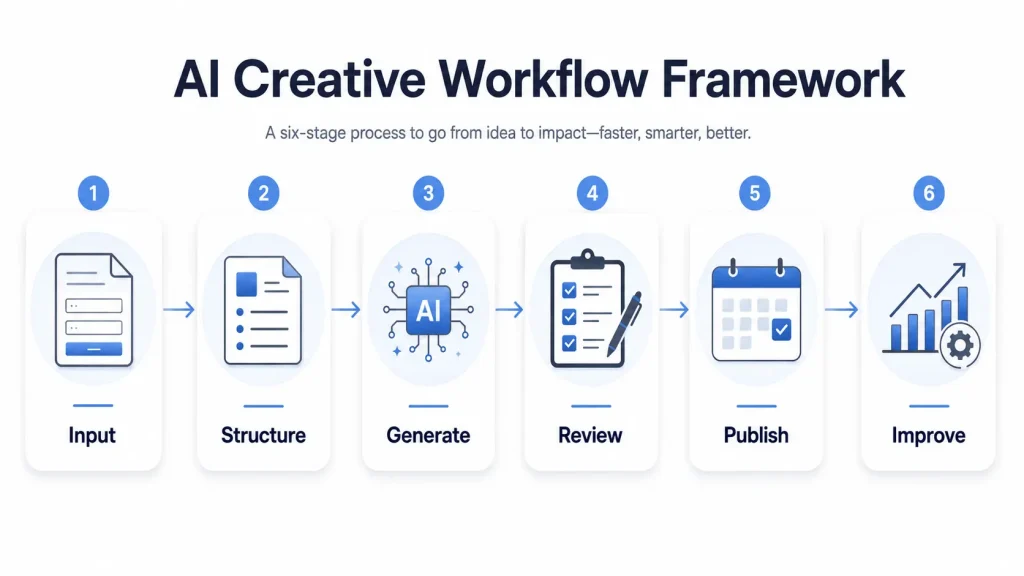
The Vistoplex AI Creative Workflow Framework
A strong AI creative workflow usually has six stages:
| Stage | What happens | Why it matters |
|---|---|---|
| Input | The idea, enquiry, brief or campaign goal is collected | Nothing gets lost in emails, chats or meetings |
| Structure | Messy notes are turned into a clear creative brief | The team starts with organised information |
| Generate | AI creates first-draft content, visuals, headlines or campaign ideas | Teams can explore more options faster |
| Review | Humans check accuracy, tone, claims and brand consistency | Quality and judgement stay in the process |
| Publish | Approved content is scheduled or sent to the right channel | Work moves from draft to delivery |
| Improve | Results are reviewed and fed into the next campaign | Future content becomes more informed |
This is what separates basic AI content creation from proper AI automation.
The goal is not just to create more content. The goal is to make the full creative process faster, clearer and easier to manage.
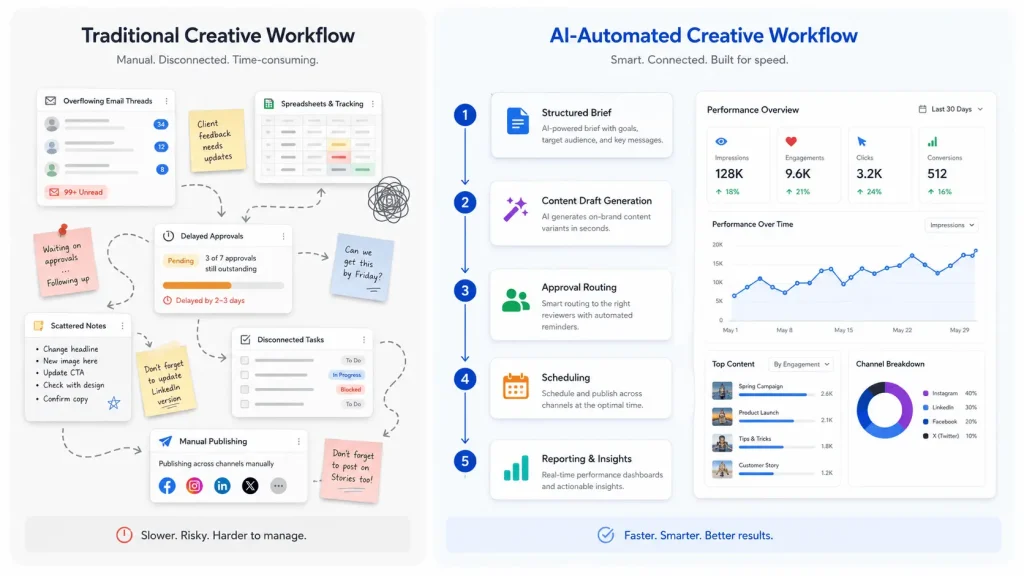
Traditional workflow vs AI-automated workflow
| Traditional Creative Workflow | AI-Automated Creative Workflow |
|---|---|
| Briefs are collected manually | Forms and notes are turned into structured briefs |
| Content starts from a blank page | AI creates first drafts and options |
| Approvals happen by email or chat | Review tasks are routed automatically |
| Content is published manually | Approved content can move into scheduling workflows |
| Reports are checked occasionally | Performance summaries can be generated automatically |
| Ideas often get lost | Ideas become repeatable workflows |
| Teams spend time copying information between tools | Systems move information automatically |
| Creative work depends on memory and manual follow-up | Tasks, reminders and next steps are triggered automatically |
This is why AI automation is becoming so useful for small businesses. It does not only help with the creative asset. It helps with the work around the asset.
AI automation turns loose ideas into usable briefs
One of the biggest creative bottlenecks is the brief.
Small businesses often have useful ideas, but those ideas are usually scattered across emails, WhatsApp messages, meeting notes, website forms and voice notes.
AI can help turn that messy input into a structured brief.
For example, a form submission could automatically create a brief with:
- Campaign objective
- Target audience
- Product or service focus
- Key selling points
- Tone of voice
- Required channels
- Deadline
- Approval contact
- Missing information
Instead of starting from a blank page, the team starts with an organised draft.
This does not remove the need for thinking. It simply means the first version of the brief is ready faster. A human can then check whether the objective is right, whether the angle is strong and whether anything important is missing.
For small teams, that alone can save hours each week.
AI makes first drafts faster, but human judgement more important
AI can produce first drafts quickly. That includes blog outlines, landing page sections, social captions, video scripts, advert variations, email subject lines and campaign ideas.
But first drafts are not the same as final work.
The value of AI is that it gives the team something to react to. Instead of spending an hour trying to create the first version, the team can spend that hour improving the direction.
That changes the role of the creative person.
The job becomes less about producing every sentence manually and more about asking:
- Is this accurate?
- Does this sound like the brand?
- Is the offer clear?
- Is the tone right for the audience?
- Is the claim safe and realistic?
- Is this useful, or just more content?
- Would a real customer trust this?
This is where human judgement becomes more important, not less.
AI can generate options. It cannot fully understand a business’s reputation, customer expectations, legal risk, commercial priorities or long-term brand positioning.
That is why the best creative workflows use AI for speed and humans for standards.
Creative teams can test more ideas before committing
Traditional creative production often forces teams to commit too early.
If every design, headline or campaign concept takes hours to produce, businesses naturally limit the number of options they test. They choose one or two ideas, polish them heavily and hope they work.
AI changes that by making early experimentation cheaper.
A small business can quickly test:
- Five landing page headlines
- Ten social media hooks
- Three email angles
- Multiple advert descriptions
- Different calls to action
- Several content structures
- Different audience pain points
The team can then choose the strongest direction before spending time on final production.
This is particularly useful for paid advertising, SEO titles, social media, email campaigns and landing pages. Instead of guessing one message, the business can explore multiple angles and select the one most likely to work.
The benefit is not just speed. It is better decision-making.
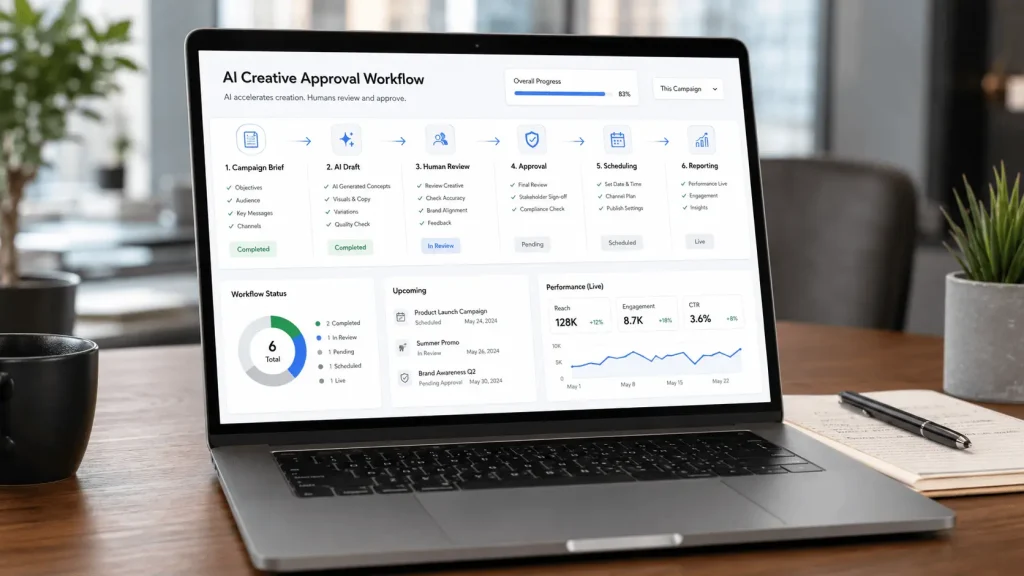
AI automation connects content creation with approval
Many creative workflows fail at the approval stage.
The content is created, but then it sits waiting for feedback. Someone forgets to reply. The wrong version is reviewed. A decision is made verbally but never recorded. The final file gets lost in a chat thread.
AI automation can make approval workflows cleaner.
For example, once a blog, advert or social post is drafted, the system can:
- Notify the correct reviewer
- Attach the right file or preview
- Set a deadline
- Ask for approval, rejection or requested changes
- Record the decision
- Send revision tasks back to the creator
- Move approved content to the scheduling stage
This matters for small businesses because creative delays are often not caused by the writing or design itself. They are caused by unclear handovers.
A simple automated approval workflow can stop content getting stuck.
AI helps turn one idea into many useful assets
Small businesses rarely need one piece of content in isolation.
A good blog post can become:
- A LinkedIn post
- A short email
- A video script
- A carousel outline
- A Google Business Profile update
- An FAQ section
- A sales follow-up
- A landing page section
Without AI, repurposing often gets ignored because everyone is busy.
With AI automation, a published blog can trigger a repurposing workflow. The system can draft channel-specific versions, prepare them for review and create tasks for scheduling.
The key is to avoid copying the same message everywhere.
A LinkedIn post should not read like a blog extract. An email should not sound like a social caption. A landing page section should be more direct and conversion-focused.
AI can create the first version of each asset, but a human should still adapt it for the channel.
AI automation improves consistency across campaigns
In small businesses, consistency is difficult.
One week the tone is formal. The next week it is casual. One landing page says one thing. A sales email says another. Social posts use different claims from the website. A paid advert promises something the team does not usually say.
That inconsistency can reduce trust.
AI can help by checking content against brand rules before it goes live.
A workflow can review draft content for:
- Tone of voice
- Banned phrases
- Required disclaimers
- Service accuracy
- Brand terminology
- Reading level
- Repeated claims
- Missing calls to action
- Inconsistent pricing or turnaround promises
This does not guarantee perfection, but it creates a useful safety layer.
For businesses in sectors such as finance, healthcare, legal services, education, property and professional services, this is especially important. Creative speed is useful only if quality and accuracy are protected.
AI does not replace creative strategy
AI automation is powerful, but it should not be confused with strategy.
A tool can suggest campaign ideas. It can draft content. It can organise tasks. It can summarise data. It can help produce variations quickly.
But it cannot decide what your business should stand for.
It cannot fully know:
- Which customers are most profitable
- Which services you want to prioritise
- Which promises you can safely make
- Which markets you want to enter
- Which tone will build trust
- Which risks are worth avoiding
- Which opportunities fit your long-term positioning
Those decisions still belong to people.
The businesses that benefit most from AI are not the ones that automate everything blindly. They are the ones that use AI to remove low-value work so people can focus on better decisions.
Example: a simple AI creative workflow for a small business
Here is what a practical AI-assisted creative workflow could look like.
Step 1: Intake
A form collects the campaign goal, service focus, target audience, deadline and preferred channels.
Step 2: Brief creation
AI turns the form answers into a structured creative brief.
Step 3: Research support
AI summarises existing website pages, previous campaigns, customer questions and competitor angles.
Step 4: First-draft ideas
AI generates several campaign concepts, headlines, hooks and content structures.
Step 5: Human selection
A person chooses the best direction and removes anything inaccurate or off-brand.
Step 6: Asset drafting
AI helps draft the blog, social posts, email copy, advert copy or landing page sections.
Step 7: Quality check
The system checks the draft for tone, clarity, claims, missing information and brand consistency.
Step 8: Approval
The right person receives a review request and approves, rejects or comments.
Step 9: Scheduling
Approved assets are moved into the publishing calendar.
Step 10: Reporting
Performance data is reviewed and summarised so the next campaign starts with better information.
That is the real opportunity. AI is not only creating assets. It is helping the whole creative system move faster.
What small businesses should automate first
A business does not need to automate everything at once.
The best starting point is usually the part of the workflow that causes the most delay.
For many small businesses, that will be one of these areas.
1. Brief collection
If the team constantly starts with incomplete information, automate the intake process first.
This could include enquiry forms, campaign request forms, client onboarding forms or internal marketing request forms.
The aim is simple: collect better information at the start so less time is wasted later.
2. Lead and enquiry follow-up
If enquiries are not being followed up quickly, automate response and qualification workflows.
For example, a new enquiry could trigger an automatic acknowledgement, create a CRM record, assign a task, send a notification and prepare a summary for the sales or marketing team.
This is especially useful when creative campaigns are connected to lead generation.
3. Content repurposing
If blogs, testimonials, case studies or videos are underused, automate the first draft of repurposed assets.
A single blog post can become social posts, email snippets, advert ideas, FAQs and short scripts.
The team can then review and improve the drafts instead of starting from nothing.
4. Approval routing
If content gets delayed because nobody knows who should approve it, automate review notifications and version tracking.
This helps reduce confusion and makes the process more accountable.
5. Reporting
If nobody checks what worked, automate weekly or monthly performance summaries.
A simple report can highlight top-performing posts, weak pages, campaign results, enquiry trends and recommended next actions.
The right workflow depends on where time is being lost. A small but well-chosen automation is usually more useful than a complicated system nobody uses.
The risks of using AI in creative workflows
AI can improve creative workflows, but it can also create problems if used carelessly.
Common risks include:
- Publishing inaccurate information
- Producing generic content
- Losing the brand’s real voice
- Making claims the business cannot prove
- Over-automating customer communication
- Creating too much low-quality content
- Forgetting human review
- Using customer data without proper controls
The solution is not to avoid AI. The solution is to build sensible checks into the workflow.
Every AI-assisted creative process should include:
- Clear input instructions
- Brand guidelines
- Human approval
- Data privacy controls
- Version history
- Quality checks
- A clear escalation route when AI is unsure
AI works best when it is part of a controlled business process, not when it is used randomly by different team members with no shared rules.
Why AI automation matters for SMEs
For large companies, workflow problems are often handled by departments, software systems and dedicated project managers.
Small businesses usually do not have that luxury.
The same person may be responsible for customer service, sales follow-up, marketing, website updates and admin. That means creative work often gets pushed back, even when it could help the business grow.
AI automation gives small teams a way to compete more effectively.
It can help them:
- Respond faster to opportunities
- Produce content more consistently
- Reduce admin around marketing
- Keep campaigns moving
- Improve follow-up
- Make better use of existing ideas
- Track performance more clearly
The value is not only in saving time. It is in creating a more reliable way of working.
The real value: less leakage between idea and delivery
The biggest benefit of AI automation is not that it creates content faster.
The biggest benefit is that it reduces leakage.
Leakage happens when:
- A good idea is mentioned but never written down
- A client question is never turned into useful content
- A campaign is drafted but not approved
- A blog is published but not repurposed
- A lead magnet is created but not followed up
- A successful post is noticed but not repeated
- A report is produced but nobody acts on it
Small businesses lose a lot of value in those gaps.
AI automation helps close them.
It turns creative work from a collection of disconnected tasks into a repeatable operating system.

Final thoughts
AI is changing creative workflows by making production faster, but the deeper change is operational.
For small businesses, the real opportunity is not replacing creative people. It is giving them a better system.
A strong AI creative workflow helps teams collect better briefs, create more options, approve work faster, repurpose content, maintain consistency and learn from performance.
The human role remains essential. People still decide the message, the standard, the positioning and the final judgement.
AI handles the mechanical work around creativity.
That is where the time saving happens.
And for small businesses, that can be the difference between having ideas and actually getting them live.
Want to automate your creative workflow?
Vistoplex builds custom AI automation systems for small businesses across the UK and UAE.
We help businesses automate enquiry handling, creative briefs, CRM workflows, approval routing, content scheduling, follow-ups and reporting.
If your team is losing time between ideas, approvals and delivery, we can help you build a clearer workflow that saves time and keeps human judgement in control.