
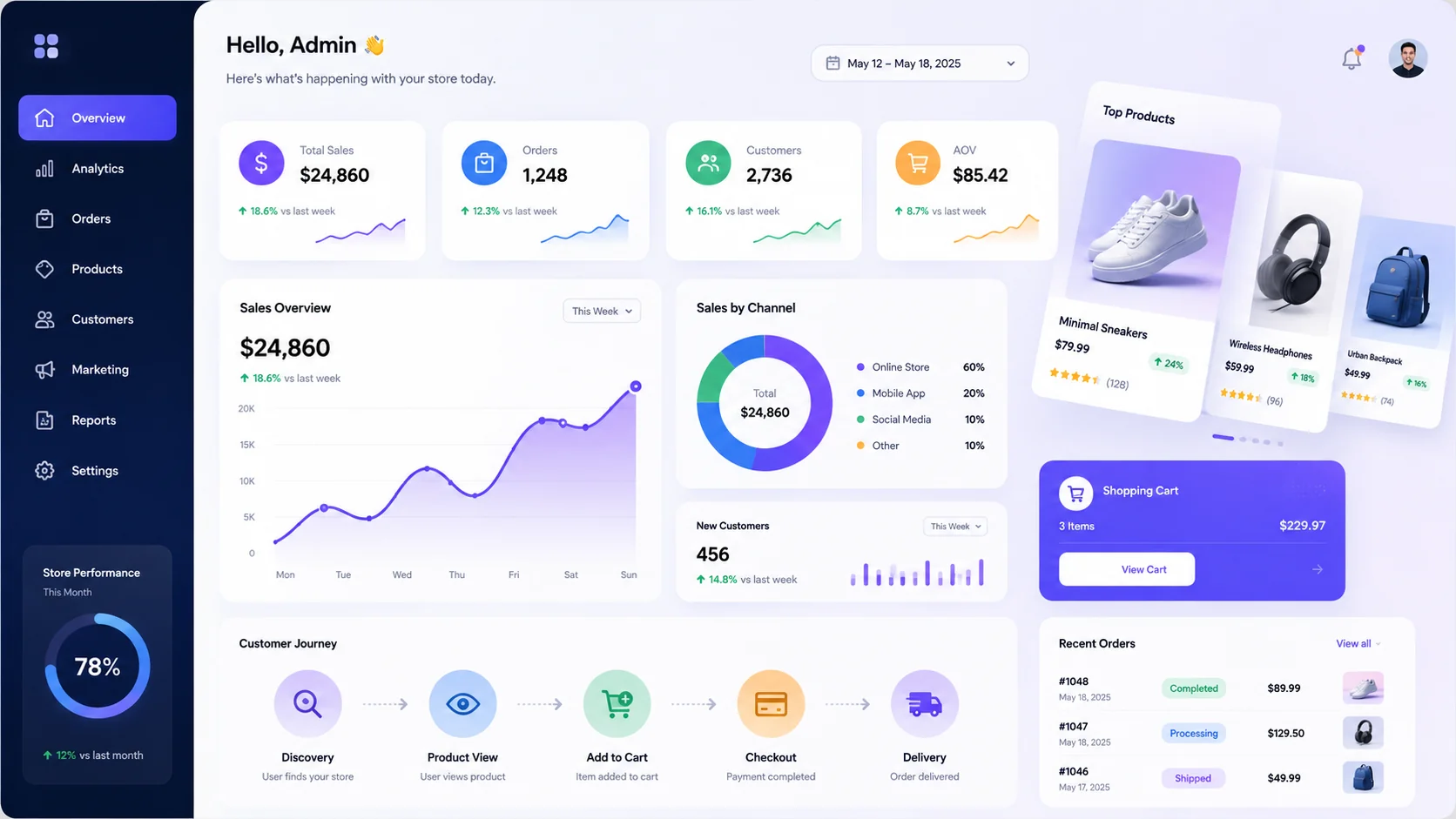
Ecommerce marketing is not just about running ads or posting products on social media.
A successful online store needs a clear system. You need to understand who your customers are, what content helps them buy, when to show the right message, how easy your website is to use, and what makes people complete the purchase.
That is where the 5 Cs of ecommerce marketing become useful.
The 5 Cs are:
- Customer
- Content
- Context
- Convenience
- Conversion
Together, they give ecommerce brands a simple but powerful way to plan their marketing, improve their website, and turn more visitors into customers.
This guide explains each of the 5 Cs in a practical way, with examples you can apply to your own online store.
What Are the 5 Cs of Ecommerce Marketing?
The 5 Cs of ecommerce marketing are a framework for building a stronger online sales strategy.
They help you answer five important questions:
- Customer: Who are we trying to sell to?
- Content: What do they need to see before they buy?
- Context: When and where should we show the message?
- Convenience: How easy is it to browse, trust, and buy from us?
- Conversion: What needs to change so more visitors become customers?
Many ecommerce brands focus only on traffic. They spend money on SEO, Google Ads, Meta Ads, TikTok Ads, influencers, or email campaigns, but they do not fix the full customer journey.
The problem is simple: traffic without strategy becomes expensive.
The 5 Cs help you connect marketing, website experience, product pages, checkout, customer trust, and retention into one clear system.
1. Customer: Understand Who You Are Selling To
The first C is Customer.
Before you create ads, write product descriptions, build landing pages, or send emails, you need to understand the people you are trying to reach.
A good ecommerce marketing strategy starts with customer research.
You need to know:
- Who your ideal buyers are
- What problem they are trying to solve
- What products they compare before buying
- What stops them from placing an order
- What makes them trust an online store
- Which platforms they use before making a purchase
- Whether they are price-driven, quality-driven, brand-driven, or convenience-driven
For example, a fashion ecommerce brand may need to focus on style, fit, social proof, user-generated content, and returns. A skincare brand may need more education, ingredients, reviews, before-and-after content, and trust signals. A B2B ecommerce brand may need specifications, bulk pricing, lead forms, downloadable brochures, and account-based follow-up.
The better you understand the customer, the easier every other part of marketing becomes.
How to Apply the Customer C
Start by reviewing your current customer data.
Look at:
- Your best-selling products
- Your highest-value customers
- Repeat purchase behaviour
- Customer support questions
- Product reviews
- Abandoned cart patterns
- Search terms inside your website
- Google Analytics behaviour
- Paid ad audience performance
- Email open rates and click-through rates
Then split your audience into useful groups.
For example:
- First-time visitors
- Returning visitors
- Cart abandoners
- Past buyers
- High-value customers
- Wholesale or B2B buyers
- Customers interested in specific product categories
Each group needs different messaging.
A first-time visitor may need trust and education. A returning visitor may need a reminder, comparison, or offer. A previous buyer may need a product recommendation, bundle, or loyalty campaign.
When you understand the customer properly, your ecommerce marketing becomes more relevant and less wasteful.
2. Content: Create the Right Assets for the Buying Journey
The second C is Content.
In ecommerce, content is not only blog posts. It includes every piece of information, image, video, page, email, advert, product description, and message that helps a customer make a decision.
Good content answers questions before the customer has to ask them.
Your ecommerce content should help people understand:
- What the product is
- Who it is for
- Why it is useful
- What makes it different
- How it compares to alternatives
- What size, model, colour, or option they should choose
- How delivery, payment, returns, and support work
- Why they should trust your brand
Many ecommerce websites lose sales because the content is too thin.
A product page with one image, a short description, and no clear benefits is not enough. Customers want detail. Search engines also need useful content to understand and rank your pages.
Types of Ecommerce Content That Matter
A strong ecommerce content strategy should include:
Product Page Content
Your product pages should include clear titles, strong descriptions, product benefits, specifications, images, videos where possible, reviews, delivery information, return details, FAQs, and trust signals.
The goal is to remove doubt.
Category Page Content
Category pages are often important for SEO. They should not just list products. Add helpful introductory content, filters, buying guidance, internal links, and FAQs.
For example, a category page for “office chairs” could explain chair types, ergonomics, materials, size options, and delivery information.
Blog and Guide Content
Blog content helps you capture people earlier in the buying journey.
Examples include:
- Buying guides
- Product comparisons
- “Best for” articles
- Care guides
- Trend articles
- Problem-solving guides
- Gift guides
- Industry-specific advice
The goal is not to publish random blogs. The goal is to create content that supports your product categories and answers real buyer questions.
Social Media Content
Social content builds awareness and trust.
For ecommerce brands, useful formats include:
- Product demos
- Behind-the-scenes content
- Customer reviews
- Packaging videos
- Before-and-after results
- Founder-led videos
- Comparison videos
- Short educational reels
- User-generated content
Email and SMS Content
Email and SMS are important because they help you recover sales and increase repeat purchases.
Useful flows include:
- Welcome sequence
- Abandoned cart emails
- Browse abandonment emails
- Post-purchase emails
- Review requests
- Win-back campaigns
- Product recommendation emails
- VIP or loyalty offers
Content should not only attract traffic. It should move people closer to buying.
3. Context: Show the Right Message at the Right Time
The third C is Context.
Context means understanding where the customer is in the journey and showing the right message at the right moment.
Not every visitor should see the same offer, advert, email, or landing page.
Someone who has never heard of your brand needs a different message from someone who added a product to their cart yesterday.
Context can be based on:
- Traffic source
- Device type
- Location
- Time of year
- Search intent
- Product interest
- Previous purchases
- Cart behaviour
- Email engagement
- Customer lifecycle stage
For example, a customer coming from a Google search for “best running shoes for flat feet” needs educational and comparison-based content. A customer clicking a retargeting ad after viewing a specific shoe may need reviews, delivery details, and a reason to buy now.
The message should match the moment.
Examples of Contextual Ecommerce Marketing
Here are practical examples:
- Show new visitors a trust-focused landing page.
- Show returning visitors products they viewed before.
- Send abandoned cart emails with the exact product left behind.
- Promote Ramadan, Eid, Black Friday, summer, or back-to-school campaigns when relevant.
- Use location-based delivery messages.
- Recommend accessories after someone buys a main product.
- Use different ad creatives for first-time buyers and repeat customers.
- Create separate landing pages for Google Ads, SEO, influencer traffic, and email campaigns.
This is where ecommerce marketing becomes more intelligent.
Instead of sending the same message to everyone, you build campaigns around customer intent.
Context and AI in Ecommerce
AI can also support contextual marketing.
Ecommerce brands can use AI to:
- Recommend products
- Segment customers
- Predict repeat purchase opportunities
- Improve email personalisation
- Analyse customer behaviour
- Power chatbots
- Support product search
- Identify weak points in the customer journey
AI should not replace strategy. It should help your marketing respond faster and more accurately to customer behaviour.
4. Convenience: Make the Buying Experience Easy
The fourth C is Convenience.
Customers do not only compare products. They compare experiences.
If your website is slow, confusing, difficult to use on mobile, or unclear at checkout, people will leave. Even if your product is good, a poor buying experience can damage sales.
Convenience is about making everything easier.
That includes:
- Website speed
- Mobile experience
- Navigation
- Product search
- Filters
- Product information
- Payment options
- Delivery information
- Return policy
- Customer support
- Checkout process
A good ecommerce website should not make customers work hard.
They should be able to find products quickly, understand the offer, trust the store, and complete the purchase without friction.
Convenience Checklist for Ecommerce Websites
Review your website and ask:
- Does the website load quickly?
- Is the mobile version easy to use?
- Can customers find products in a few clicks?
- Are filters useful and easy to understand?
- Are product images clear?
- Is pricing easy to see?
- Are delivery costs shown early enough?
- Is the return policy easy to find?
- Are payment methods clear?
- Can customers check out as guests?
- Are forms short and simple?
- Is customer support easy to access?
- Are trust signals visible near the buying decision?
Small friction points can create big revenue leaks.
For example, hiding delivery costs until the last checkout step can increase abandonment. Forcing account creation can slow down buyers. Poor mobile filters can stop customers finding the right product.
Convenience is not just a design issue. It is a revenue issue.
5. Conversion: Turn More Visitors Into Customers
The fifth C is Conversion.
Conversion is where traffic becomes revenue.
A conversion can be:
- A product purchase
- A quote request
- A consultation booking
- A newsletter sign-up
- An account creation
- A repeat order
- A wholesale enquiry
For most ecommerce stores, the main goal is sales. But you should also track smaller actions that lead to sales.
Conversion rate optimisation, also known as CRO, is the process of improving your website and campaigns so more visitors take action.
This does not mean guessing. It means reviewing data, finding weak points, testing improvements, and measuring results.
What Affects Ecommerce Conversion Rates?
Common conversion factors include:
- Product page quality
- Price clarity
- Product photography
- Reviews and social proof
- Trust badges
- Delivery and returns information
- Website speed
- Mobile usability
- Checkout steps
- Payment methods
- Cart design
- Offer quality
- Remarketing
- Email follow-up
For example, if many people view a product but do not add it to cart, the issue may be product content, price, images, trust, or unclear benefits.
If many people add to cart but do not complete checkout, the issue may be delivery fees, payment options, checkout length, or lack of trust.
Different stages need different fixes.
Conversion Improvements to Test
Here are practical CRO ideas:
- Add stronger product benefits above the fold.
- Improve product images and videos.
- Add customer reviews near the add-to-cart button.
- Show delivery and return information clearly.
- Add FAQs to product and category pages.
- Reduce unnecessary checkout fields.
- Offer guest checkout.
- Add multiple payment options.
- Use abandoned cart emails.
- Add product comparison content.
- Improve internal search.
- Test product bundles.
- Add urgency only when it is genuine.
- Make mobile buttons easier to tap.
- Improve page speed.
Conversion is not a one-time task. It should be reviewed every month.
A small improvement in conversion rate can make your existing traffic more profitable.
How the 5 Cs Work Together
The 5 Cs are strongest when they work together.
Here is a simple example.
An ecommerce brand selling premium home furniture wants to grow online.
Using the 5 Cs:
- Customer: They identify that their buyers care about quality, dimensions, delivery, reviews, and interior style.
- Content: They improve product descriptions, add room-style photos, publish buying guides, and create comparison pages.
- Context: They run different campaigns for new visitors, cart abandoners, and previous buyers.
- Convenience: They improve filters, add delivery information earlier, and simplify checkout.
- Conversion: They test product page layouts, add reviews, and track checkout abandonment.
This is much stronger than simply “running more ads”.
More traffic will not fix a weak ecommerce experience. The 5 Cs help you improve the full system.
Ecommerce Marketing Metrics to Track
To use the 5 Cs properly, you need to measure performance.
Here are useful metrics for each area:
| 5 C | Metrics to Track |
|---|---|
| Customer | Repeat purchase rate, customer lifetime value, customer acquisition cost, audience segments |
| Content | Organic traffic, keyword rankings, product page engagement, email clicks, social saves |
| Context | Retargeting performance, email automation revenue, campaign conversion rate |
| Convenience | Page speed, mobile conversion rate, bounce rate, checkout drop-off |
| Conversion | Conversion rate, add-to-cart rate, cart abandonment rate, revenue per visitor |
The goal is not to track everything. The goal is to understand where growth is being blocked.
If traffic is low, you may need SEO, ads, content, and visibility.
If traffic is strong but sales are weak, you may need UX, CRO, trust signals, and checkout improvements.
If sales happen once but customers do not return, you may need email marketing, retention, product recommendations, and loyalty campaigns.
Common Ecommerce Marketing Mistakes
Many ecommerce brands struggle because they focus on one part of the journey and ignore the rest.
Common mistakes include:
- Running ads before fixing the website
- Writing product pages with very little detail
- Ignoring mobile experience
- Not using abandoned cart emails
- Sending the same message to every customer
- Publishing blogs that do not support product categories
- Hiding delivery costs until checkout
- Not showing reviews or trust signals
- Not tracking conversion rate properly
- Relying only on discounts to drive sales
- Not building customer retention campaigns
The best ecommerce marketing strategy is not the one with the most channels.
It is the one where every channel supports the customer journey.
How an Ecommerce Marketing Agency Can Help
An ecommerce marketing agency can help by looking at the full picture.
That includes:
- SEO strategy
- Paid advertising
- Product page optimisation
- Category page optimisation
- Website design
- UX improvements
- Conversion rate optimisation
- Email marketing automation
- Analytics and tracking
- Content strategy
- AI automation
- Customer journey mapping
For ecommerce brands, this is important because growth usually depends on multiple areas working together.
You may need better traffic, but you may also need better product pages. You may need more leads, but you may also need stronger checkout design. You may need better content, but you may also need technical SEO and faster website performance.
A strong agency should not only send reports. It should help you understand what is stopping growth and what to fix next.
Quick 5 Cs Ecommerce Audit
Use this quick audit to review your current ecommerce marketing.
Customer
- Do you know your main customer groups?
- Do you know why people buy from you?
- Do you know why people do not buy?
- Are you using customer data to guide campaigns?
Content
- Are product pages detailed enough?
- Do category pages have useful SEO content?
- Do you have buying guides or comparison content?
- Are emails and ads connected to the buying journey?
Context
- Do new visitors and returning visitors see different messages?
- Do you use retargeting?
- Do you have abandoned cart flows?
- Do you plan campaigns around seasonal demand?
Convenience
- Is your website fast?
- Is the mobile experience easy?
- Is navigation simple?
- Are delivery, returns, and payment details clear?
Conversion
- Do you track add-to-cart and checkout drop-off?
- Do you test product page improvements?
- Do you review conversion rate monthly?
- Do you have a plan to increase repeat purchases?
If you cannot answer these clearly, your ecommerce marketing may be leaking revenue.
Final Thoughts
The 5 Cs of ecommerce marketing give online stores a practical way to grow.
They help you move beyond random marketing activity and build a stronger customer journey.
To recap:
- Customer: Know who you are selling to.
- Content: Give people the information they need to buy.
- Context: Show the right message at the right time.
- Convenience: Make the buying experience easy.
- Conversion: Improve the steps that turn visitors into customers.
Ecommerce growth does not come from one channel alone. It comes from the connection between your website, content, ads, SEO, email, user experience, and customer data.
At Vistoplex, we help ecommerce businesses build smarter digital systems across website design, SEO, content, paid media, analytics, and AI automation.
If your ecommerce website is getting traffic but not enough sales, or if you want a clearer strategy for growth, Vistoplex can help you identify what is holding your store back and what to improve first.
FAQs
What are the 5 Cs of ecommerce marketing?
The 5 Cs of ecommerce marketing are Customer, Content, Context, Convenience, and Conversion. They help online stores understand their buyers, create useful content, show the right message at the right time, improve the shopping experience, and turn more visitors into customers.
Why are the 5 Cs important for ecommerce?
The 5 Cs are important because ecommerce growth depends on more than traffic. A store needs the right customers, strong product content, timely messaging, an easy website experience, and a clear conversion strategy.
Which of the 5 Cs is most important?
Customer is usually the most important because every other part of ecommerce marketing depends on understanding who the buyer is. However, all 5 Cs need to work together to create consistent growth.
How do the 5 Cs improve conversion rates?
The 5 Cs improve conversion rates by reducing friction in the buying journey. Better customer understanding, stronger content, relevant messaging, easier navigation, clearer checkout, and stronger trust signals can all help more visitors complete a purchase.
Is ecommerce marketing only about ads?
No. Ads are only one part of ecommerce marketing. A complete ecommerce strategy can include SEO, content, website design, email marketing, social media, paid ads, conversion rate optimisation, analytics, and customer retention.
How can an ecommerce marketing agency help?
An ecommerce marketing agency can help by reviewing your full customer journey, improving traffic quality, strengthening product and category pages, fixing website issues, setting up campaigns, improving conversion rates, and building better tracking.
How often should ecommerce marketing be reviewed?
Ecommerce marketing should be reviewed every month. Traffic, conversion rates, checkout performance, product page engagement, email flows, and customer retention should be monitored regularly so improvements can be made based on real data.