
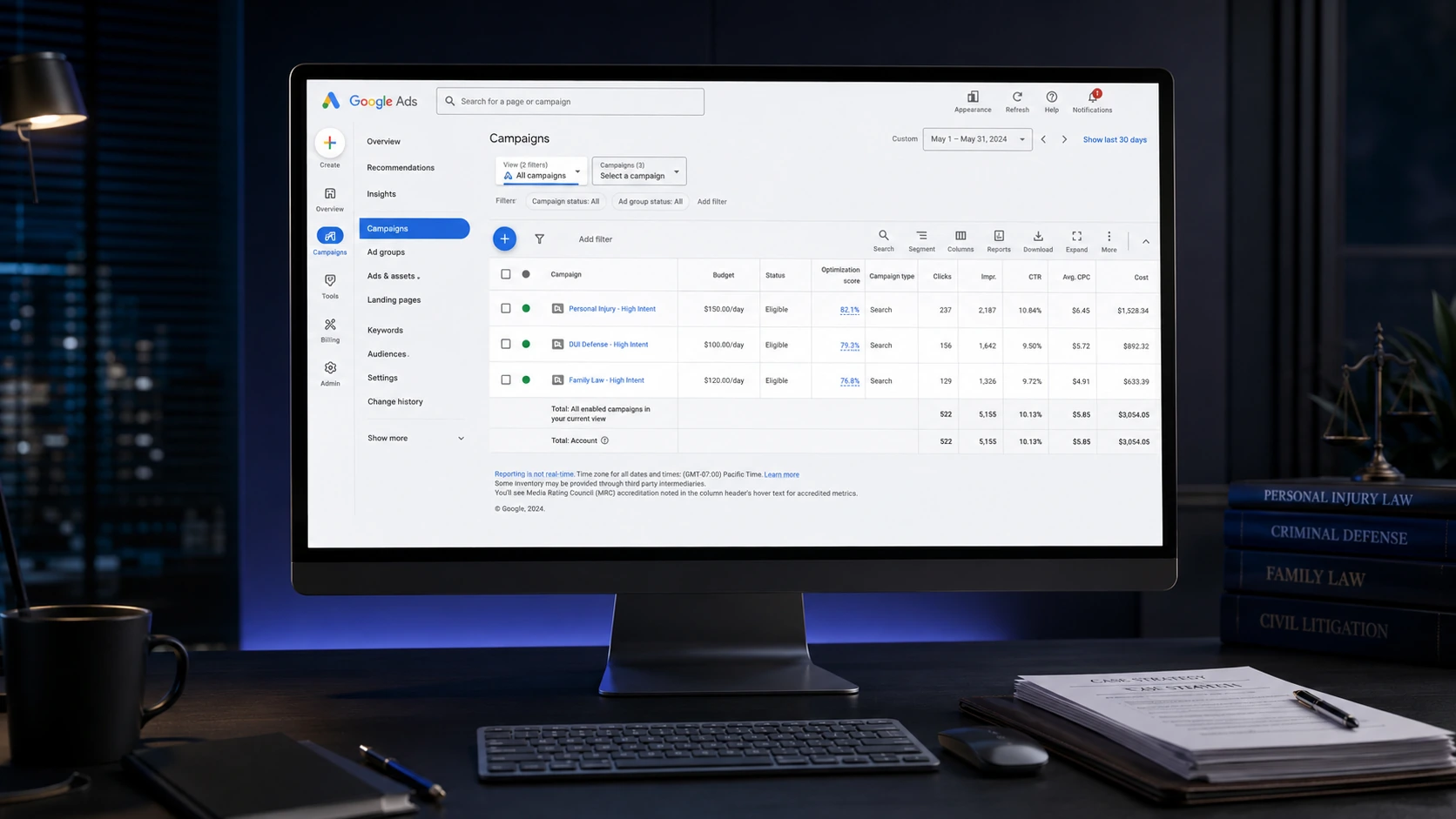
PPC for law firms can generate enquiries quickly, but it can also waste budget quickly if campaigns are not set up properly.
Legal keywords are often expensive because they have strong commercial intent. Someone searching for “immigration solicitor near me”, “employment solicitor settlement agreement” or “family lawyer consultation” may be close to making an enquiry. That makes PPC attractive for law firms, but it also means poor keyword targeting, weak landing pages or missing tracking can become costly.
For UK solicitors, a good PPC campaign is not just about appearing at the top of Google. It is about attracting the right enquiries, filtering out poor-fit clicks, tracking calls and forms, and understanding which campaigns turn into signed matters.
This guide explains how PPC works for law firms, when to use it, what to avoid, and how to build a campaign that supports real client acquisition.
For firms that want PPC, SEO, website design and content handled together, Vistoplex provides digital marketing services for law firms.
What is PPC for law firms?
PPC stands for pay-per-click. It is a form of online advertising where a law firm pays when someone clicks on its ad.
The most common PPC platform for law firms is Google Ads. A firm can bid to appear when people search for relevant legal services, such as:
- family solicitor near me
- immigration solicitor London
- conveyancing quote
- employment solicitor settlement agreement
- probate solicitor Manchester
- criminal defence solicitor near me
- personal injury solicitor
- commercial litigation lawyer
PPC can also include Microsoft Ads, paid social campaigns, remarketing and display advertising. However, for most law firms, search advertising is the first PPC channel to get right because it captures people who are already searching for legal help.
The aim is not simply to get more clicks. The aim is to get qualified enquiries from people who need the firm’s services and are likely to become clients.
Why PPC matters for solicitors
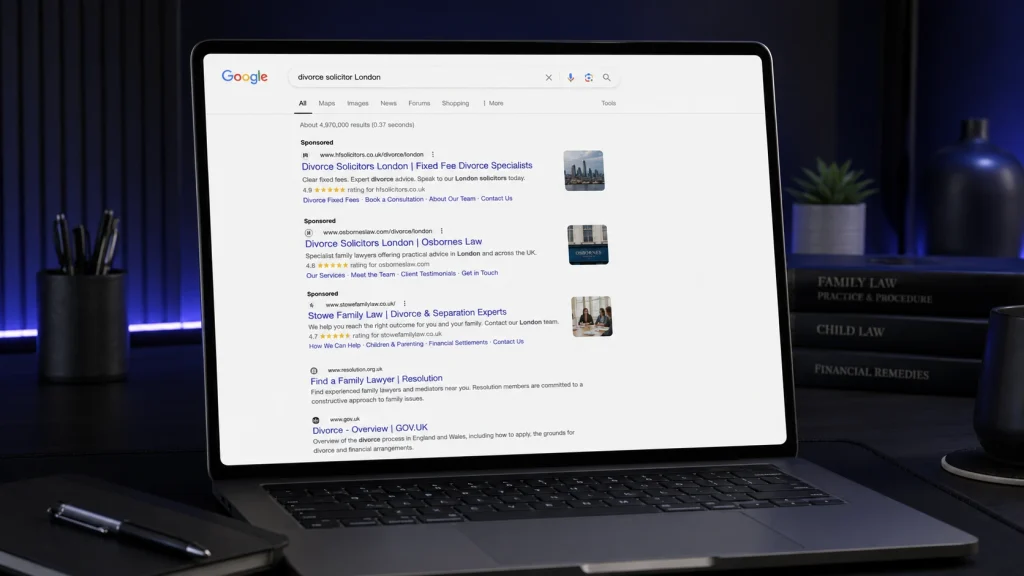
SEO is important, but it takes time. PPC can put a law firm in front of potential clients much faster.
This makes PPC useful when a firm wants to:
- generate enquiries quickly
- test a new practice area
- promote a high-value legal service
- support a new office location
- fill gaps while SEO grows
- target urgent legal searches
- compete in high-value local markets
- retarget previous website visitors
PPC is especially useful for practice areas where the client has immediate intent. For example, a person searching for an emergency criminal defence solicitor, an immigration solicitor after a refusal, or an employment solicitor for a settlement agreement is often closer to contacting a firm than someone reading a general blog post.
However, PPC is not a shortcut for a weak website. If the landing page is poor, the enquiry form is hard to use, the call button is hidden, or the service is not clearly explained, the firm may pay for clicks that do not convert.
Good PPC needs three things working together:
- The right keywords.
- The right landing pages.
- The right tracking.
Without those, the campaign may look active but fail commercially.
PPC vs SEO for law firms
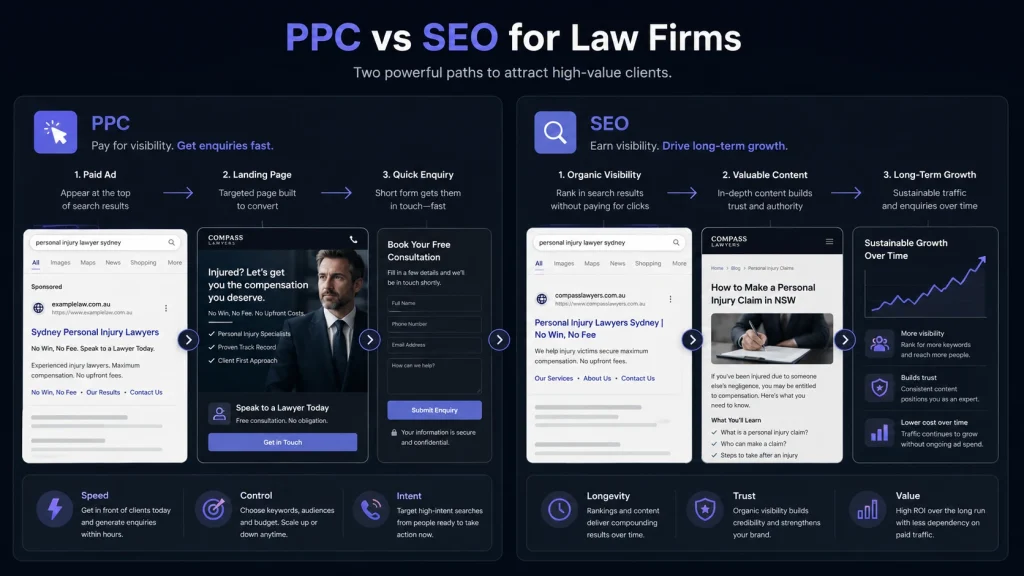
PPC and SEO both help law firms appear in search results, but they work differently.
| Channel | Best for | Speed | Main strength | Main risk |
|---|---|---|---|---|
| PPC | Fast enquiries | Fast | Immediate visibility | Wasted spend if poorly managed |
| SEO | Long-term enquiries | Slow to medium | Sustainable visibility | Takes time and consistency |
| Local SEO | Local solicitor searches | Medium | Map and local visibility | Weak reviews or thin local pages |
| Content marketing | Authority and long-tail traffic | Medium | Supports SEO and trust | Generic content with no enquiry path |
PPC is often best for speed and testing. SEO is better for long-term visibility. The strongest law firm marketing strategies usually use both.
For example, PPC can target immediate enquiries for “settlement agreement solicitor”, while SEO builds supporting pages and guides around employment law. PPC can show quickly which keywords convert, and SEO can then use that data to guide content and landing page priorities.
Read our full guide to SEO for law firms for the long-term organic strategy.
When should a law firm use PPC?
A law firm should consider PPC when there is a clear service, clear location, clear budget and clear way to handle enquiries.
PPC is usually a good fit when:
- the firm has strong service pages or landing pages
- the firm can respond quickly to calls and forms
- the average matter value justifies ad spend
- the target service has strong search intent
- the firm can track enquiries properly
- the campaign is focused rather than broad
PPC is not always the best first step if the website is weak, the firm has no clear intake process, or the target service is too vague.
For example, running ads for “legal advice” is usually too broad. Running ads for “settlement agreement solicitor in London” or “spouse visa solicitor Birmingham” is much more specific.
The more specific the campaign, the easier it is to match the keyword, ad copy, landing page and enquiry process.
The best PPC campaign structure for law firms
A law firm PPC campaign should be structured by practice area and intent.
Avoid putting every service into one campaign. Family law, conveyancing, immigration, employment law and criminal defence are different services with different search intent, keywords, budgets and landing pages.
A better structure would look like this:
| Campaign | Ad groups | Landing page |
| Family law | Divorce, child arrangements, financial settlements | Family law or specific sub-service pages |
| Immigration | Spouse visa, visa refusal, sponsor licence | Immigration landing pages |
| Employment law | Settlement agreements, unfair dismissal, redundancy | Employment law landing pages |
| Conveyancing | Sale, purchase, remortgage, quote | Conveyancing quote page |
| Probate | Probate application, estate administration, wills | Probate landing page |
| Criminal defence | Police station, motoring offences, emergency defence | Urgent contact page |
This structure makes it easier to control budgets and understand which services are producing useful enquiries.
A campaign for divorce enquiries should not share the same ads and landing page as a campaign for conveyancing. The client’s situation, concerns and next step are completely different.
Keyword strategy for law firm PPC
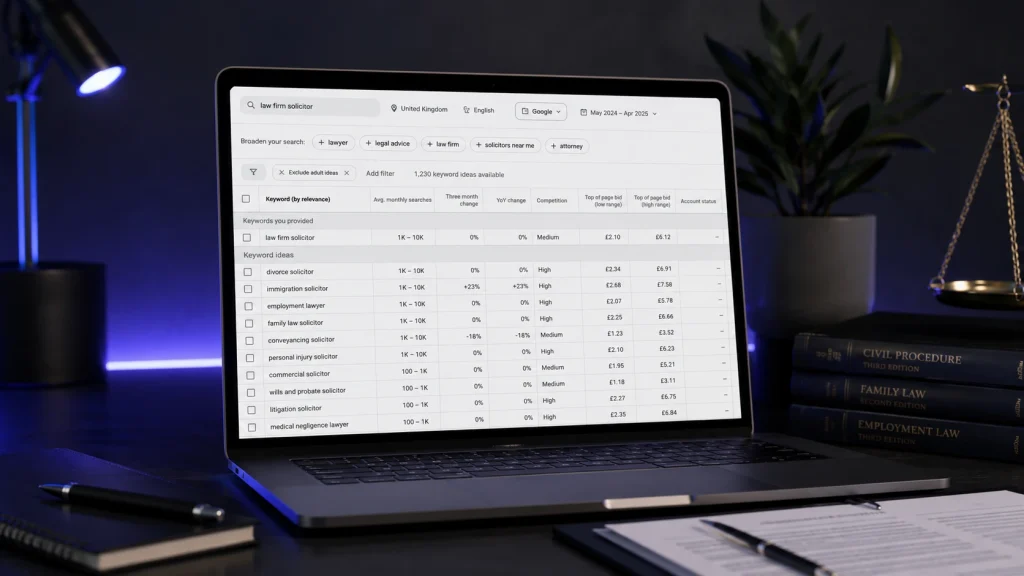
Keyword research is one of the most important parts of PPC.
Law firms should focus on keywords with clear legal service intent. These are searches where the person is likely to need a solicitor, not just general information.
Examples of high-intent keywords include:
- divorce solicitor near me
- settlement agreement solicitor
- immigration solicitor London
- conveyancing solicitor quote
- probate solicitor near me
- criminal defence solicitor
- family lawyer consultation
- employment solicitor for unfair dismissal
Lower-intent keywords may include:
- what is divorce
- employment law meaning
- how long does probate take
- immigration rules UK
- what is a settlement agreement
These informational searches may be better suited to SEO and content marketing rather than PPC.
A PPC campaign should usually start with a smaller set of high-intent keywords. Once performance data is available, the campaign can be expanded carefully.
Match types and negative keywords
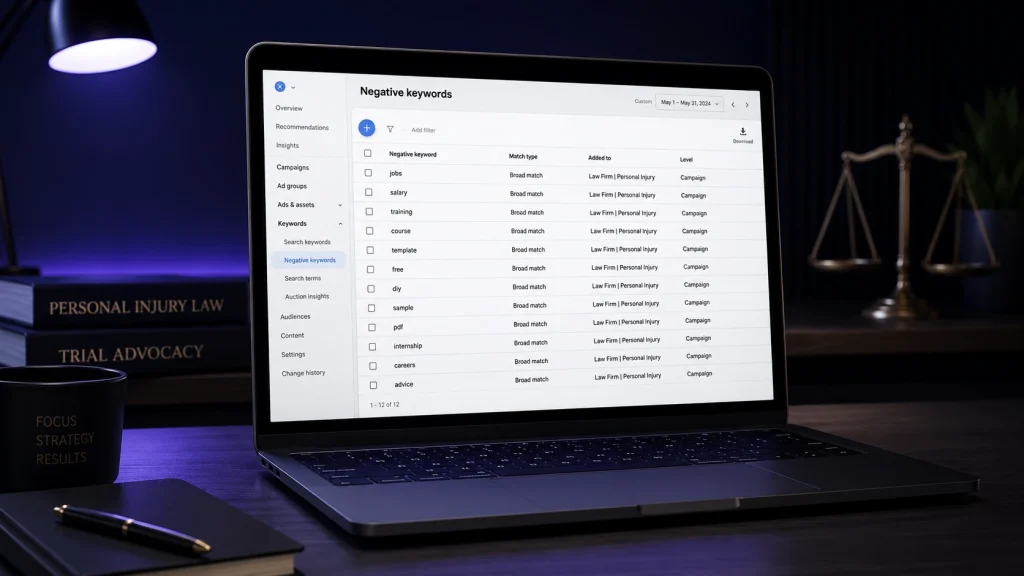
Google Ads allows advertisers to use different match types to control how closely a search must match the selected keyword.
For law firms, match types should be used carefully. Broad targeting can bring in irrelevant traffic if the campaign does not have strong controls. Phrase and exact match can provide more control, especially at the start.
Negative keywords are just as important as positive keywords. They help stop ads from showing for irrelevant searches.
Examples of negative keywords for law firm campaigns may include:
- jobs
- salary
- training
- course
- template
- free
- DIY
- sample
- meaning
- university
- legal aid, if the firm does not offer legal aid
- pro bono, if the firm does not offer pro bono work
- internship
- career
- qualification
The right negative keywords depend on the practice area.
For example, a conveyancing campaign may need to exclude searches around “DIY conveyancing”, “conveyancing jobs” or “conveyancing course”. An employment law campaign may need to exclude “employment law degree”, “employment law course” and “employment solicitor jobs”.
Negative keywords should be reviewed regularly through the search terms report. This is one of the best ways to protect PPC budget.
Ad copy for law firms
Law firm ad copy should be clear, specific and careful.
Good ad copy should explain:
- the legal service
- the location, if relevant
- the type of client helped
- the next step
- a trust signal, where appropriate
- a clear call to action
Example structure:
Headline ideas:
- Family Solicitors in Manchester
- Settlement Agreement Solicitors
- Immigration Solicitors in London
- Conveyancing Quote Online
- Probate Solicitors Near You
Description ideas:
- Speak to a solicitor about your next steps.
- Clear advice from experienced UK solicitors.
- Get practical legal support for your matter.
- Request a consultation with our legal team.
- Fixed fee options available where applicable.
Avoid exaggerated claims such as:
- guaranteed results
- best solicitors in the UK
- win your case
- cheapest legal advice
- 100% success rate
- no risk
- instant approval
Legal advertising should be accurate, evidence-based and not misleading. If a firm uses claims about experience, success, reviews, pricing or speed, those claims should be supportable.
Landing pages for law firm PPC
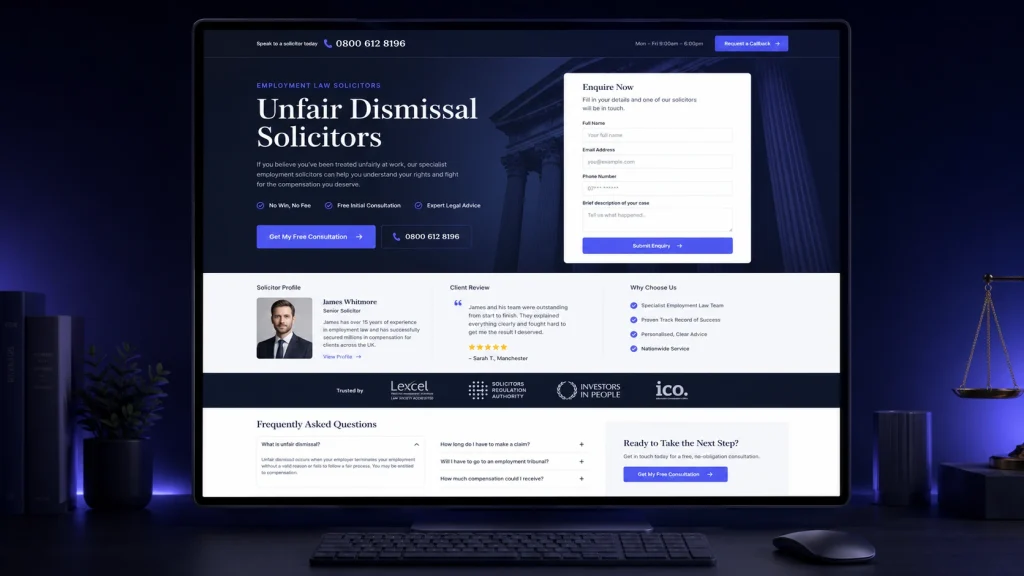
The landing page is where many law firm PPC campaigns succeed or fail.
Sending all paid traffic to the homepage is usually a mistake. The landing page should match the search.
A person searching for “settlement agreement solicitor” should land on a settlement agreement page. A person searching for “spouse visa solicitor” should land on a spouse visa page. A person searching for “conveyancing quote” should land on a conveyancing quote page.
A good PPC landing page should include:
- clear page heading
- short explanation of the service
- who the service is for
- what happens next
- visible phone number
- short enquiry form
- trust signals
- solicitor profiles
- reviews or testimonials where appropriate
- pricing information where applicable
- FAQs
- mobile-friendly layout
- fast loading speed
The landing page should reduce uncertainty. Clients often contact the firm when they understand what the firm does, what the next step is and how easy it is to speak to someone.
For legal PPC, clarity usually converts better than clever wording.
PPC landing page examples by practice area
Different legal services need different landing page angles.
Family law
A family law landing page should feel calm, private and reassuring. It should explain divorce, child arrangements, financial settlements or urgent support clearly. Calls to action should be sensitive and simple.
Immigration law
An immigration landing page should focus on the visa type or issue. For example, spouse visas, visa refusals, sponsor licences or appeals. It should explain timescales, next steps and document preparation where relevant.
Employment law
Employment PPC should separate employee and employer intent. Settlement agreement searches are very different from employer HR advice searches. The landing page should match the audience.
Conveyancing
Conveyancing pages should make quotes easy. Users often compare price, speed and process. The page should be clear about what is included and how to request a quote.
Probate
Probate pages should be simple, clear and reassuring. People may be dealing with grief or family pressure, so the page should avoid aggressive sales language.
Criminal defence
Criminal defence PPC often needs urgent contact options. Mobile click-to-call, office hours, emergency support wording and clear next steps matter.
Budget planning for law firm PPC
There is no single correct PPC budget for a law firm.
The right budget depends on:
- practice area
- location
- competition
- average matter value
- conversion rate
- enquiry quality
- landing page strength
- how quickly the firm can respond
- whether the firm is testing or scaling
A small firm testing one service in one city may start with a controlled monthly budget. A regional firm targeting several practice areas may need separate budgets for each campaign.
The key is not to spread the budget too thinly.
For example, a firm with a modest budget may get better results by focusing only on settlement agreements in one region rather than trying to advertise family law, immigration, conveyancing and employment law at the same time.
PPC should be treated as a testable investment. Start focused, track properly, then expand the parts that generate quality enquiries.
Tracking PPC enquiries
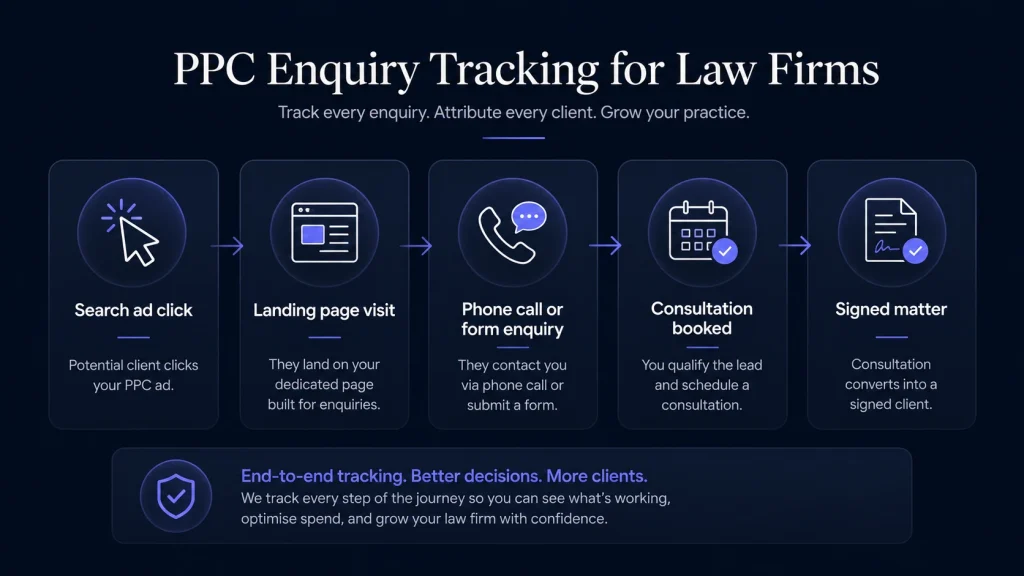
PPC without tracking is risky.
At minimum, a law firm should track:
- phone calls
- form submissions
- consultation bookings
- live chat enquiries
- source campaign
- keyword or search term
- landing page
- enquiry quality
- signed matters
- cost per enquiry
- cost per signed client
Many campaigns look successful because they generate leads. But the real question is whether those leads become profitable matters.
A campaign that generates 40 low-quality enquiries may be worse than a campaign that generates eight strong enquiries.
Tracking should connect the ad click to the final outcome as much as possible. That means marketing data and intake data need to be reviewed together.
Call tracking for law firm PPC

Phone calls are often one of the most important conversion actions for law firms.
Many potential clients prefer to call, especially for urgent or sensitive matters. If calls are not tracked, PPC performance can be seriously underreported.
Call tracking can show:
- which campaign generated the call
- which keyword triggered the ad
- which landing page the user visited
- call duration
- missed calls
- repeat calls
- call quality
This helps the firm understand whether PPC is producing useful conversations.
It also highlights intake issues. If a campaign generates calls but many are missed, the PPC problem may actually be a response process problem.
Quality Score and landing page relevance
Quality Score is a Google Ads diagnostic metric that can help identify whether ads, keywords and landing pages are relevant.
For law firms, this means campaign performance is not only about bidding more. Relevance matters.
A campaign is usually stronger when:
- the keyword matches the ad
- the ad matches the landing page
- the landing page answers the searcher’s need
- the page loads quickly
- the contact options are clear
- the content is useful and specific
For example, an ad for “settlement agreement solicitor” should lead to a settlement agreement landing page, not a general employment law homepage.
Better relevance can improve user experience and help reduce wasted clicks.
Compliance-conscious PPC for solicitors
Law firm PPC must be careful because legal services are high-trust and regulated.
Ads and landing pages should avoid misleading claims. Be careful with wording around:
- success rates
- guaranteed outcomes
- “no win no fee”
- pricing
- reviews
- awards
- “specialist” claims
- “best” claims
- comparisons with competitors
- urgent deadlines
- free consultations
- fixed fees
If the firm advertises fees, the landing page should explain what is included and what is not included. If the firm advertises “free consultation”, the scope should be clear.
If the firm uses testimonials, awards or accreditations, the firm should be able to evidence them.
PPC copy should also align with the firm’s actual services. Do not advertise legal services the firm does not provide or locations it cannot properly serve.
PPC for different law firm practice areas
PPC strategy should change depending on the practice area.
Family law PPC
Family law PPC should focus on sensitivity, privacy and clear next steps. Good campaigns may separate divorce, child arrangements, financial settlements and mediation.
Immigration PPC
Immigration PPC should be structured by visa type or issue. Spouse visa, sponsor licence and visa refusal campaigns should usually have separate ad groups and landing pages.
Employment law PPC
Employment PPC should separate employee and employer searches. Settlement agreement enquiries often have strong commercial intent and need a dedicated landing page.
Conveyancing PPC
Conveyancing PPC should focus on quote requests, location, process clarity and speed. Landing pages should make it easy to request a quote.
Probate PPC
Probate PPC should use careful, reassuring wording. Clients may need help understanding the process and likely costs.
Criminal defence PPC
Criminal defence PPC needs urgent contact options, mobile-first design and clear service availability.
Personal injury PPC
Personal injury PPC needs careful claims wording, transparency around fees and a strong intake process.
Commercial law PPC
Commercial law PPC may work better with more specific campaigns, such as shareholder disputes, contract disputes, debt recovery or employment advice for employers.
Retargeting for law firms
Retargeting shows ads to people who have already visited the firm’s website.
For law firms, retargeting should be handled carefully. Legal matters can be sensitive. A person researching divorce, immigration, debt, criminal defence or employment issues may not want obvious legal ads following them around the web.
Retargeting may be more suitable for:
- commercial law
- employer services
- webinars
- legal updates
- downloadable guides
- business audiences
For sensitive consumer legal services, firms should be cautious. Privacy, user comfort and brand trust matter.
PPC and AI search
AI search is changing how people research legal questions, but paid search still matters because people continue to use Google for urgent, local and high-intent legal searches.
PPC can also provide useful data for wider marketing. Search terms, enquiries and conversion rates can show what people are actually looking for. That data can then support SEO, content marketing and landing page improvements.
For example, if PPC shows that “settlement agreement solicitor fixed fee” converts well, the firm may want to improve its organic page and blog content around that topic.
PPC should not sit separately from SEO. It should feed the wider digital strategy.
A 90-day PPC plan for law firms
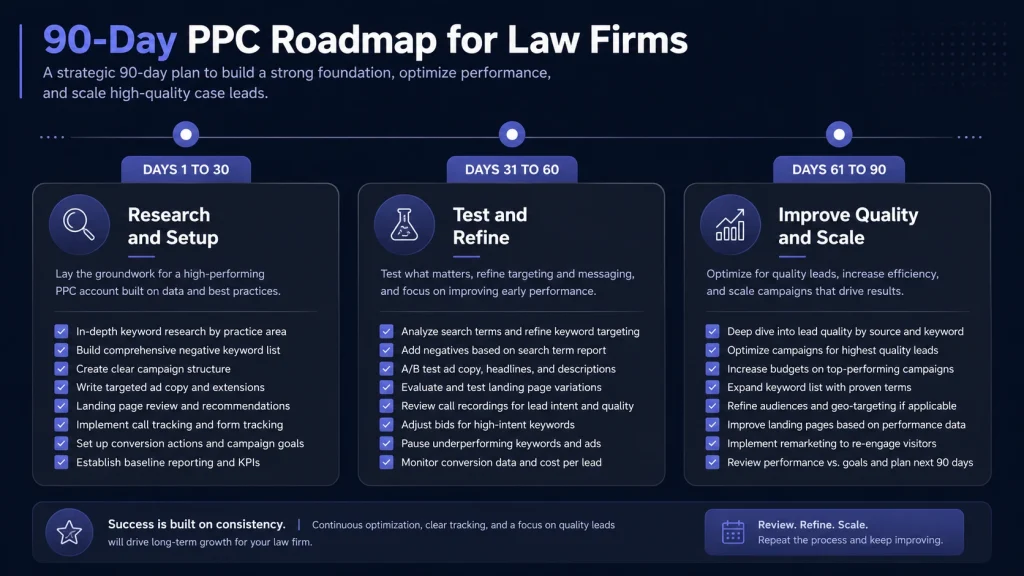
A law firm can build a better PPC campaign by following a staged plan.
Days 1–30: Research and setup
Start with:
- practice area selection
- competitor review
- keyword research
- negative keyword list
- campaign structure
- landing page review
- conversion tracking setup
- call tracking setup
- ad copy drafting
- budget planning
- compliance review
The goal is to launch carefully, not quickly.
Days 31–60: Test and refine
Review:
- search terms
- cost per click
- click-through rate
- conversion rate
- cost per enquiry
- call quality
- form quality
- landing page performance
- location performance
- device performance
Add negative keywords, pause weak search terms, improve ad copy and adjust landing pages where needed.
Days 61–90: Improve quality and scale
Once useful data is available, focus on:
- increasing spend on strong campaigns
- reducing budget on poor-fit campaigns
- improving landing pages
- testing new ad copy
- reviewing signed matters
- separating strong practice areas
- building SEO pages based on converting keywords
- improving intake response
The aim is not just more leads. The aim is more of the right leads.
Common PPC mistakes law firms make
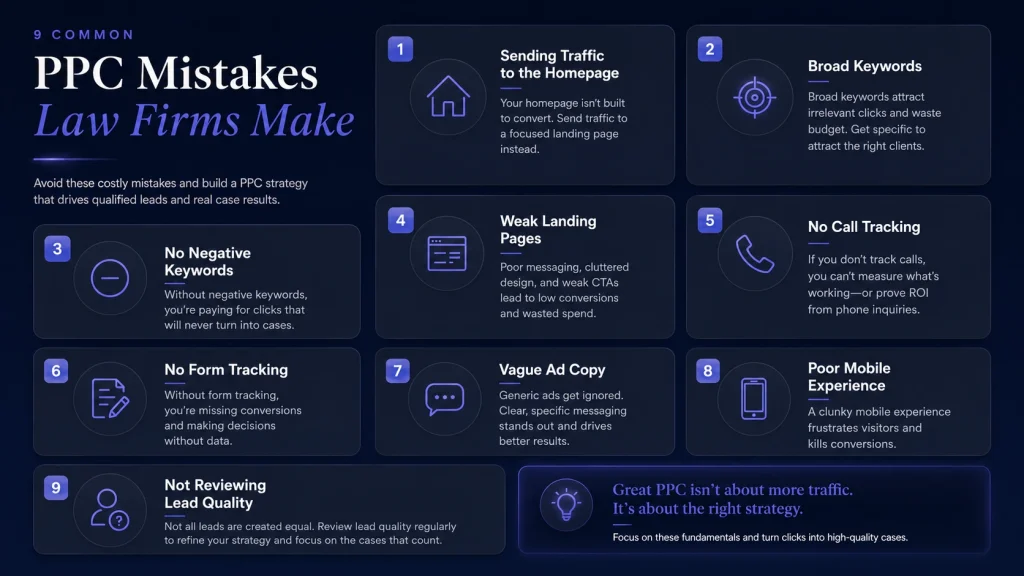
Many law firms waste PPC budget because the campaign is too broad or not tracked properly.
Common mistakes include:
- sending all traffic to the homepage
- using broad keywords without enough control
- not using negative keywords
- targeting too many services at once
- no call tracking
- no form tracking
- weak landing pages
- slow mobile pages
- vague ad copy
- exaggerated claims
- no location control
- not checking search terms
- judging success only by clicks
- not reviewing lead quality
- ignoring missed calls
- poor follow-up process
The most serious mistake is treating PPC as a set-and-forget channel. PPC needs regular review because search terms, competition, costs and lead quality change over time.
How PPC supports wider law firm marketing
PPC works best when it is connected to SEO, local SEO, website design and content.
For example:
- PPC tests which keywords convert.
- SEO builds long-term visibility around those topics.
- Local SEO improves trust and map visibility.
- Website design improves conversion.
- Content answers common questions.
- Tracking shows which enquiries become clients.
This is why PPC should not be managed in isolation. A law firm may pay for traffic, but the website and intake process still need to convert that traffic.
Read our wider guide to digital marketing for law firms and our guide to local SEO for law firms for the full strategy.
FAQs
What is PPC for law firms?
PPC for law firms is paid online advertising where a firm pays when someone clicks on its ad. It is commonly used on Google Ads to appear for legal service searches.
Is Google Ads worth it for law firms?
Google Ads can be worth it for law firms when campaigns are focused, tracked properly and connected to strong landing pages. It can be expensive if campaigns are too broad or poorly managed.
How much should law firms spend on PPC?
The right PPC budget depends on the practice area, location, competition and average client value. Firms should start with a focused budget, track lead quality and scale what works.
What are the best PPC keywords for solicitors?
The best PPC keywords are usually high-intent terms such as “settlement agreement solicitor”, “family solicitor near me”, “immigration solicitor London” or “conveyancing quote”. The best keywords depend on the firm’s services and location.
Should law firms use broad match keywords?
Broad match can bring in extra search volume, but it can also create irrelevant clicks if not controlled. Many law firms should start with tighter targeting and a strong negative keyword list.
What are negative keywords in law firm PPC?
Negative keywords stop ads from showing for irrelevant searches. For example, a law firm may exclude terms such as “jobs”, “course”, “template”, “free” or “salary”.
Should PPC traffic go to the homepage?
Usually not. PPC traffic should go to a landing page that matches the search. A divorce ad should go to a divorce page, and a conveyancing ad should go to a conveyancing quote page.
How can law firms track PPC results?
Law firms should track calls, forms, booked consultations, enquiry quality, signed matters, cost per enquiry and cost per client. Clicks alone are not enough.
Is PPC better than SEO for law firms?
PPC is better for fast visibility. SEO is better for long-term visibility. Most growing law firms benefit from using both together.
Can solicitors advertise on Google?
Yes, solicitors can advertise on Google, but ads and landing pages should use accurate, non-misleading wording and comply with relevant advertising and professional obligations.
Final thoughts
PPC can be a powerful channel for law firms, but only when it is managed carefully.
The best law firm PPC campaigns are focused, tracked and connected to strong landing pages. They use specific keywords, negative keywords, clear ad copy, call tracking, form tracking and regular lead-quality reviews.
For UK solicitors, the goal is not to buy as many clicks as possible. The goal is to generate better enquiries from people who need the firm’s services and are ready to take the next step.
For a joined-up approach to PPC, SEO, local SEO, website design and content, see Vistoplex’s digital marketing services for law firms.