
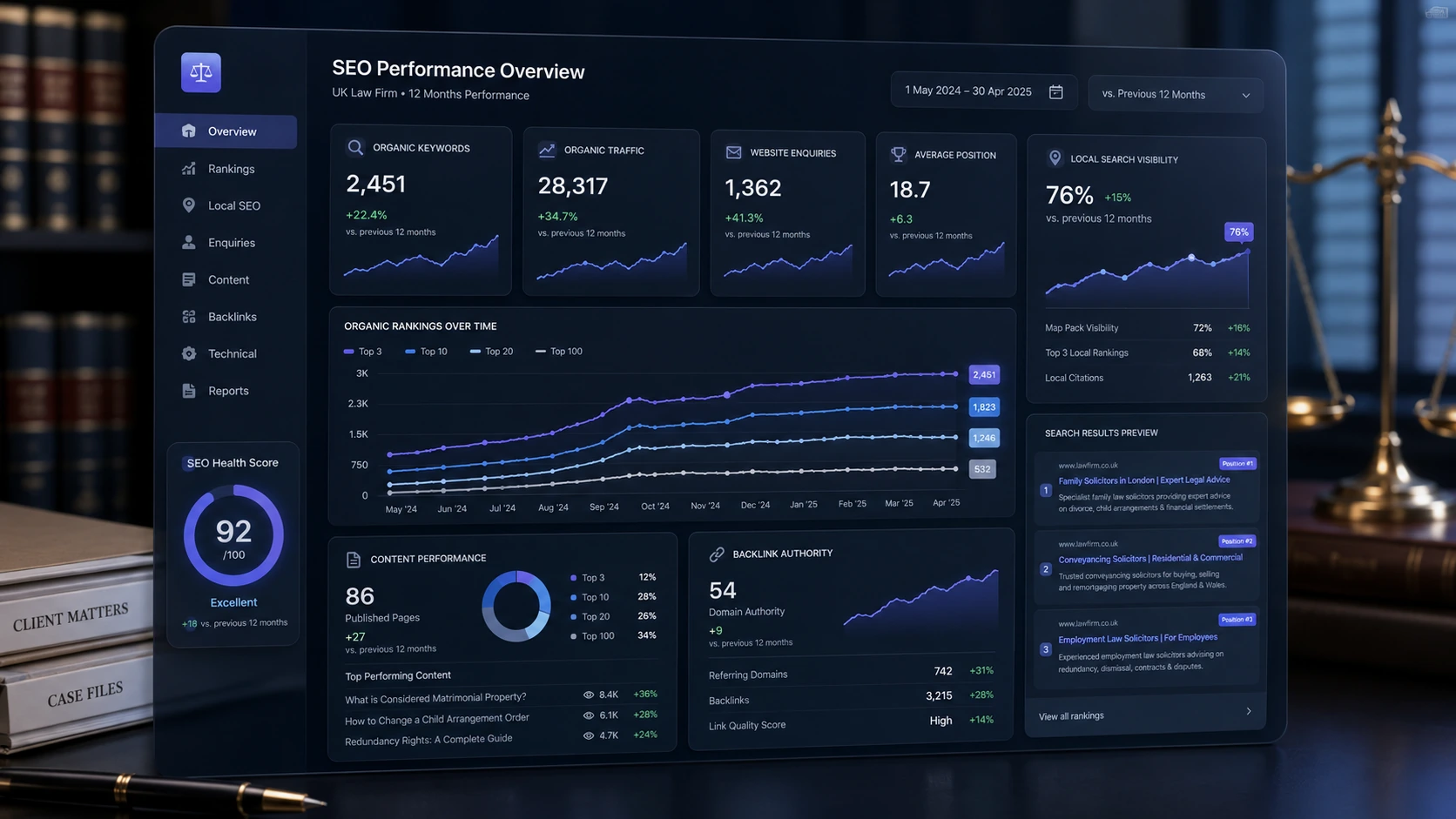
SEO for law firms is the process of improving a law firm’s visibility in Google so potential clients can find the firm when they search for legal advice, local solicitors or specific legal services.
For UK law firms, SEO is not only about ranking for one broad phrase such as “solicitors near me”. The best results usually come from a clear structure: strong practice-area pages, local SEO, useful legal guides, reviews, technical improvements, internal links and authority-building.
Done properly, SEO can help a law firm attract better enquiries without relying only on referrals or paid ads. Done badly, it can lead to thin content, wasted budget and pages that rank but do not convert.
This guide explains how SEO for law firms works, what UK solicitors should prioritise, and how to build an SEO strategy that turns search visibility into real enquiries.
For firms that want SEO, PPC, website design and content handled together, Vistoplex provides digital marketing services for law firms.
What is SEO for law firms?
SEO stands for search engine optimisation. For law firms, it means improving your website so it appears higher in search results when potential clients look for legal services.
Examples include searches such as:
- family solicitor in London
- immigration solicitor near me
- conveyancing solicitor Manchester
- employment lawyer settlement agreement
- probate solicitor Birmingham
- criminal defence solicitor Leeds
- commercial litigation solicitor UK
Law firm SEO usually includes:
- keyword research
- service page optimisation
- local SEO
- Google Business Profile optimisation
- technical SEO
- content marketing
- internal linking
- link building
- reviews and trust signals
- conversion tracking
The aim is not just more traffic. The real aim is more relevant enquiries from people who need legal help and are likely to instruct.
Why SEO matters for solicitors
Most people now research legal services online before contacting a firm. Even when a client receives a referral, they may still search the firm’s name, read reviews, compare websites and check solicitor profiles before making contact.
That means your website needs to be visible, trustworthy and easy to use.
The Law Society explains that having a website is only the start; firms need to make their website visible, which is where SEO comes in. Google also tries to serve relevant, credible websites with good user experience, so SEO and website quality need to work together.
For law firms, SEO matters because it can:
- increase visibility for practice-area searches
- improve local presence
- reduce reliance on paid ads
- support long-term enquiry growth
- build trust before the first call
- improve website structure and user experience
- help potential clients understand your services
SEO is especially important in competitive legal markets because clients often compare several firms before making contact. If your competitors have stronger service pages, better reviews, clearer solicitor profiles and more useful content, they may win the enquiry before your firm is even considered.
SEO for law firms vs general SEO
SEO for law firms is different from general SEO because legal services are high-trust, high-intent and often location-sensitive.
A person searching for a solicitor may be dealing with divorce, immigration, employment problems, probate, criminal allegations, injury claims or commercial disputes. They are not simply browsing. They need reassurance, clarity and credibility.
This means law firm SEO must focus on:
- clear legal service pages
- specific practice-area content
- local search visibility
- trust signals
- solicitor expertise
- reviews
- transparent contact options
- compliance-conscious wording
- fast mobile experience
- enquiry tracking
Generic SEO tactics are not enough. A law firm needs content that is accurate, useful and aligned with how real clients search.
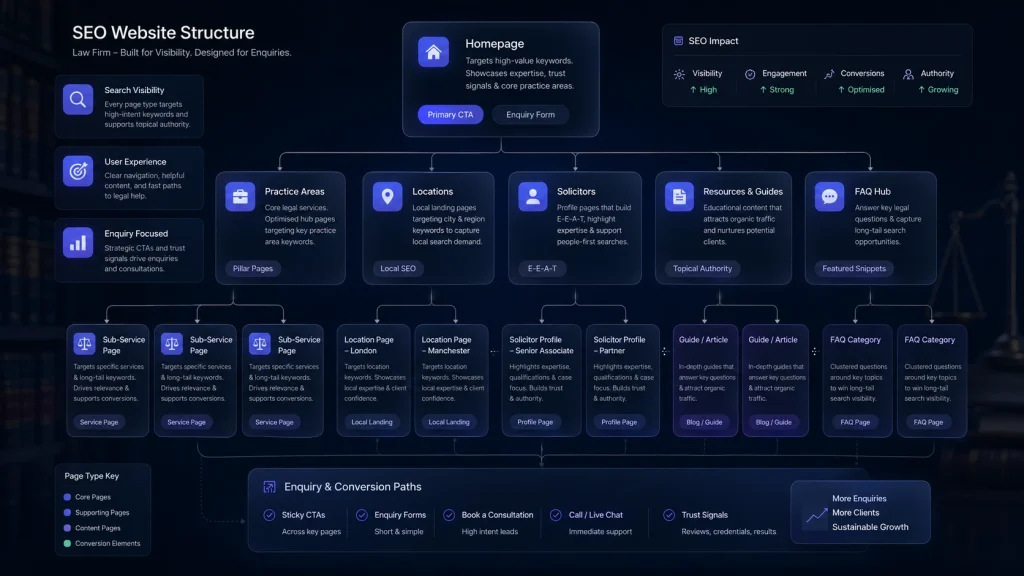
The best SEO structure for a law firm website
A strong law firm website needs a clear structure. Google and users should both understand what the firm does, where it operates and who it helps.
A good structure usually looks like this:
| Page type | Purpose | Example |
|---|---|---|
| Main service page | Targets broad practice area | Family Law Solicitors |
| Sub-service page | Targets specific legal issue | Divorce Solicitors |
| Location page | Targets local search | Family Solicitors in Manchester |
| Blog guide | Answers common questions | How does the divorce process work? |
| Solicitor profile | Builds trust | Jane Smith, Family Law Solicitor |
| FAQ section | Captures long-tail searches | How long does divorce take? |
A weak structure often has only one general page for each department. For example, a firm may have a page called “Family Law” but no separate pages for divorce, child arrangements, financial settlements or cohabitation disputes.
That limits the firm’s ability to rank for specific searches.
A better structure would include:
- Family Law Solicitors
- Divorce Solicitors
- Child Arrangement Solicitors
- Financial Settlement Solicitors
- Cohabitation Agreement Solicitors
- Family Solicitors in [Location]
- Divorce Process Guide
- Family Law FAQs
This gives Google more context and gives clients a clearer journey.
Keyword research for law firms
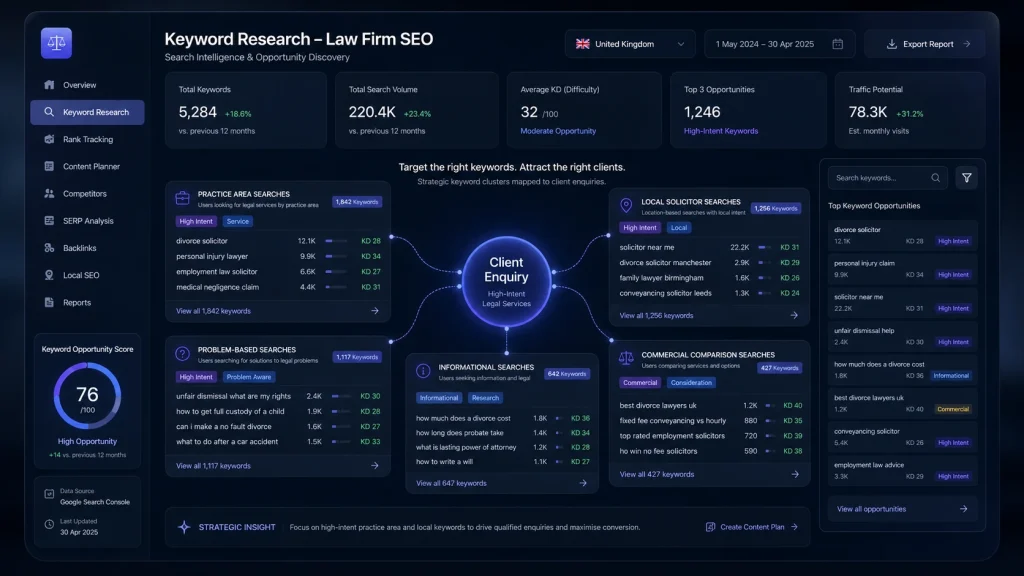
Keyword research helps you understand what potential clients are actually searching for.
For law firms, keywords usually fall into five groups:
1. Practice-area keywords
These relate to the legal service.
Examples:
- family law solicitor
- immigration solicitor
- conveyancing solicitor
- employment solicitor
- probate solicitor
- personal injury solicitor
- commercial litigation solicitor
2. Problem-based keywords
These reflect the client’s situation.
Examples:
- unfair dismissal advice
- spouse visa refusal
- child custody agreement
- contested probate
- settlement agreement advice
3. Local keywords
These combine the service with a location.
Examples:
- divorce solicitor in Leeds
- conveyancing solicitor in Bristol
- immigration lawyer in Birmingham
- employment solicitor in London
4. Informational keywords
These are used by people researching before contacting a solicitor.
Examples:
- how long does probate take
- what is a settlement agreement
- how to apply for a spouse visa
- what happens during divorce mediation
5. Commercial comparison keywords
These are used by people close to choosing a firm.
Examples:
- best family solicitor near me
- immigration solicitor fees
- fixed fee conveyancing solicitor
- employment lawyer consultation
The mistake many law firms make is focusing only on broad, competitive keywords. Long-tail and local keywords often convert better because they match the client’s exact need.
On-page SEO for law firms
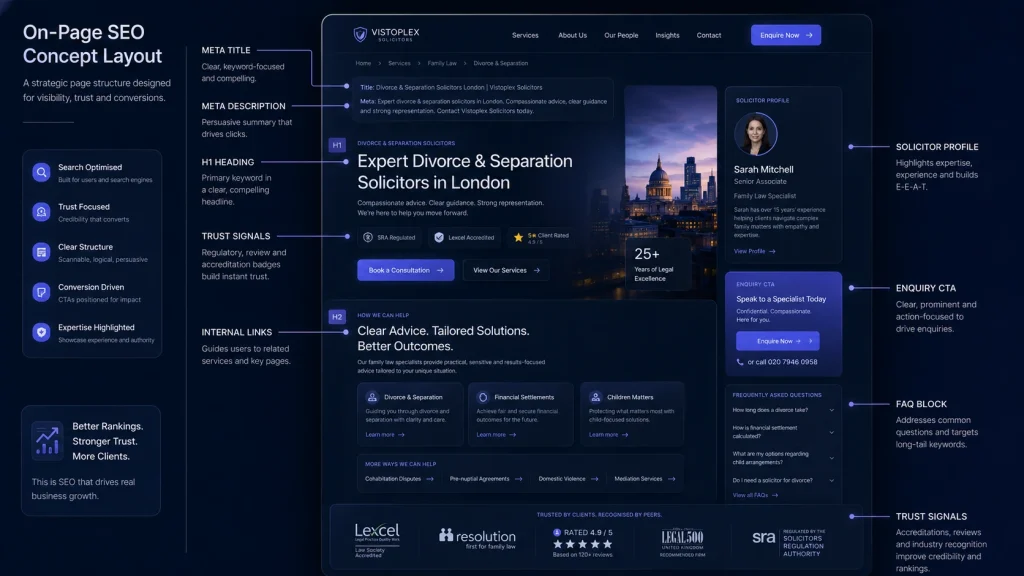
On-page SEO means improving individual pages so search engines and users can understand them.
For a law firm service page, this includes:
- clear H1 heading
- useful H2 and H3 headings
- descriptive title tag
- strong meta description
- clear URL
- helpful body content
- internal links
- FAQs
- image alt text
- solicitor profiles
- calls to action
- trust signals
MLT Digital highlights several on-page factors for law firms, including headings, internal links, body text, meta descriptions, images and social proof.
A strong service page should not just list what the firm does. It should explain:
- who the service is for
- what problems the client may be facing
- how the firm can help
- what the process looks like
- who will handle the matter
- why the firm is credible
- how to make contact
For example, a page for employment settlement agreements should explain what a settlement agreement is, when legal advice is needed, what the solicitor reviews, likely timescales, fees where applicable, and what happens after the client enquires.
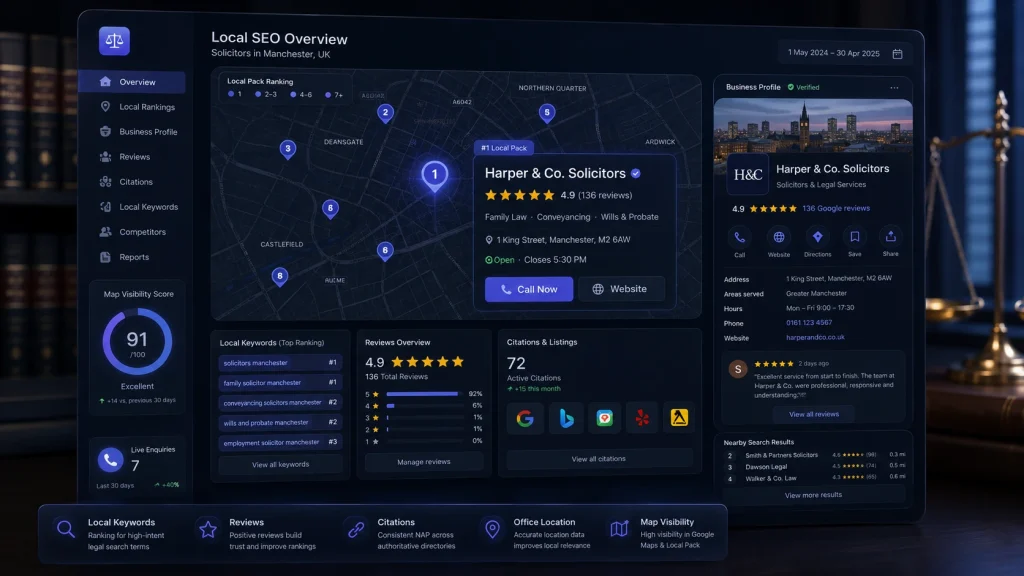
Local SEO for law firms
Local SEO helps law firms appear when people search for legal services in a specific area.
This is critical for many firms because clients often want a solicitor near them or a firm that understands their local court, area or community.
Local SEO includes:
- Google Business Profile optimisation
- local service pages
- consistent name, address and phone details
- local citations
- Google reviews
- location-specific content
- map pack visibility
- local backlinks
Cal Partners also identifies local optimisation as a key strategy for law firms, including Google Business Profile, location-based keywords and client testimonials.
A good local SEO setup should include:
- correct business name
- correct categories
- complete service list
- up-to-date opening hours
- photos
- regular updates
- review responses
- local landing pages
- contact details matching across directories
The website should also support local search. A firm with offices in London, Manchester and Birmingham should not rely on one generic contact page. Each office location should have a useful page explaining services, team members, contact details, directions and local relevance.
Content marketing and legal SEO
Content is one of the strongest ways to build SEO visibility, but only when it is planned properly.
Useful law firm content includes:
- legal process guides
- FAQs
- cost guides
- local guides
- comparison articles
- legal update articles
- practice-area explainers
- client journey guides
- case-study style content
The best content answers real client questions and links back to relevant service pages.
For example:
| Blog topic | Should link to |
|---|---|
| How long does divorce take? | Divorce Solicitors page |
| What is a settlement agreement? | Employment Law page |
| What happens after a spouse visa refusal? | Immigration Solicitors page |
| Do I need probate? | Probate Solicitors page |
| What happens after a police interview? | Criminal Defence page |
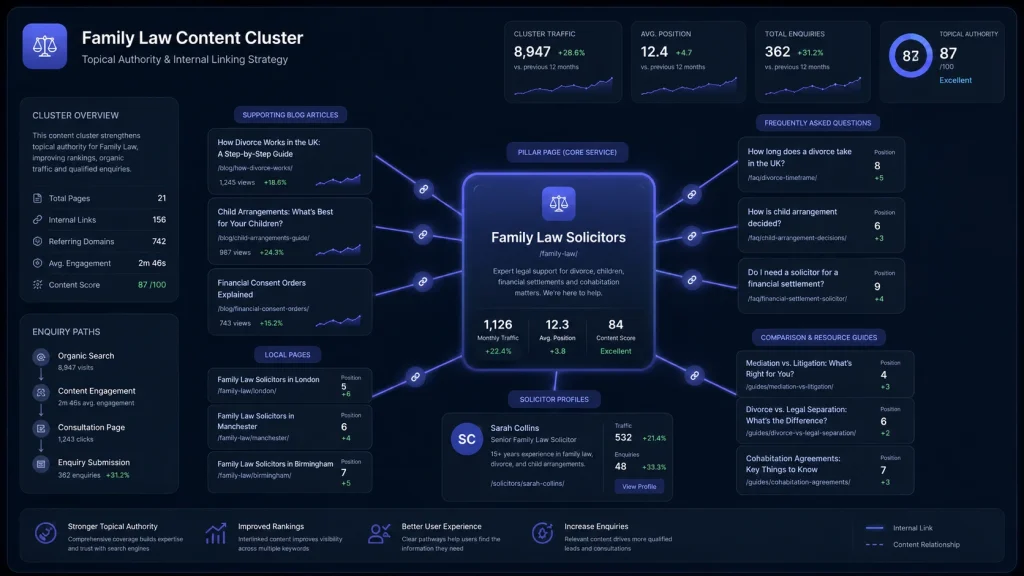
Content should not be published randomly. Each blog should support a commercial page or a wider topic cluster.
A good topic cluster for a family law firm might include:
- Family Law Solicitors
- Divorce Solicitors
- Child Arrangement Solicitors
- Financial Settlement Solicitors
- How long does divorce take?
- What is a child arrangement order?
- What happens at family mediation?
- How are assets split in divorce?
This helps Google understand the firm’s expertise and gives potential clients several useful entry points.
Technical SEO for law firm websites
Technical SEO makes sure search engines can crawl, understand and index your website properly.
For law firms, technical SEO should cover:
- mobile usability
- page speed
- secure HTTPS
- indexability
- XML sitemap
- robots.txt
- canonical tags
- broken links
- redirect issues
- structured data
- duplicate content
- Core Web Vitals
Technical SEO is often invisible to clients, but it affects performance. A slow, poorly structured or difficult-to-crawl website may struggle even if the written content is good.
Google’s documentation explains that SEO can help search engines understand content and help users find a site through search.
For law firms, technical SEO becomes especially important when the site has:
- many practice-area pages
- many office locations
- blog archives
- old pages from previous websites
- duplicated local pages
- tracking scripts
- embedded forms
- third-party chat tools
Before investing heavily in content, the technical foundation should be checked.

Backlinks and authority for law firms
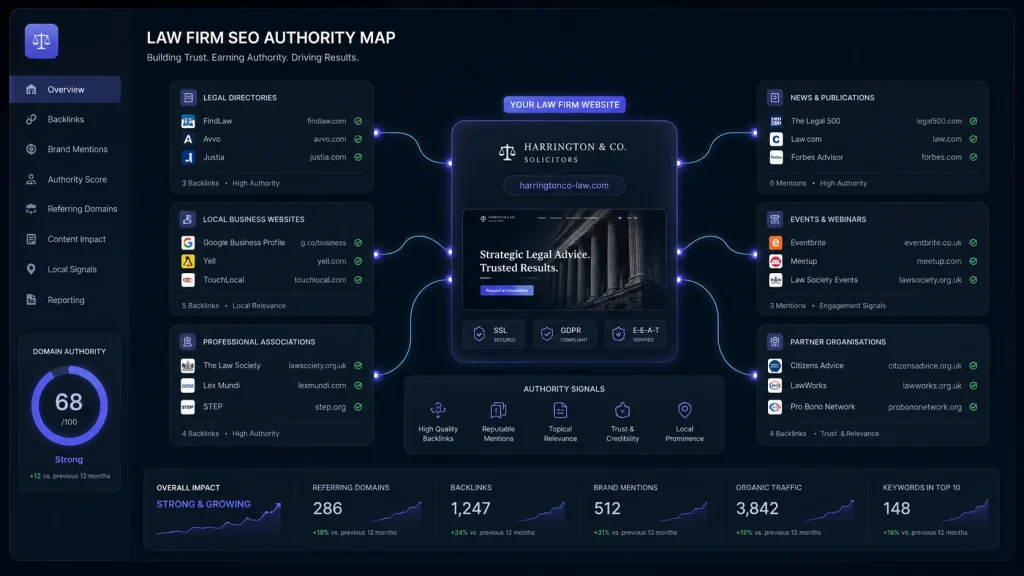
Backlinks are links from other websites to your law firm’s website. They can help build authority when they come from credible and relevant sources.
For law firms, strong backlink opportunities may include:
- legal directories
- local business directories
- chambers of commerce
- professional associations
- charity sponsorship pages
- local news
- guest commentary
- legal publications
- partner organisations
- universities or events
- podcasts and interviews
MLT Digital recommends focusing on respected legal directories and credible local citations rather than low-quality link schemes.
This matters because many law firm SEO campaigns fail after the basics are done. The service pages are improved, blogs are published, but the website still lacks enough external authority to compete.
Good link building should be earned, relevant and safe. Avoid bulk directory submissions, paid spam links and irrelevant guest posts. These may create short-term noise but can damage long-term SEO quality.
Reviews and trust signals
SEO is not only about rankings. A client still has to choose your firm.
Trust signals help turn search visitors into enquiries. These include:
- Google reviews
- ReviewSolicitors reviews
- testimonials
- accreditations
- solicitor profiles
- Legal 500 or Chambers mentions where applicable
- case experience
- clear contact information
- transparent process information
- pricing information where required
Reviews also support local SEO because they influence how attractive your firm looks in the map pack and local search results.
A law firm should have a simple review process. The team should know when to ask, which platform to use and how to respond professionally.
SEO and conversion tracking
SEO should be judged by enquiries, not rankings alone.
A keyword ranking is useful, but it does not pay the bills. The real question is whether SEO is generating good-quality enquiries and signed matters.
Track:
- organic traffic
- phone calls from organic search
- form submissions
- live chat enquiries
- booked consultations
- enquiry quality
- signed matters
- revenue by source
- pages that generate leads
- pages with high traffic but low conversion
A firm may discover that one blog attracts a lot of traffic but no enquiries, while one local service page attracts fewer visitors but generates signed matters every month.
That is why SEO reporting should combine visibility data with business data.
SEO for different practice areas
Different legal services need different SEO strategies.
Family law
Family law SEO is often local and trust-led. Useful topics include divorce, child arrangements, financial settlements, mediation and urgent applications.
Immigration law
Immigration SEO often combines national and local intent. Strong content is needed around visas, appeals, refusals, family migration and sponsor licences.
Conveyancing
Conveyancing SEO is price-sensitive and location-sensitive. Pages should be clear about the process, fees, timescales and quote requests.
Employment law
Employment SEO can target both employees and employers. Settlement agreements, unfair dismissal, redundancy and workplace disputes often have strong search demand.
Probate and private client
Probate SEO should focus on clarity and reassurance. Clients often search during stressful situations and need simple explanations.
Criminal defence
Criminal defence SEO is urgent and local. Mobile performance, click-to-call buttons and clear emergency contact options matter.
Commercial law
Commercial law SEO often needs thought leadership, sector pages, partner profiles and B2B content rather than only local search pages.
Common law firm SEO mistakes
Many law firms struggle with SEO because the strategy is incomplete.
Common mistakes include:
- using one generic page for every legal service
- publishing thin blog posts
- ignoring local SEO
- not optimising Google Business Profile
- using duplicated location pages
- hiding solicitor profiles
- not tracking phone calls
- not building internal links
- focusing only on rankings
- not improving website conversion
- using generic AI content without legal review
- buying low-quality backlinks
Another common issue is having a visually attractive website that is not structured for search. A site can look premium but still fail if service pages are too thin, headings are unclear, or Google cannot understand the structure.
A 90-day SEO plan for law firms
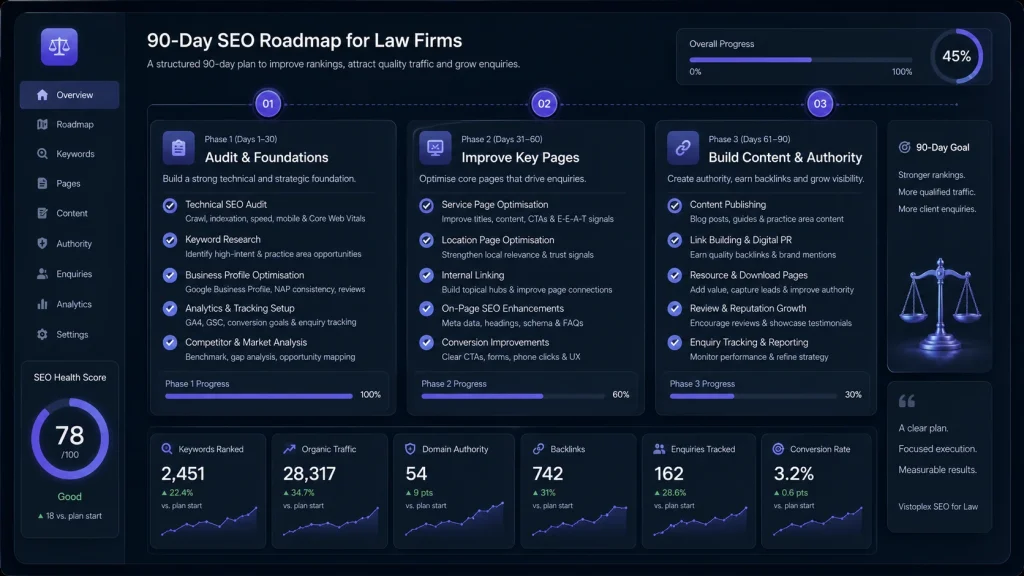
SEO takes time, but the first 90 days should create a clear foundation.
Days 1–30: Audit and fix foundations
Start with:
- keyword research
- competitor review
- technical SEO audit
- Google Search Console review
- Google Business Profile audit
- page speed check
- service page review
- internal linking review
- tracking setup
- call tracking setup
Identify which pages should be improved first. Usually, these are high-value practice-area pages and location pages.
Days 31–60: Improve key pages
Focus on:
- rewriting main service pages
- improving title tags and meta descriptions
- adding FAQs
- adding solicitor profiles
- improving calls to action
- adding internal links
- strengthening local pages
- improving Google Business Profile
- starting review generation
This stage should make the site clearer for both Google and potential clients.
Days 61–90: Build content and authority
Then move to:
- publishing supporting blogs
- building topic clusters
- earning relevant links
- improving underperforming pages
- reviewing enquiry quality
- tracking rankings and conversions
- expanding successful topics
By the end of 90 days, the firm should have a stronger structure, better tracking and a clearer content plan.
How long does SEO take for law firms?
SEO is usually a medium to long-term strategy. Some improvements may be seen within weeks, especially if technical issues or weak pages are fixed. More competitive rankings often take several months or longer.
The timeline depends on:
- current website quality
- domain authority
- competition
- location
- practice area
- content quality
- backlink profile
- technical issues
- review profile
- consistency of work
A small local firm may see local improvements faster than a firm trying to rank nationally for competitive legal keywords.
SEO should not be judged after two weeks. It should be reviewed through month-by-month progress in rankings, impressions, enquiries and signed matters.
Should law firms hire an SEO agency?
A law firm can do some SEO internally, especially basic content updates, Google Business Profile improvements and review generation.
However, SEO becomes more complex when the firm needs:
- technical audits
- keyword research
- content strategy
- local SEO
- backlink strategy
- conversion tracking
- analytics reporting
- PPC and SEO coordination
- multi-office SEO
- practice-area content clusters
Clio recommends checking legal SEO experience, references, case studies and warning signs such as guaranteed results or unclear processes when choosing an SEO expert.
A good SEO agency for law firms should explain what they are doing and why. They should connect SEO work to enquiries and business outcomes, not just keyword rankings.
FAQs
What is law firm SEO?
Law firm SEO is the process of improving a law firm’s website so it appears higher in search results for relevant legal services, questions and local solicitor searches.
Is SEO worth it for law firms?
Yes, SEO can be valuable for law firms because it can generate long-term visibility, trust and enquiries. It works best when combined with strong service pages, local SEO, reviews and conversion tracking.
What is the difference between SEO for law firms and SEO for solicitors?
They are very similar. “SEO for law firms” usually refers to the firm as a business, while “SEO for solicitors” is often used in the UK to describe SEO for solicitor practices and regulated legal services.
How long does SEO take for solicitors?
SEO usually takes several months to show meaningful results. Some technical and local improvements may work faster, but competitive legal rankings normally require consistent content, authority and optimisation.
What are the best SEO keywords for law firms?
The best keywords depend on the practice area and location. Examples include “family solicitor in London”, “immigration solicitor near me”, “employment lawyer settlement agreement” and “conveyancing solicitor Manchester”.
Do law firms need local SEO?
Most consumer-facing law firms need local SEO because clients often search for solicitors by location. Local SEO is especially important for family law, conveyancing, immigration, employment, probate and criminal defence.
Should law firms blog for SEO?
Yes, but blogs should be planned around real search demand and linked to relevant service pages. Random legal updates are less effective than useful guides that answer client questions and support commercial pages.
What should a law firm service page include?
A good service page should explain the legal service, who it helps, the process, common questions, fees where appropriate, solicitor experience, trust signals and clear contact options.
Can AI content be used for law firm SEO?
AI can help with research and drafting, but legal content should be reviewed by someone with suitable expertise. Inaccurate or generic content can harm trust and performance.
How should law firms measure SEO success?
Law firms should measure rankings, impressions, organic traffic, calls, form submissions, enquiry quality, consultations and signed matters. Rankings alone are not enough.
Final thoughts
SEO for law firms is not about chasing one keyword or publishing occasional blog posts. It is about building a search-friendly website that clearly explains your services, proves your expertise and makes it easy for potential clients to contact you.
The strongest law firm SEO strategies combine service pages, local SEO, content, technical performance, reviews, backlinks and tracking. When these elements work together, SEO can become one of the most reliable sources of new enquiries for a law firm.
For a joined-up approach to SEO, PPC, web design and content, see Vistoplex’s digital marketing services for law firms.