
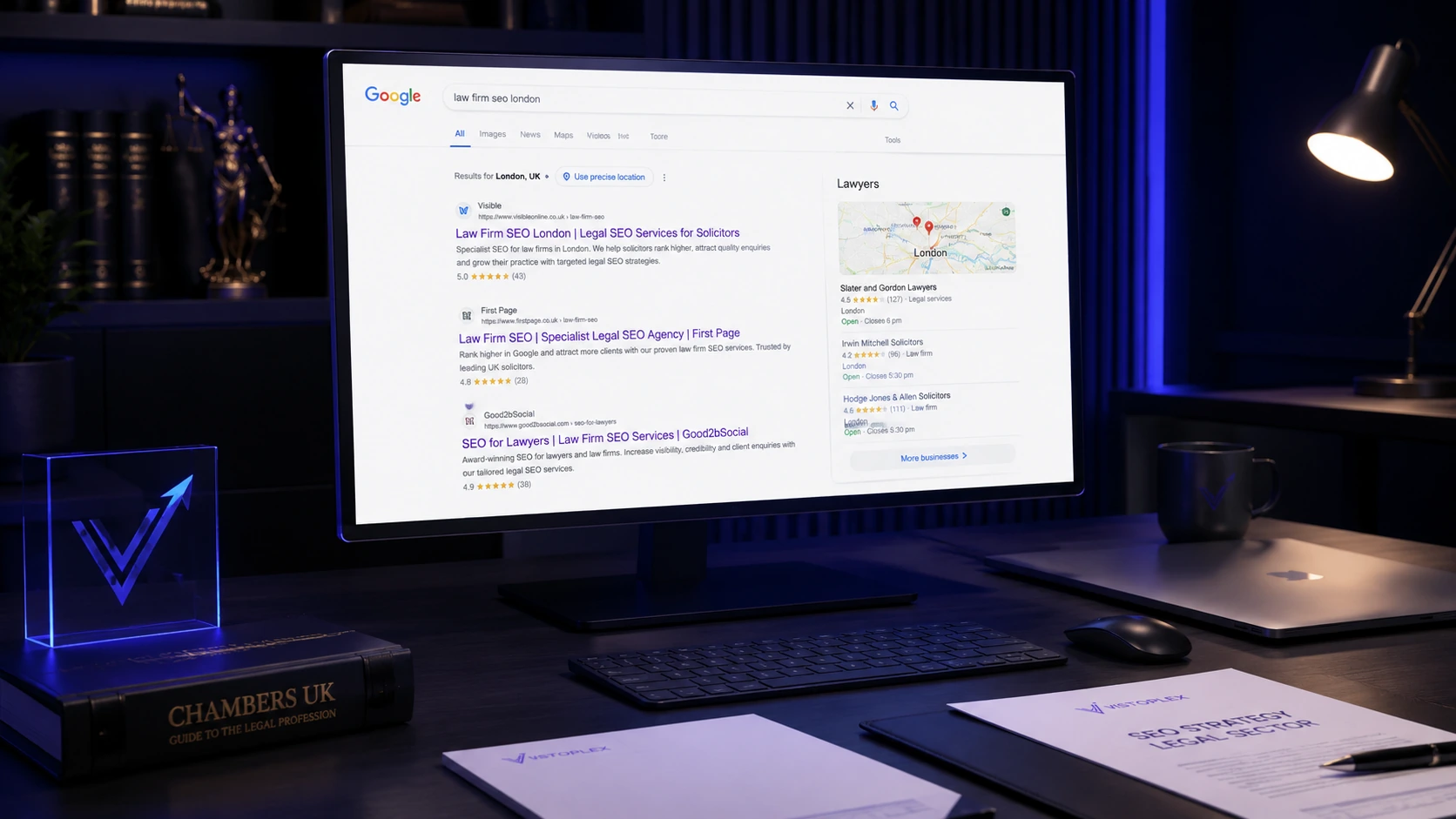
Local SEO for law firms is the process of improving a solicitor’s visibility in local Google results, Google Maps and location-based searches.
For many UK law firms, local SEO can be one of the most valuable sources of enquiries. A person searching for “family solicitor near me”, “immigration solicitor in Birmingham” or “conveyancing solicitor in Manchester” is often much closer to making contact than someone reading a general legal article.
The challenge is that local SEO is not just about adding a city name to a page. It involves Google Business Profile optimisation, reviews, local landing pages, consistent business details, trust signals, website structure, citations and tracking.
This guide explains how local SEO works for law firms, what solicitors should prioritise, and how to turn local visibility into better-quality enquiries.
For firms that want SEO, PPC, website design and content handled together, Vistoplex provides digital marketing services for law firms.
What is local SEO for law firms?
Local SEO helps law firms appear when potential clients search for legal services in a specific area.
Examples include:
- divorce solicitor near me
- immigration solicitor in London
- employment solicitor Birmingham
- conveyancing solicitor Manchester
- probate solicitor Leeds
- family law firm in Bristol
- criminal defence solicitor near me
These searches usually have strong intent. The person is not only researching a legal topic. They are often looking for a solicitor they can contact soon.
Local SEO usually focuses on three areas:
- Google Business Profile and map visibility
- Local service and location pages on the website
- Reviews, citations and local trust signals
When these areas work together, a law firm can appear more often in local searches and convert more local visitors into enquiries.
Why local SEO matters for solicitors
Legal services are often local, especially for consumer-facing practice areas. Even when meetings can be handled remotely, clients may still prefer a firm that appears local, established and easy to contact.
Local SEO matters because it helps firms capture searches from people who are already looking for legal help in their area.
This is especially useful for:
- family law
- conveyancing
- immigration
- probate
- employment law
- criminal defence
- personal injury
- landlord and tenant disputes
- wills and lasting powers of attorney
Local visibility also builds trust. If a firm appears in Google Maps, has strong reviews, clear contact details and a helpful local landing page, it can look more credible than a competitor with a thin website and weak review profile.
For many law firms, the first local SEO goal should be simple: make it easy for nearby clients to find, trust and contact the firm.
How Google local rankings work
Google local visibility is influenced by three broad factors: relevance, distance and prominence.
Relevance
Relevance is how well your business matches what someone is searching for.
For a law firm, this means your Google Business Profile, website pages and content should clearly explain your services. If you handle family law, immigration, conveyancing or employment matters, that should be clear across your profile and website.
A vague profile that only says “legal services” gives Google and users less detail. A complete profile with accurate categories, services, descriptions and matching website pages gives stronger relevance signals.
Distance
Distance is how close your firm is to the searcher or the location used in the search.
You cannot control where the searcher is, but you can make sure your office details are accurate and consistent. If your firm has more than one office, each office should be represented clearly and correctly.
Prominence
Prominence is how well known and trusted the firm appears to be.
For law firms, prominence can be supported by reviews, links, citations, directory mentions, local press, legal profiles and overall online authority.
This is why local SEO is not only a Google Business Profile task. Your website, reviews and wider online footprint all matter.
Google Business Profile for law firms
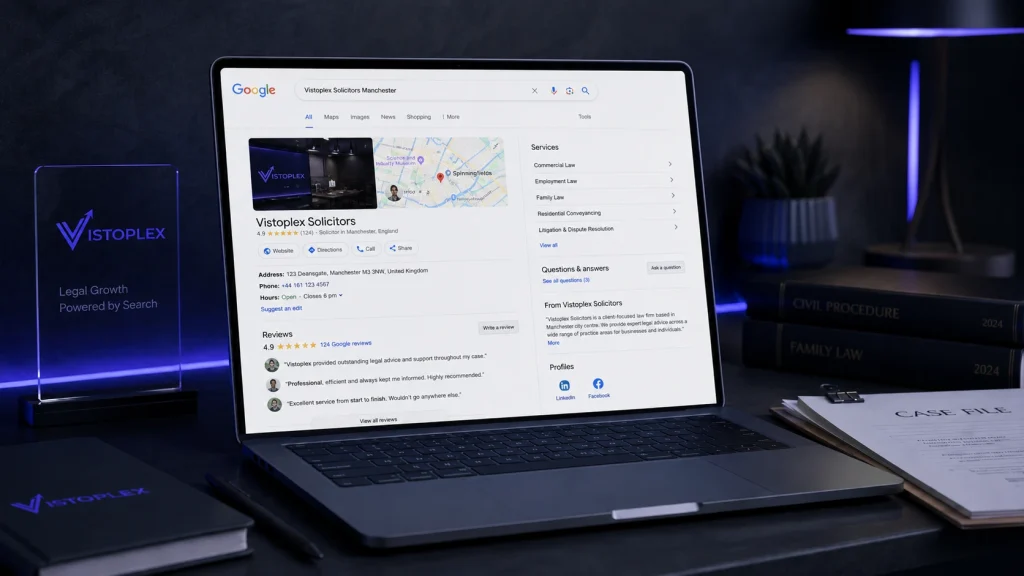
Google Business Profile is one of the most important assets for local SEO.
A well-optimised profile can help a law firm appear in map results and local search results. It also gives potential clients quick access to the firm’s phone number, website, directions, reviews, opening hours and services.
A law firm’s Google Business Profile should include:
- correct firm name
- accurate address
- correct phone number
- website link
- opening hours
- relevant business category
- service list
- business description
- photos
- review responses
- appointment or contact link where suitable
The information should match the firm’s website and other directory listings. If the firm name, phone number or address is inconsistent across the web, it can create confusion for both users and search engines.
Choosing the right Google Business Profile categories
Categories help Google understand what type of business you are.
For law firms, the primary category should usually be the most accurate legal category available. Depending on the firm, this may be a general solicitor/law firm category or a more specific legal service category.
The firm should also use relevant services inside the profile. For example:
- Family law
- Divorce law
- Immigration law
- Conveyancing
- Employment law
- Wills and probate
- Criminal defence
- Commercial law
- Personal injury
Do not add services that the firm does not genuinely provide. Accuracy matters more than stuffing the profile with every possible legal term.
The goal is to help Google and clients understand what the firm actually does.
Optimising the business description
The business description should be clear and natural. It should explain who the firm helps, what legal services it offers and where it operates.
Avoid vague wording such as:
“We are a leading law firm providing a wide range of legal services.”
A stronger version would be:
“We are a UK law firm supporting individuals and businesses with family law, immigration, conveyancing, employment law and private client matters. Our solicitors provide clear advice, practical next steps and responsive support for clients in [location] and across England and Wales.”
The exact wording should reflect the firm’s real services, location and audience.
The description should not be overloaded with keywords. It should read like useful business information.
Reviews and local trust
Reviews are extremely important for local law firm marketing.
Potential clients often compare firms before making contact. A strong review profile can help a firm stand out in Google Maps and search results.
Reviews can support:
- trust
- click-through rate
- local visibility
- conversion rate
- reputation
- enquiry quality
However, reviews must be handled carefully. Law firms should never buy reviews, offer incentives for reviews, pressure clients to leave positive feedback, or ask for specific wording.
A good review process should be ethical and simple:
- Identify appropriate moments to ask for feedback.
- Ask clients to share their genuine experience.
- Make the review link easy to access.
- Respond professionally to reviews.
- Monitor review platforms regularly.
A review request should be neutral. For example:
“Thank you for choosing our firm. If you would like to share your experience, you can leave a review here.”
Avoid wording that only asks happy clients for five-star reviews. Review generation should be genuine and balanced.
How law firms should respond to reviews
Responding to reviews shows that the firm is active and values feedback.
Positive review response example:
“Thank you for your kind feedback. We are pleased we could assist and appreciate you taking the time to share your experience.”
Negative review response example:
“Thank you for your feedback. We are sorry to hear about your concerns. Please contact us directly so we can review this matter appropriately.”
For law firms, responses must be careful. Do not reveal confidential information, case details or anything that could identify private matters.
Keep responses short, professional and neutral.
Local landing pages for law firms
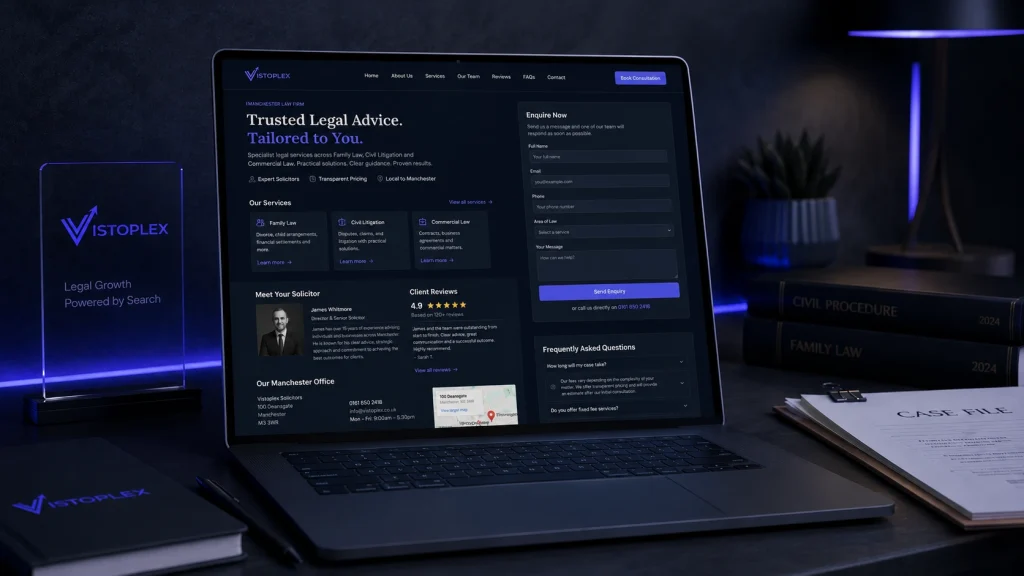
A strong local SEO strategy needs proper local landing pages.
If a firm wants to rank for “family solicitor in Birmingham”, it needs more than a generic family law page. It should have a useful location-focused page that explains the service in that area.
A good local landing page should include:
- clear H1 heading
- relevant legal service
- location information
- office/contact details
- team or solicitor information
- service explanation
- FAQs
- reviews or testimonials where appropriate
- internal links
- clear call to action
For example:
Family Solicitors in Manchester
This page could explain:
- family law services offered
- divorce support
- child arrangement matters
- financial settlements
- how consultations work
- who handles the work
- how to contact the Manchester office
- related FAQs
The page should be genuinely useful. It should not be a copied template with only the city name changed.
Avoiding duplicated location pages
One of the biggest local SEO mistakes is creating dozens of near-identical location pages.
For example:
- Divorce Solicitors in Manchester
- Divorce Solicitors in Leeds
- Divorce Solicitors in Birmingham
- Divorce Solicitors in Bristol
If every page has the same wording and only the city changes, the pages are unlikely to perform well.
Each location page should include unique and helpful information, such as:
- local office details
- local team members
- relevant services
- local court or process notes where appropriate
- FAQs specific to that location
- testimonials linked to that office or service
- directions or accessibility information
- local contact options
Quality is better than quantity.
It is better to have five strong location pages than fifty thin pages.
Local SEO for multi-office law firms
Multi-office law firms need a more structured approach.
Each office should usually have its own page with:
- office name
- address
- phone number
- opening hours
- map embed
- services available at that office
- solicitor profiles
- accessibility information
- parking or travel information
- local FAQs
- clear enquiry options
The Google Business Profile for each office should match the website details.
A common mistake is sending every office profile to the homepage. It is usually better to link each profile to the relevant office page, especially if the office page is well optimised.
For example:
- Google Business Profile: Birmingham office
- Website link:
/locations/birmingham/
This creates a cleaner local journey.
Local citations and NAP consistency
NAP means name, address and phone number.
For local SEO, the firm’s details should be consistent across important platforms, such as:
- Google Business Profile
- Bing Places
- Apple Maps
- legal directories
- local business directories
- chamber of commerce listings
- social profiles
- review platforms
- the firm’s website
Inconsistent details can confuse users and weaken trust.
For example, avoid having:
- different phone numbers across listings
- old office addresses still visible
- old firm names after rebranding
- duplicate profiles
- wrong opening hours
- broken website links
A citation clean-up can be one of the quickest local SEO improvements, especially for firms that have moved office, merged, rebranded or changed phone systems.
Local content for law firms
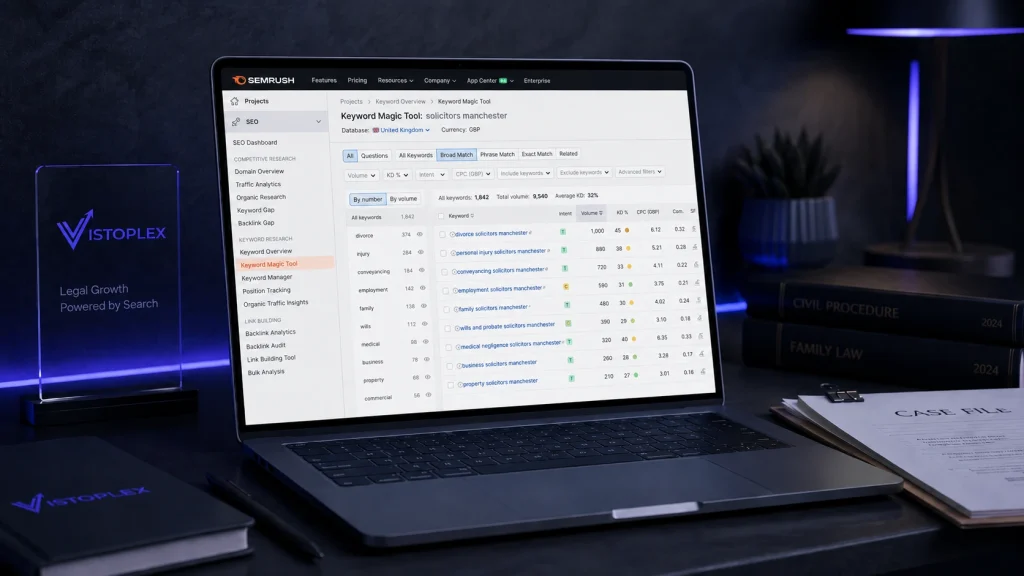
Local content helps connect the firm’s services with real local search intent.
Useful local content includes:
- local service pages
- guides for clients in a specific city
- local court or process explainers
- community involvement pages
- local business/legal updates
- office pages
- local FAQs
- area-specific legal guides
Examples:
- How to choose a family solicitor in Leeds
- What to expect from a conveyancing solicitor in Manchester
- Immigration solicitor consultations in Birmingham
- Employment law advice for employers in London
- Probate solicitor support in Bristol
The content should be genuinely useful. It should not exist only to target a location keyword.
Local SEO for different practice areas
Different legal services need different local SEO approaches.
Family law
Family law is usually trust-led and local. Clients want reassurance, privacy and clear next steps. Local family law pages should include solicitor profiles, process information, FAQs and clear consultation options.
Conveyancing
Conveyancing searches are often price-sensitive and local. Pages should make the process clear and make quote requests easy.
Immigration law
Immigration can be local or national. Local SEO should focus on consultations, urgent support, visa types and clear service pages.
Employment law
Employment law can target both employees and employers. Pages should separate settlement agreements, unfair dismissal, redundancy, discrimination and employer advice.
Probate and wills
Private client services need clarity and trust. Local pages should explain process, timescales and how the firm supports families.
Criminal defence
Criminal defence is often urgent. Mobile speed, click-to-call buttons and clear emergency contact options are important.
Law firm website conversion for local SEO
Ranking locally is useful only if visitors turn into enquiries.
A local landing page should make contact easy. Include:
- visible phone number
- short enquiry form
- office address
- consultation details
- clear next steps
- solicitor profiles
- trust signals
- reviews
- related services
- FAQs
Many law firm pages fail because they explain the service but do not make the next step obvious.
A good page should answer:
- Can this firm help me?
- Are they local or relevant to my area?
- Do they look credible?
- Who will handle my enquiry?
- What happens after I contact them?
- How do I get started?
If the page answers those questions clearly, it is more likely to convert.
Structured data for local law firm pages
Structured data helps search engines understand key business information.
For law firms, useful structured data may include:
- LocalBusiness schema
- LegalService schema
- Organization schema
- FAQ schema
- Breadcrumb schema
- Review or aggregate rating schema where appropriate and compliant
Structured data will not magically make a page rank, but it can support clarity and eligibility for certain search features.
The most important thing is that structured data matches the visible page content. Do not add misleading schema or reviews that are not clearly shown on the page.
Tracking local SEO enquiries
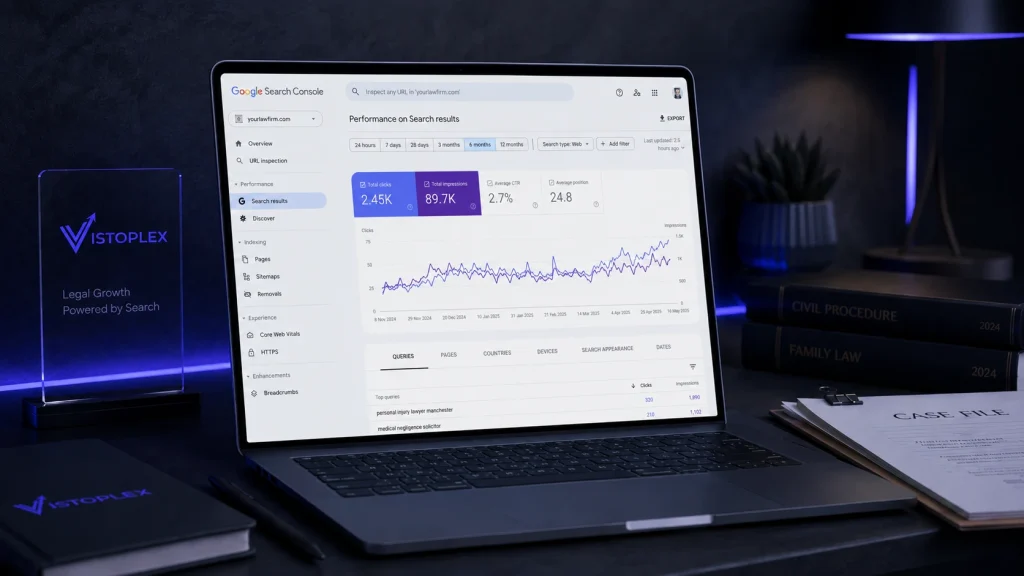
Local SEO should be measured by enquiries, not just rankings.
Track:
- Google Business Profile calls
- direction requests
- website clicks
- form submissions
- phone calls from landing pages
- booked consultations
- enquiry quality
- signed matters
- location-based performance
- organic traffic to local pages
A firm may find that one office page generates fewer visits but better quality enquiries. Another page may get traffic but no conversions.
That is why tracking should look at business outcomes, not just impressions.
Useful tools include:
- Google Search Console
- Google Analytics
- Google Business Profile performance
- call tracking
- CRM source tracking
- form tracking
- reporting dashboards
The aim is to understand which locations, pages and services are actually producing valuable enquiries.
A 90-day local SEO plan for law firms
Local SEO does not need to be complicated at the start. The first 90 days should focus on visibility, accuracy and conversion.
Days 1–30: Fix the local foundations
Start with:
- Google Business Profile audit
- business category review
- service list update
- address and phone number check
- opening hours update
- website link check
- photo upload
- review response review
- citation audit
- local landing page audit
- tracking setup
This stage makes sure the firm’s local information is accurate and complete.
Days 31–60: Improve local pages and reviews
Focus on:
- improving office pages
- improving practice-area location pages
- adding local FAQs
- adding solicitor profiles
- strengthening internal links
- starting a review request process
- updating directory listings
- fixing old citations
- adding clear enquiry forms
This stage improves both local relevance and conversion.
Days 61–90: Build authority and measure results
Then move to:
- local content creation
- local backlinks
- review growth
- Google Business Profile updates
- performance reporting
- enquiry quality review
- improving pages with weak conversions
- expanding successful local topics
By the end of 90 days, the firm should have stronger local foundations and clearer data.
Common local SEO mistakes law firms make
Many firms struggle with local SEO because they only optimise one piece of the puzzle.
Common mistakes include:
- incomplete Google Business Profile
- wrong business categories
- old office addresses online
- inconsistent phone numbers
- no review process
- not responding to reviews
- thin local landing pages
- duplicated city pages
- no solicitor profiles
- no local FAQs
- no call tracking
- sending every local listing to the homepage
- ignoring mobile users
- weak internal links
- no clear contact options
Another common mistake is treating local SEO as a one-time setup. Local SEO needs regular review, especially when services, team members, office details or opening hours change.
How local SEO supports wider digital marketing
Local SEO works best when it is connected to the rest of the firm’s digital marketing.
For example:
- SEO brings in organic visitors.
- Local SEO captures map and location-based searches.
- PPC tests high-intent local keywords.
- Website design improves conversion.
- Reviews build trust.
- Content answers client questions.
- Tracking shows which enquiries turn into clients.
This is why local SEO should not sit separately from the wider marketing strategy. It should support the firm’s service pages, content strategy, PPC campaigns and enquiry process.
Read our full guide to digital marketing for law firms and our guide to SEO for law firms for the broader strategy.
FAQs
What is local SEO for law firms?
Local SEO for law firms is the process of improving a solicitor’s visibility in location-based Google searches, Google Maps and local search results.
Why is local SEO important for solicitors?
Local SEO is important because many clients search for legal services near them. It helps solicitors appear for searches such as “family solicitor near me” or “conveyancing solicitor in Manchester”.
How do law firms rank in Google Maps?
Google Maps visibility is influenced by relevance, distance and prominence. A complete Google Business Profile, accurate business information, reviews and a strong website can all support local visibility.
Do law firms need Google Business Profile?
Yes, most law firms should have a complete and accurate Google Business Profile. It helps clients find the firm in Google Search and Maps.
Can solicitors ask clients for Google reviews?
Yes, solicitors can ask clients to share genuine feedback, but they should not offer incentives, pressure clients, or ask only for positive reviews.
What should a law firm location page include?
A location page should include services, office details, solicitor profiles, contact information, FAQs, local relevance, trust signals and clear enquiry options.
Should every office have its own page?
For multi-office law firms, each office should usually have its own useful page with accurate details, services, team information and contact options.
What are local citations?
Local citations are online mentions of the firm’s name, address and phone number. They may appear on directories, legal platforms, local business sites and map services.
How long does local SEO take for law firms?
Some local SEO improvements can be seen within weeks, especially after fixing Google Business Profile or citation issues. Stronger local rankings usually take several months of consistent work.
How should law firms track local SEO success?
Track calls, form submissions, Google Business Profile actions, website clicks, direction requests, booked consultations and signed matters from local pages and local search.
Final thoughts
Local SEO can be one of the most effective marketing channels for law firms because it captures people searching for legal help in a specific place.
The strongest results usually come from combining Google Business Profile optimisation, reviews, local landing pages, accurate citations, strong website conversion and clear tracking.
A law firm that appears locally, looks trustworthy and makes it easy to enquire has a much better chance of turning search visibility into real clients.
For a joined-up approach to local SEO, website design, PPC and content, see Vistoplex’s digital marketing services for law firms.