

Digital marketing for law firms is no longer just about having a website and posting the occasional update online. Clients now compare solicitors through Google, reviews, local search results, directory listings, social media, AI search results and the quality of a firm’s website before they make contact.
For many law firms, the problem is not a lack of marketing activity. It is that SEO, PPC, website design, content, reviews and lead tracking are treated as separate tasks instead of one joined-up client acquisition system.
This guide explains how UK law firms can approach digital marketing properly, which channels matter most, what to prioritise first, and how to turn more website visitors into real enquiries.
For firms that want SEO, PPC, web design, content and automation handled together, Vistoplex provides digital marketing services for law firms.
What is digital marketing for law firms?
Digital marketing for law firms means using online channels to attract, inform and convert potential clients. It usually includes search engine optimisation, Google Ads, local SEO, website design, content marketing, review generation, email marketing, social media, conversion tracking and reporting.
For a law firm, the goal is not simply “more traffic”. The real goal is better quality enquiries from people who need legal help and are ready to take the next step.
A strong digital marketing strategy should answer four questions:
- Can potential clients find the firm when they search?
- Does the website build enough trust for them to enquire?
- Can the firm track where enquiries came from?
- Can the firm turn those enquiries into signed matters?
If any of those steps are weak, the firm may spend money on marketing without seeing enough return.
Why digital marketing matters for UK law firms
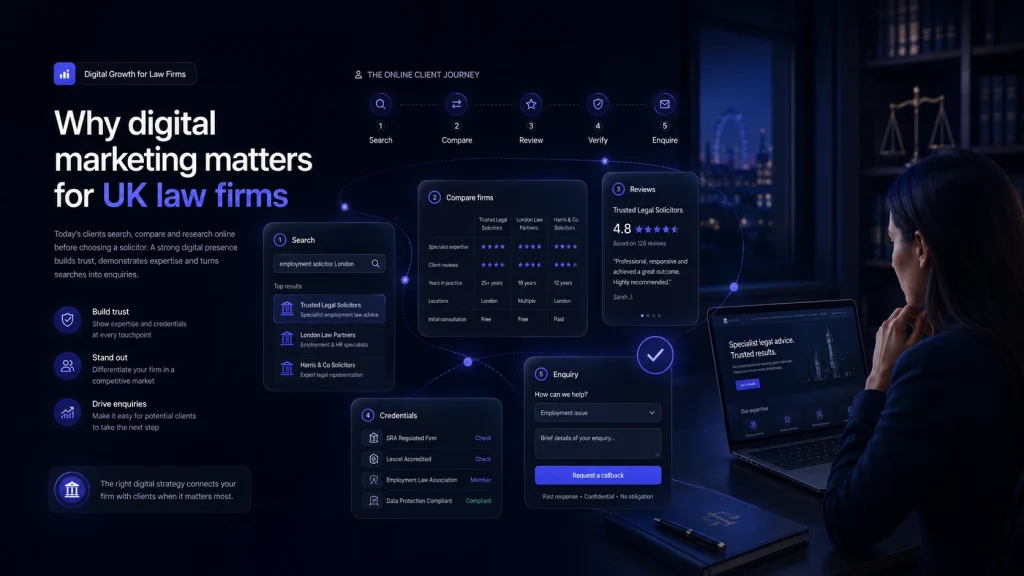
Most legal clients do some form of online research before contacting a solicitor. They may search for a local solicitor, compare several firms, read reviews, check solicitor profiles, look at pricing pages, or ask AI tools for recommendations.
That means your online presence has to do more than look professional. It has to prove trust quickly.
This is especially important for practice areas such as family law, immigration, conveyancing, employment law, probate, criminal defence, commercial disputes and personal injury. In these areas, clients are often under pressure and want clear answers, visible credibility and a simple way to contact the firm.
For regulated legal businesses, marketing also has to be careful. The SRA Code of Conduct for Firms states that firms must not mislead or attempt to mislead clients, the court or others, and the SRA Transparency Rules require certain information, including cost and complaints information, to be published clearly where applicable.
That is why law firm marketing should never rely on exaggerated claims, unclear fees or generic promises. It should focus on clarity, expertise and measurable enquiry growth.
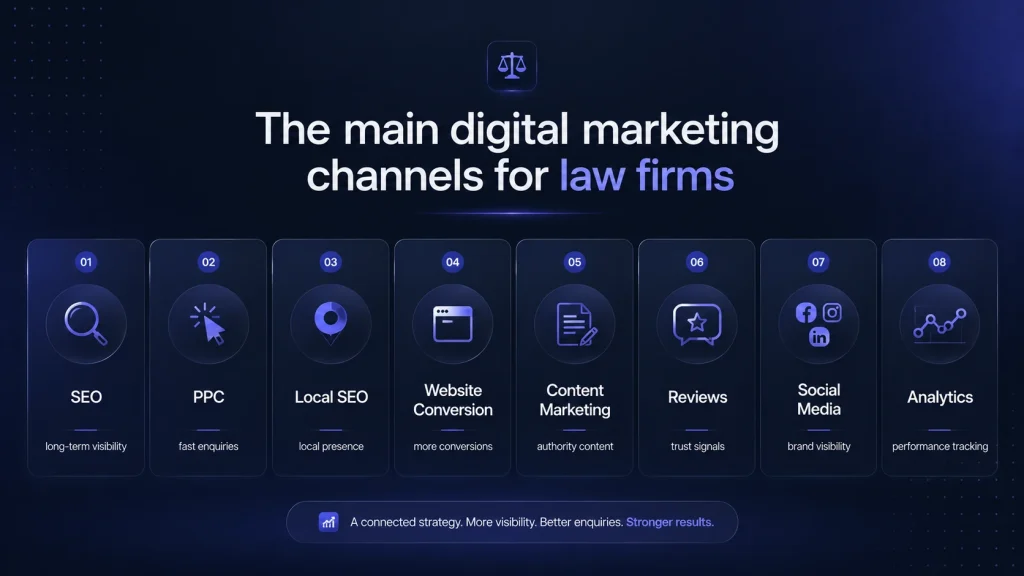
The main digital marketing channels for law firms
A complete strategy usually combines several channels. Each one has a different role.
| Channel | Best for | Speed | Main risk |
|---|---|---|---|
| SEO | Long-term organic enquiries | Slow to medium | Thin content or weak authority |
| Local SEO | Local solicitor searches | Medium | Weak Google Business Profile or reviews |
| PPC / Google Ads | Fast enquiries | Fast | Wasted spend without tracking |
| Website conversion | Turning traffic into enquiries | Fast to medium | Poor layout, unclear CTAs |
| Content marketing | Building authority and rankings | Medium | Generic articles with no enquiry path |
| Reviews | Trust and local conversion | Medium | No review process |
| Commercial and B2B law firms | Medium | Inconsistent posting | |
| Email marketing | Nurturing past contacts and referrals | Medium | Poor consent management |
| AI search visibility | Future search visibility | Emerging | Weak authority signals |
The best approach depends on the firm’s practice areas, location, competition, case value and internal capacity.
A small family law firm may need local SEO, Google reviews and a stronger enquiry form first. A commercial law firm may need thought leadership, LinkedIn, partner profiles and high-value content. A multi-office firm may need location pages, tracking dashboards, SEO content clusters and structured reporting.
SEO for law firms
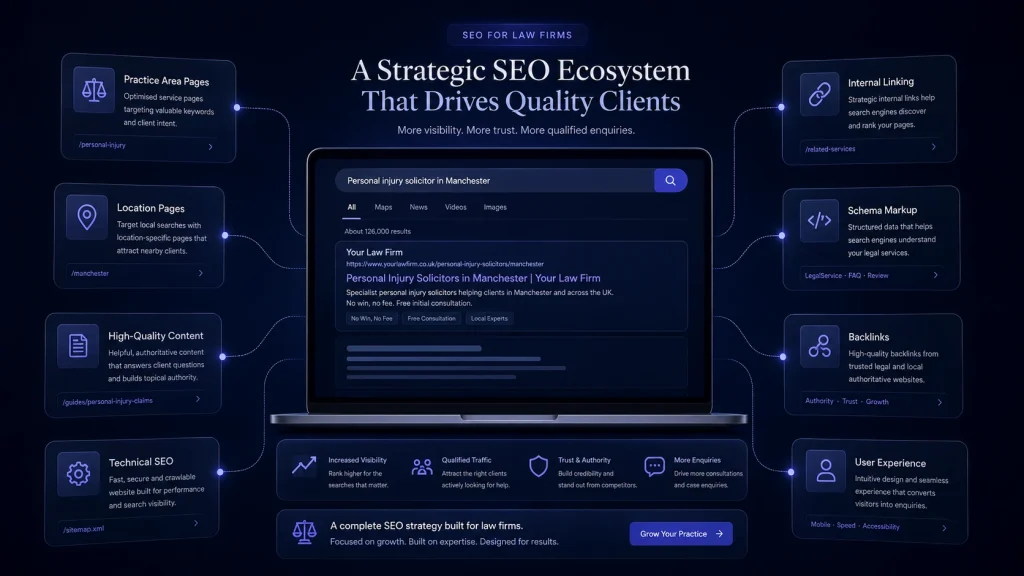
SEO for law firms is the process of improving a firm’s visibility in Google’s organic search results. It helps the firm appear when people search for legal services, legal questions and local solicitor terms.
Examples include:
- family solicitor in Manchester
- immigration solicitor in Birmingham
- employment lawyer for settlement agreement
- conveyancing solicitor near me
- probate solicitor in London
- commercial litigation solicitor UK
Strong law firm SEO usually includes practice-area pages, location pages, FAQs, internal links, technical SEO, backlinks and expert-led content.
The biggest mistake law firms make with SEO is publishing general legal information without a clear commercial structure. A blog post explaining divorce law may attract traffic, but it will not generate many enquiries unless it links to a strong family law service page, includes trust signals, and gives the reader a clear next step.
A proper SEO structure should look like this:
- Main legal service page
- Supporting location pages
- Supporting blog guides
- FAQs answering common client questions
- Internal links between related pages
- Clear enquiry buttons
- Solicitor profiles showing relevant experience
For example, a family law firm should not only have a page called “Family Law”. It should also have supporting pages and blogs around divorce, child arrangements, financial settlements, mediation, urgent applications and local family law searches.
Local SEO for law firms
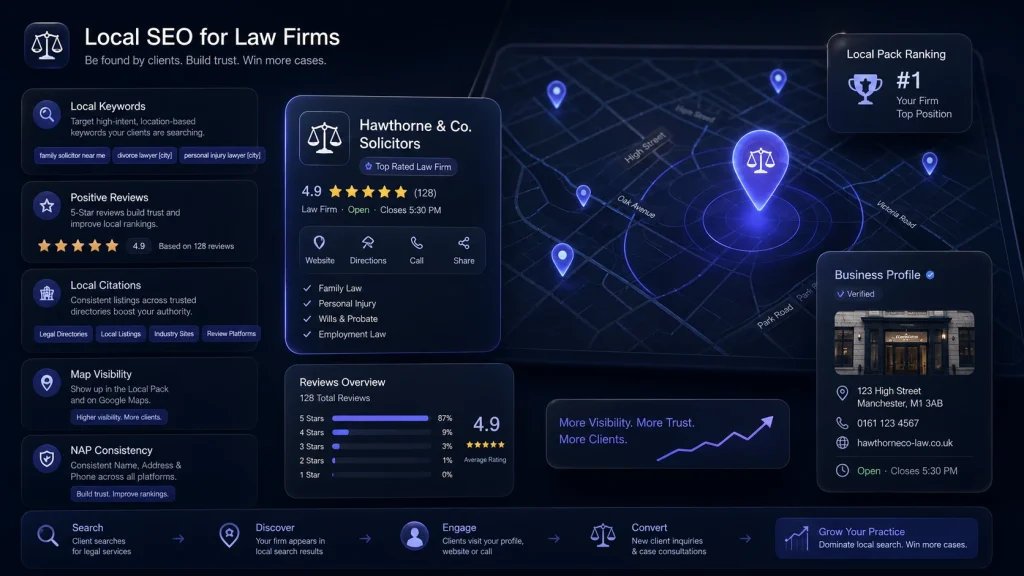
Local SEO is especially important for solicitors because many clients still search by location. A person looking for a divorce solicitor, immigration solicitor or conveyancing solicitor often wants someone local, credible and easy to contact.
Local SEO includes:
- Google Business Profile optimisation
- consistent name, address and phone details
- location pages
- local citations
- reviews
- map pack visibility
- service categories
- localised website content
A law firm with strong local SEO can appear in the map results and organic results at the same time. That gives the firm more visibility and more trust.
Reviews are a major part of this. A firm with detailed, recent reviews will usually look more credible than a firm with no visible feedback. Reviews should not be treated as an afterthought. They should be built into the client journey after a matter has progressed or completed successfully.
The page content also matters. A location page should not be a copied template with only the town name changed. It should explain the services offered in that area, who the team is, how clients can contact the firm, and what types of matters the firm handles locally.
PPC and Google Ads for law firms
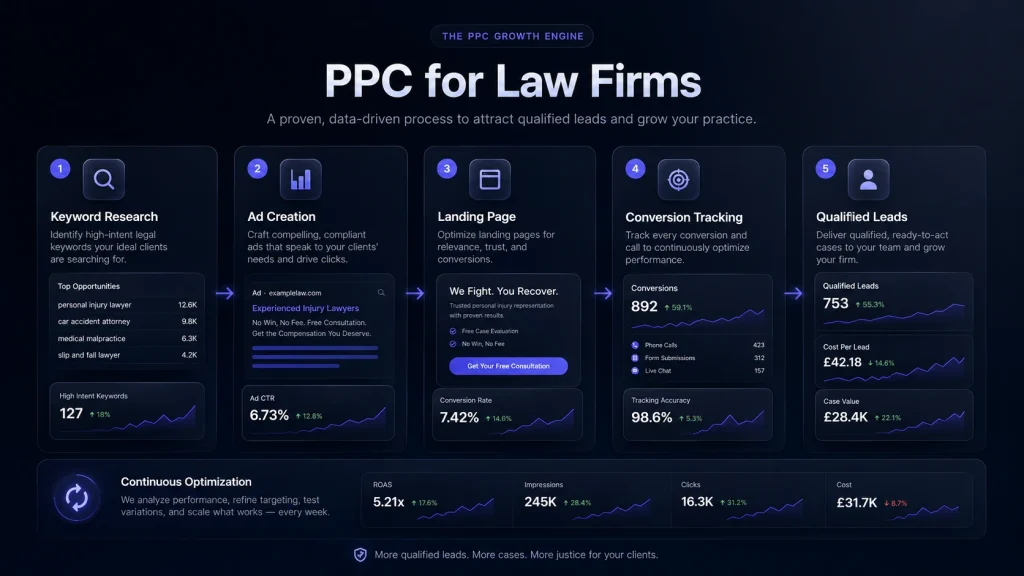
PPC can work very well for law firms, but it can also become expensive quickly.
Legal keywords often have high commercial intent. Someone searching “immigration solicitor near me” or “employment solicitor settlement agreement” may be close to making an enquiry. However, if campaigns are poorly structured, a firm can spend heavily on irrelevant clicks.
Good law firm PPC should include:
- tightly grouped campaigns by practice area
- exact and phrase match keywords where appropriate
- strong negative keyword lists
- location targeting
- call tracking
- landing pages for each service
- conversion tracking
- enquiry quality review
- clear budget control
A common mistake is sending all Google Ads traffic to the homepage. This usually reduces conversion. Someone searching for a “conveyancing solicitor” should land on a conveyancing page. Someone searching for “family law solicitor” should land on a family law page.
The landing page should match the search intent. It should explain the service, show trust signals, introduce the team, include reviews or accreditations where possible, and make it easy to call or submit an enquiry.
PPC should also be judged by signed matters, not only form submissions. A campaign that generates 50 weak enquiries may be worse than a campaign that generates 10 strong enquiries.
Law firm website design and conversion
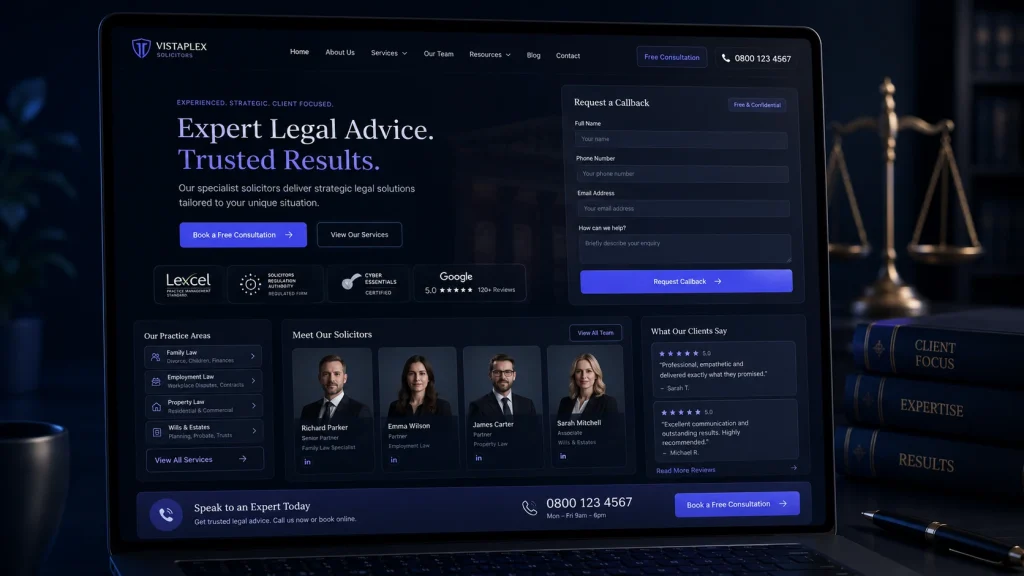
A law firm website has two jobs. It must help people find the firm, and it must persuade the right people to make contact.
Many law firm websites look professional but fail to convert because the user journey is unclear. The phone number may be hidden, the service pages may be too general, the forms may be too long, or the site may not explain what happens after the enquiry.
A high-converting law firm website should include:
- clear practice-area navigation
- visible phone number
- short enquiry forms
- fast mobile loading
- solicitor profile pages
- review and trust signals
- accreditations
- clear pricing information where required
- FAQs
- strong internal linking
- clear calls to action
- accessibility-conscious design
For regulated firms, website content should also support transparency. The SRA Transparency Rules require relevant firms to publish cost information for certain services, complaints information and regulatory information clearly and accessibly where applicable.
Good website design is not only about appearance. It affects SEO, PPC conversion, local trust and enquiry volume.
Content marketing for lawyers
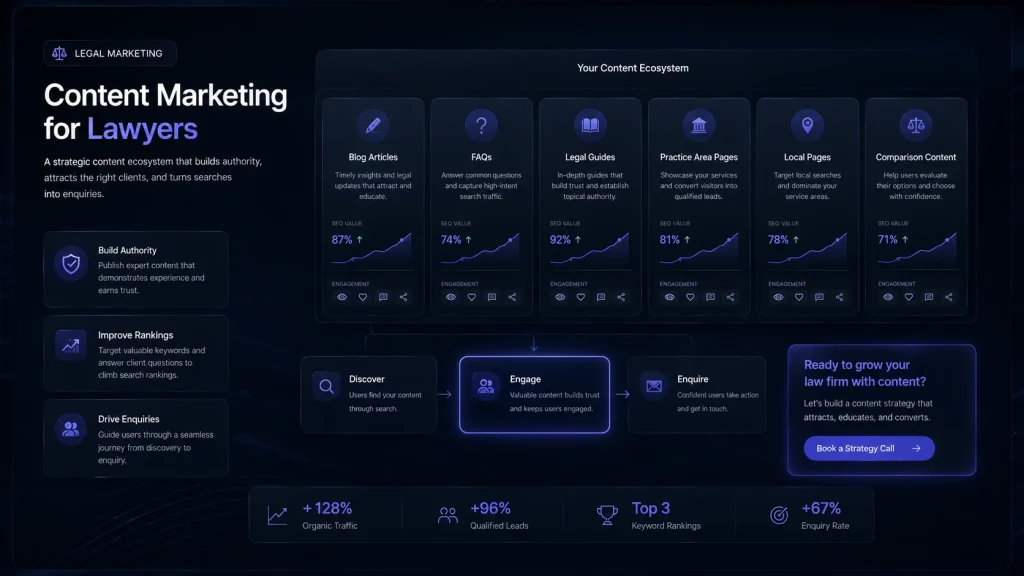
Content marketing helps law firms answer client questions before the client makes contact. It also gives Google and AI search systems more context about what the firm does.
Useful content for law firms includes:
- legal guides
- FAQs
- practice-area explainers
- local legal guides
- comparison articles
- process guides
- cost guides
- case-study style content
- partner commentary
- legal update articles
The best legal content is specific. A generic article called “What is family law?” is unlikely to stand out. A more useful article might be “What happens at the first family law consultation?” or “How child arrangement disputes are handled in England and Wales”.
The content should also support commercial pages. Every blog should link to a relevant service page. For example, a blog about settlement agreements should link to the employment law service page. A blog about spouse visas should link to the immigration service page.
This is how content becomes part of a client acquisition system rather than just a publishing exercise.
Reviews and online reputation
For law firms, trust is often the deciding factor. Potential clients may compare three or four firms before contacting one. Reviews, testimonials, accreditations, solicitor profiles and case experience all influence that decision.
A review strategy should be simple and consistent. The firm should know when to ask, who asks, which platform matters most, and how to respond to reviews professionally.
Useful review platforms may include Google, ReviewSolicitors, Trustpilot, legal directories and sector-specific platforms. The right mix depends on the firm’s market and audience.
Reviews also help local SEO. A firm with a strong Google Business Profile, recent reviews and clear services is usually more attractive in local search results than a firm with little visible feedback.
LinkedIn and social media for law firms
Social media is not always the strongest direct lead source for every law firm, but it can support trust, authority and visibility.
LinkedIn is especially useful for commercial law, employment law, corporate law, dispute resolution, property law and professional services work. It allows partners and senior solicitors to share useful commentary, explain legal changes and stay visible to referral partners.
For consumer-facing firms, Facebook and Instagram can support brand awareness, recruitment, community visibility and remarketing. However, social media should not replace SEO or PPC if the firm needs measurable enquiry growth.
The best law firm social media is not generic. It should sound like it comes from real solicitors with real experience. Posts should explain practical issues, answer common questions, share firm updates and show the people behind the firm.
Email marketing and follow-up
Email marketing can work for law firms, but it must be handled carefully. The ICO guidance on electronic mail marketing says organisations must not send marketing emails or texts to individuals without specific consent, except in limited “soft opt-in” situations for previous customers, and each message must provide a valid opt-out route.
For law firms, email marketing is usually best used for:
- past client updates
- referral partner updates
- commercial law newsletters
- event invitations
- legal updates
- nurturing enquiries that are not ready yet
The key is relevance. A commercial law firm may send useful updates about employment law, company law or contract changes. A private client firm may share updates about wills, probate or lasting powers of attorney.
Email should never be spammy. It should be permission-based, useful and easy to unsubscribe from.
AI search visibility for law firms
Search is changing. Potential clients may use Google, ChatGPT, Gemini, Perplexity, Copilot or AI Overviews to understand legal issues and compare options.
This does not mean law firms should abandon SEO. It means content needs to be clearer, better structured and more authoritative.
AI search visibility may be supported by:
- clear service pages
- expert author profiles
- structured FAQs
- strong internal links
- local business information
- consistent directory listings
- third-party mentions
- reviews
- schema markup
- original insights
- well-organised content hubs
A law firm with thin pages, no author information and no clear expertise signals is less likely to be referenced by AI systems. A firm with detailed service pages, strong solicitor profiles, useful FAQs and external authority signals is in a better position.
How much should law firms spend on digital marketing?
There is no single correct budget. A realistic budget depends on the size of the firm, the practice areas, the location, the competition and the value of each new client.
A small local firm may start with local SEO, review generation, website improvements and a small PPC test. A regional firm may need SEO, content, PPC, landing pages and reporting. A multi-office firm may need a more advanced strategy with local landing pages, content clusters, conversion tracking and dashboards.
As a broad planning framework:
| Firm type | Good starting focus |
|---|---|
| Solo or small local firm | Local SEO, Google Business Profile, reviews, core service pages |
| Growing regional firm | SEO, PPC, content, website conversion, call tracking |
| Multi-office firm | Location SEO, content clusters, PPC, dashboards |
| Commercial law firm | Thought leadership, LinkedIn, SEO, remarketing |
| High-value consumer firm | PPC, CRO, local SEO, review strategy |
The most important point is not the size of the budget. It is whether the budget is connected to measurable enquiries and signed matters.
A 90-day digital marketing plan for law firms
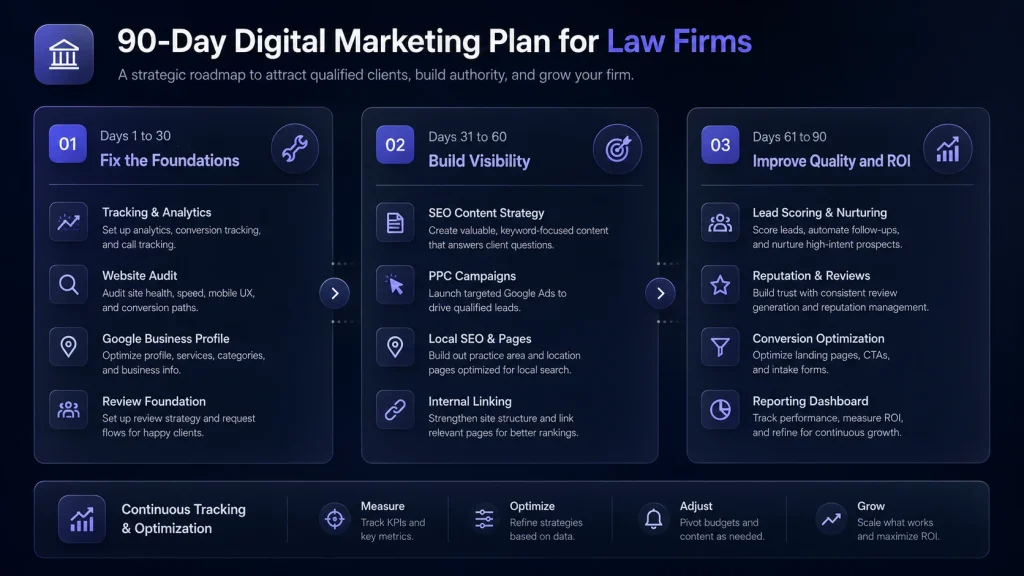
A law firm does not need to do everything at once. The first 90 days should focus on foundations, visibility and measurable improvement.
Days 1–30: Fix the foundations
Start with tracking and website basics.
Set up or review:
- Google Analytics
- Google Search Console
- call tracking
- form tracking
- Google Business Profile
- conversion events
- enquiry source tracking
- website speed
- mobile usability
- service page structure
Then review the website from a client’s point of view. Is it clear what the firm does? Is the phone number visible? Are the service pages specific? Are solicitor profiles easy to find? Is the enquiry form simple?
Days 31–60: Build visibility
Once the foundations are in place, improve search visibility.
Focus on:
- practice-area page improvements
- local SEO updates
- review requests
- internal linking
- blog content
- PPC test campaigns
- landing page improvements
- Google Business Profile posts and updates
This stage should create more entry points into the website.
Days 61–90: Improve quality and ROI
By this stage, the firm should have more data.
Review:
- which pages generate enquiries
- which PPC keywords waste budget
- which calls are good quality
- which forms convert
- which practice areas produce the best matters
- which content needs improvement
Then refine the strategy. Pause weak ads, improve landing pages, expand winning content, and build a reporting dashboard that shows real performance.
The aim is not only to get more enquiries. It is to get better enquiries that the firm can convert into profitable work.
Common digital marketing mistakes law firms make
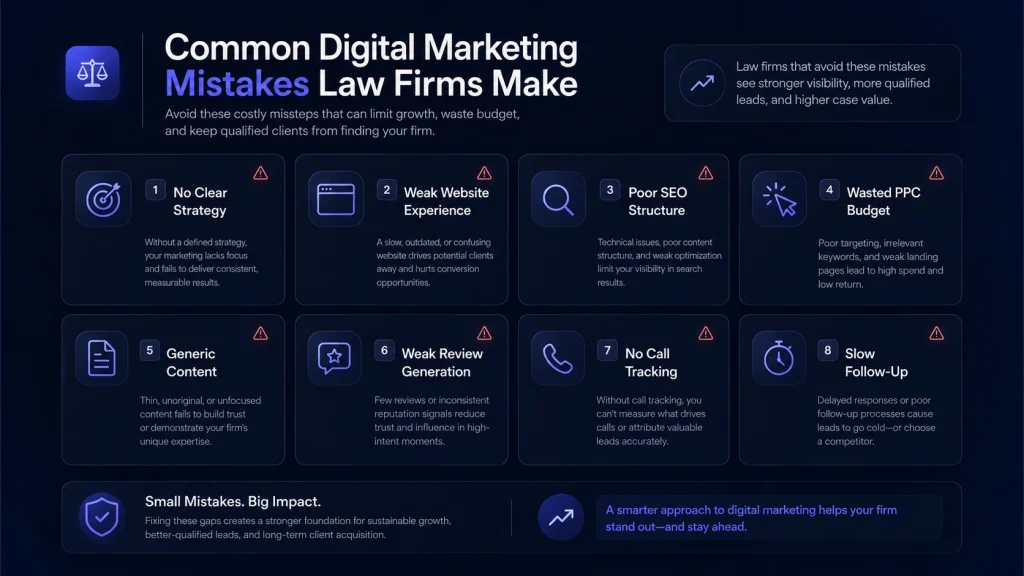
Many law firms make the same mistakes online.
The first mistake is treating the website like a brochure. A website should not only describe the firm. It should help people choose the firm and take action.
The second mistake is running PPC without proper tracking. Without call tracking and form tracking, the firm cannot see which keywords, ads or pages are producing real enquiries.
The third mistake is publishing generic blogs. Content needs to support real search demand and link to relevant service pages.
The fourth mistake is ignoring local SEO. For many legal services, local visibility is still one of the strongest enquiry sources.
The fifth mistake is using vague claims. Legal marketing should be clear, accurate and supported. The CAP Code says marketing communications must not materially mislead and that marketers must hold documentary evidence for objective claims before publication.
The sixth mistake is not following up properly. Marketing does not end when the enquiry arrives. Response speed, intake quality and follow-up all affect return on investment.
When should a law firm hire a digital marketing agency?
A law firm should consider hiring an agency when marketing has become too important or too complex to manage casually.
DIY marketing can work at the beginning, especially for a small firm. But as soon as the firm is spending on PPC, publishing regular content, targeting competitive SEO terms or trying to measure ROI, specialist support becomes more valuable.
A good legal marketing agency should understand:
- search behaviour in legal services
- local SEO
- PPC lead quality
- website conversion
- legal content structure
- review generation
- reporting
- compliance-sensitive messaging
- practice-area differences
The agency should not only report clicks and impressions. It should help the firm understand enquiries, lead quality and signed matters.
Vistoplex supports law firms with connected SEO, PPC, web design, content and automation. Learn more about our law firm digital marketing services.
FAQs
What is digital marketing for law firms?
Digital marketing for law firms is the use of online channels such as SEO, PPC, local SEO, website design, content marketing, reviews, social media and email to attract and convert potential legal clients.
What is the best digital marketing channel for solicitors?
For most solicitors, the strongest channels are SEO, local SEO, Google Business Profile optimisation, reviews, PPC and website conversion. The right mix depends on practice area, location and budget.
Is SEO or PPC better for law firms?
SEO is better for long-term visibility and lower cost per enquiry over time. PPC is better for faster enquiries and testing demand. Many law firms benefit from using both together.
How long does SEO take for a law firm?
SEO usually takes several months to show meaningful results, especially in competitive areas such as family law, immigration, conveyancing, employment law and personal injury. Local SEO may show progress faster if the firm already has reviews and a strong local presence.
Can solicitors use Google Ads?
Yes, solicitors can use Google Ads, but campaigns need careful keyword targeting, landing pages, tracking and compliance-conscious wording. Poorly managed campaigns can waste budget quickly.
Do law firms need local SEO?
Most consumer-facing law firms need local SEO because clients often search for solicitors near them. Local SEO is especially useful for family law, conveyancing, immigration, employment, probate and criminal defence.
What should a law firm website include?
A law firm website should include clear service pages, solicitor profiles, contact details, enquiry forms, trust signals, reviews, FAQs, pricing information where required, complaints information where required, and clear next steps for potential clients.
How can law firms track marketing ROI?
Law firms can track ROI through call tracking, form tracking, analytics, CRM source tracking, enquiry quality review and signed matter reporting. The key is to measure not only leads, but also which leads become clients.
Should law firms use AI content?
AI can help with research, outlines and editing, but law firm content should be reviewed by qualified professionals. Generic AI content can damage trust if it is inaccurate, vague or not aligned with the firm’s expertise.
How can a law firm improve online enquiries?
Start with the basics: improve service pages, make contact options clear, strengthen Google Business Profile, collect reviews, track calls and forms, create useful content, and run targeted PPC only where there is a clear landing page and follow-up process.